

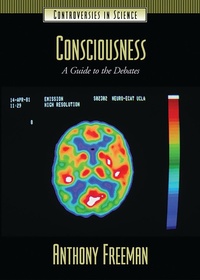
Consciousness
A Guide to the Debates
Published on 10. October 2003
352 pages
978-1-57607-792-4 (ISBN)
Description

An exciting introduction to consciousness research and its applications to our waking and sleeping moments.
Once the domain of philosophers, the study of consciousness is now an exciting branch of science. Author Anthony Freeman, managing editor of the Journal of Consciousness Studies, opens Consciousness with a history of mind study, from the ancient Greeks to the present, and provides a multidisciplinary review of cognitive science. Freeman untangles the conflicting theories on the working of the brain, analyzing the techniques developed for its study over the years.
"Seeing" v. "believing," mind/body connections, zombies, and assembly line robots are just the beginning. Even chaos theory and quantum physics are relevant, with opposing approaches inciting disciplinary battles. This illustrated and accessible volume introduces key researchers like Wilder Penfield, who talked with his conscious sister while operating on her brain tumor.
Once the domain of philosophers, the study of consciousness is now an exciting branch of science. Author Anthony Freeman, managing editor of the Journal of Consciousness Studies, opens Consciousness with a history of mind study, from the ancient Greeks to the present, and provides a multidisciplinary review of cognitive science. Freeman untangles the conflicting theories on the working of the brain, analyzing the techniques developed for its study over the years.
"Seeing" v. "believing," mind/body connections, zombies, and assembly line robots are just the beginning. Even chaos theory and quantum physics are relevant, with opposing approaches inciting disciplinary battles. This illustrated and accessible volume introduces key researchers like Wilder Penfield, who talked with his conscious sister while operating on her brain tumor.
More details
Series
Language
English
Place of publication
New York
United States
Publishing group
Bloomsbury Publishing Plc
Target group
Interest Age: From 7 to 17 years
Illustrations
33 bw illus
File size
3,89 MB
ISBN-13
978-1-57607-792-4 (9781576077924)
Copyright in bibliographic data and cover images is held by Nielsen Book Services Limited or by the publishers or by their respective licensors: all rights reserved.
Schweitzer Classification
Other editions
Additional editions
Book
10/2003
ABC-CLIO
€104.50
Shipment within 3-4 weeks
Person
Anthony Freeman is managing editor of the Journal of Consciousness Studies.
Content
- Cover
- Consciousness
- Contents
- Preface
- 1 The "Impossible" Science
- Atomic Theory: A Roller-coaster History
- Body, Mind, and Soul in Ancient and Medieval Times
- René Descartes and the Enlightenment
- The Origins and Development of Psychology
- The Dominance and Decline of Behaviorism
- The Bandwagon Starts to Roll
- 2 The Biological Brain
- Brain Anatomy and Physiology
- Brain-Mapping Techniques
- Single-Cell Investigations
- Searching for the Mechanism of Consciousness
- 3 From Light to Sight
- Neuronal Hierarchies and the "Grandmother" Cell
- Seeing for Acting
- A Grand Illusion?
- 4 The Conscious Brain
- What Counts as a Neural Correlate of Consciousness?
- Neural Correlates for the Contents of Consciousness
- Neurons in Concert
- 5 The Mind-Body Problem
- Substance Dualism: Descartes versus Ryle
- Reductive Physicalism
- Eliminative Materialism
- Nonreductive Physicalism
- 6 The (Un)Conscious Computer
- A Computer Is Just an Adding Machine
- A Computer Is a Functional System
- Consciousness as an Intrinsic Feature of a System
- 7 Embodied Consciousness
- The Embodied Mind
- Emotion
- 8 The Once and Future Self
- Different Types of Memory
- A Mechanism for Memory and Learning
- Combating Memory Loss
- 9 Quantum Physics and Consciousness
- Quantum Mechanics
- Consciousness and Quantum Science
- A Possible Quantum Origin for Consciousness
- 10 Decision Time
- The Timing of Experience
- Free Will and Causality
- 11 Dreams, Visions, and Art
- Dreaming Consciousness and Waking Consciousness
- God and the Brain
- Art and the Brain
- 12 What Is It Like to Be Conscious?
- Searle, Dennett, and Chalmers
- The Hard Problem of Consciousness
- In Place of a Conclusion
- References
- Further Reading
- General Books on Consciousness
- Collections of Original Texts
- Journals
- Chronology
- Glossary
- Documents
- Document 1
- Document 2
- Document 3
- Document 4
- Document 5
- Document 6
- Document 7
- Document 8
- Document 9
- Document 10
- Index
- About the Author
