

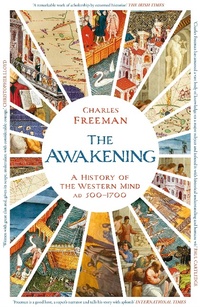
The Awakening
A History of the Western Mind Ad 500 - 1700
1st Edition
Published on 6. August 2020
816 pages
978-1-78954-564-7 (ISBN)
Description

A monumental and exhilarating history of European thought, from the fall of Rome in the fifth century AD to the Scientific Revolution thirteen centuries later.
The Awakening traces the recovery and refashioning of Europe's classical heritage from the ruins of the Roman Empire. The process of preservation of surviving texts, fragile at first, was strengthened under the Christian empire founded by Charlemagne in the eighth century; later, during the High Middle Ages, universities were founded and the study of philosophy was revived. Renewed interest in ancient Greek and Roman thought provided the intellectual impetus for the Renaissance of the fifteenth and sixteenth centuries, whose ideas - aesthetic, political and scientific - were disseminated across Europe by the invention of the printing press. Equally momentous was Europe's encounter with the New World, and the resulting maritime supremacy which conferred global reach on Europe's merchants and colonists.
Vivid in detail and informed by the latest scholarship, The Awakening is powered not by the fate of kings or the clash of arms but by deeper currents of thought, inquiry and discovery, which first recover and then surpass the achievements of classical antiquity, and lead the West to the threshold of the Age of Reason. Charles Freeman takes the reader on an enthralling journey, and provides us with a vital key to understanding the world we live in today.
Praise for The Awakening:
'The subject of this stimulating and erudite book is nothing less than the development of the Western mind from the demise of classical civilisation in the fifth century AD, through the Middle Ages and Renaissance, to the Scientific Revolution of the seventeenth century. The Awakening is a work of serious scholarship by an author who has clearly been everywhere, seen everything and read voraciously. But it is also a work written with great elan and, given its scope, undertaken with considerable courage... An arrestingly clear design, combined with numerous judiciously chosen illustrations, completes an extraordinary achievement' Christopher Lloyd, Surveyor of the Queen's Pictures, 1988-2005
'The Awakening recounts the slow evolution of Western thought that restored legitimacy to independent examination and analysis, that eventually led to a celebration, albeit a cautious one, of reason over blind faith. In the process, Freeman reminds us that quality, engaging narrative history has not gone extinct, while demonstrating that it is possible to produce a work that is so well-written it is readable by a general audience while meeting the rigorous standards of scholarship demanded by academia' Stan Prager
'The Awakening is a very timely book and an excellently written and produced one. Freeman is a good host, a superb narrator and tells his story with aplomb... His elegant prose is a treat for the mind and the accompanying illuminations a treat for the eye' International Times
The Awakening traces the recovery and refashioning of Europe's classical heritage from the ruins of the Roman Empire. The process of preservation of surviving texts, fragile at first, was strengthened under the Christian empire founded by Charlemagne in the eighth century; later, during the High Middle Ages, universities were founded and the study of philosophy was revived. Renewed interest in ancient Greek and Roman thought provided the intellectual impetus for the Renaissance of the fifteenth and sixteenth centuries, whose ideas - aesthetic, political and scientific - were disseminated across Europe by the invention of the printing press. Equally momentous was Europe's encounter with the New World, and the resulting maritime supremacy which conferred global reach on Europe's merchants and colonists.
Vivid in detail and informed by the latest scholarship, The Awakening is powered not by the fate of kings or the clash of arms but by deeper currents of thought, inquiry and discovery, which first recover and then surpass the achievements of classical antiquity, and lead the West to the threshold of the Age of Reason. Charles Freeman takes the reader on an enthralling journey, and provides us with a vital key to understanding the world we live in today.
Praise for The Awakening:
'The subject of this stimulating and erudite book is nothing less than the development of the Western mind from the demise of classical civilisation in the fifth century AD, through the Middle Ages and Renaissance, to the Scientific Revolution of the seventeenth century. The Awakening is a work of serious scholarship by an author who has clearly been everywhere, seen everything and read voraciously. But it is also a work written with great elan and, given its scope, undertaken with considerable courage... An arrestingly clear design, combined with numerous judiciously chosen illustrations, completes an extraordinary achievement' Christopher Lloyd, Surveyor of the Queen's Pictures, 1988-2005
'The Awakening recounts the slow evolution of Western thought that restored legitimacy to independent examination and analysis, that eventually led to a celebration, albeit a cautious one, of reason over blind faith. In the process, Freeman reminds us that quality, engaging narrative history has not gone extinct, while demonstrating that it is possible to produce a work that is so well-written it is readable by a general audience while meeting the rigorous standards of scholarship demanded by academia' Stan Prager
'The Awakening is a very timely book and an excellently written and produced one. Freeman is a good host, a superb narrator and tells his story with aplomb... His elegant prose is a treat for the mind and the accompanying illuminations a treat for the eye' International Times
Reviews / Votes
Charles Freeman has done it again - amassed a vast body of knowledge on a major subject and infused it with historical understanding and humane wit. Above all else, he makes us realise why the twelve centuries between late Antiquity and early Modernity remain urgently relevant to the world of the twenty-first century. Aquinas, Erasmus, Dante, Descartes... theirs and a host of others' mindbending ideas are made to leap off the page, grab us by the throat and demand our undivided attention A remarkable work of scholarship by esteemed historian Charles Freeman... The book is a fine production, adorned with coloured images of frescos and ancient manuscripts' * Irish Times * My favourite book of the year... The wonderful images of the art, architecture and books bring to life the detailed argument of Awakening... Freeman makes the subject matter alive and relevant in a way that few historians of ideas can... A book to read slowly, to ponder and enjoy leisurely * Goodreads * PRAISE FOR THE CLOSING OF THE WESTERN MIND:'An elegant story, engagingly told. Freeman has a talent for narrative history and for encapsulating the more arcane disputes of ancient historians and theologians' Independent.
'There is much here to admire... It is a panoramic view that Freeman handles with grace, erudition and lucidity' Washington Times.
'Entertaining... An excellent and readable account of the development of Christian doctrine' * New York Times *
More details
Edition
1. Auflage
Language
English
Place of publication
London
United Kingdom
Publishing group
Head of Zeus
ISBN-13
978-1-78954-564-7 (9781789545647)
Copyright in bibliographic data and cover images is held by Nielsen Book Services Limited or by the publishers or by their respective licensors: all rights reserved.
Schweitzer Classification
Other editions
Additional editions
Book
03/2024
Apollo
€20.00
Shipment within 3-4 weeks
Book
08/2020
Apollo
€37.50
Shipment within 3-4 weeks
Person
Charles Freeman is a specialist on the ancient world and its legacy. He has worked on archaeological digs on the continents surrounding the Mediterranean and develops study tour programs in Italy, Greece, and Turkey. Freeman is Historical Consultant to the Blue Guides series and the author of numerous books, including the bestseller The Closing of the Western Mind and, most recently, Holy Bones, Holy Dust. He lives in the UK.
Content
- Intro
- Title Page
- Dedication
- Copyright
- Contents
- Preface
- Prologue: The Collapse of Learning
- 1: The Saving of the Texts 500 - 750
- 2: Charlemagne Restores the Discipline of Learning
- 3: Conformity and Diversity in the Christian Communities of the Late First Millennium
- 4: Authority and Dissent in the Medieval Church, 1000 - 1250
- 5: Abelard and the Battle for Reason
- 6: The Cry of Libertas: the Rebirth of the City-State
- 7: Success and Failure within the Medieval University
- 8: Medieval Philosophy: A Reawakening or a Dead End?
- 9: The Glimmerings of a Scientific Revival, 1200 - 1350
- 10: Dante, Marsilius and Boccaccio and their Worlds
- 11: Humanism and the Challenge to the Scholastics
- 12: The Exuberance of Florentine Humanism
- 13: The Flowering of the Florentine Renaissance
- 14: Plato Re-enters the Western Mind
- 15: The Printing Press: What was Published and Why?
- 16: The Loss of Papal Authority and the Rise of the Laity, 1300-1550
- 17: Defining Global Space: The Mapping of the New World
- 18: How Europe Learned to See Again: Leonardo and Vesalius
- 19: Exploring the Natural World in the Sixteenth Century
- 20: Imagining Princely Politics, from Utopia to the Machiavellian Ruler
- 21: Broadening Horizons: From the Laocoön to the Academies
- 22: Encountering the Peoples of the 'Newe Founde Worldes', 1492-1610
- 23: The Reformation and the Reassertion of Christian Authority?
- 24: The World of Catholic Renewal
- 25: Montaigne and Hamlet: Peace or Turmoil in the Solitary Soul?
- 26: Absolutist France versus the Dutch Republic: A Study of Political Contrasts
- 27: Britain's Revolutionary Century
- 28: Envisaging an Ideal Society in the Seventeenth Century
- 29: From Natural Philosophy into Science: The Astronomers
- 30: Was There an English Scientific Revolution?
- 31: Did the Seventeenth Century see the Making of the Modern Mind?
- 32: Was There Really 'a Reawakening of the Western Mind'?
- Appendix I
- Appendix II
- Acknowledgements
- Bibliography
- Notes
- Preface
- Prologue
- 1: The Saving of the Texts
- 2: Charlemagne
- 3: Conformity and Diversity
- 4: Authority and Dissent
- 5: Abelard and the Battle for Reason
- 6: The Rebirth of the City-State
- 7: The Medieval University
- 8: Medieval Philosophy
- 9: A Scientific Revival, 1200-1350
- 10: Dante, Marsilius and Boccaccio
- 11: The Challenge to the Scholastics
- 12: Florentine Humanism
- 13: The Florentine Renaissance
- 14: Plato Re-enters the Western Mind
- 15: The Printing Press
- 16: The Rise of the Laity, 1300-1550
- 17: The Mapping of the New World
- 18: Leonardo and Vesalius
- 19: Exploring the Natural World
- 20: Imagining Princely Politics
- 21: Broadening Horizons
- 22: Peoples of the 'Newe Founde Worldes'
- 23: The Reformation
- 24: Catholic Renewal
- 25: Montaigne and Hamlet
- 26: Absolutist France versus the Dutch Republic
- 27: Britain's Revolutionary Century
- 28: Envisaging an Ideal Society
- 29: The Astronomers
- 30: An English Scientific Revolution
- 31: The Making of the Modern Mind
- 32: 'A Reawakening of the Western Mind'
- An Invitation from the Publisher
