

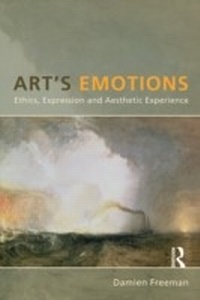
Art's Emotions
Ethics, Expression and Aesthetic Experience
1st Edition
Published on 3. September 2014
224 pages
978-1-317-54756-3 (ISBN)
Description

Despite the very obvious differences between looking at Manet's Woman with a Parrot and listening to Elgar's Cello Concerto, both experiences provoke similar questions in the thoughtful aesthete: why does the painting seem to express reverie and the music, nostalgia? How do we experience the reverie and nostalgia in such works of art? Why do we find these experiences rewarding in similar ways? As our awareness of emotion in art, and our engagement with art's emotions, can make such a special contribution to our life, it is timely for a philosopher to seek to account for the nature and significance of the experience of art's emotions.
Damien Freeman develops a new theory of emotion that is suitable for resolving key questions in aesthetics. He then reviews and evaluates three existing approaches to artistic expression, and proposes a new approach to the emotional experience of art that draws on the strengths of the existing approaches. Finally, he seeks to establish the ethical significance of this emotional experience of art for human flourishing. Freeman challenges the reader not only to consider how art engages with emotion, but how we should connect up our answers to questions concerning the nature and value of the experiences offered by works of art.
Damien Freeman develops a new theory of emotion that is suitable for resolving key questions in aesthetics. He then reviews and evaluates three existing approaches to artistic expression, and proposes a new approach to the emotional experience of art that draws on the strengths of the existing approaches. Finally, he seeks to establish the ethical significance of this emotional experience of art for human flourishing. Freeman challenges the reader not only to consider how art engages with emotion, but how we should connect up our answers to questions concerning the nature and value of the experiences offered by works of art.
Reviews / Votes
"Freeman has given us an ingenious, sophisticated theory that will become a benchmark for serious study in this field. This is a book anyone interested in aesthetic experience in general or in the role of arts in relation to emotions should read. It is clearheaded, well informed, methodical, and handsomely argued. It addresses issues everyone, and not just philosophers, should be concerned with: the role of art in society, the role of aesthetic experience in relation to other valued activities, the role emotions play in the world of arts, and reasons for thinking that emotions as presented in the arts play a peculiarly important role in relation to human flourishing. Art's Emotions deserves to be recognized as one of the most important books in a field of burgeoning philosophical interest." - Journal of Aesthetics and Art Criticism"Freeman takes on the monumental task of developing a theory of aesthetic experience that accounts for its emotional aspects, its ethical aspects, and the role certain kinds of aesthetic experience can play in a fulfilling life. Despite the enormity of the task, he does an excellent job." - Notre Dame Philosophical Reviews
"Art's Emotions is bold, resourceful and ambitious. At every stage of the argument well-chosen examples are used to illustrate the abstract claims being made, and Freeman is meticulous in making clear the precise nature and limits of these claims. The work is very well researched and displays a command of all the materials referred to, both those of major and those of minor figures." - Malcolm Budd, President of the British Society for Aesthetics
"A remarkably erudite, bold, and fascinating exploration of the nature of emotion, the distinctive emotional impact of art, and its value as a contribution to human flourishing. Highly recommended reading for anyone who ponders why art matters." - Dominic McIver Lopes, University of British Columbia, Canada
"Freeman starts from some very powerful intuitions about human emotional life and the role of the arts in our emotional life. An important book that is very much worth reading." - Raymond Geuss, University of Cambridge, UK"Central issues in aesthetics are engaged with in an original and thought-provoking way." - Derek Matravers, The Open University, UK
More details
Language
English
Place of publication
London
United Kingdom
Publishing group
Taylor & Francis Ltd
Target group
College/higher education
File size
9,27 MB
ISBN-13
978-1-317-54756-3 (9781317547563)
Copyright in bibliographic data and cover images is held by Nielsen Book Services Limited or by the publishers or by their respective licensors: all rights reserved.
Schweitzer Classification
Other editions
Additional editions
Book
12/2011
1st Edition
Acumen Publishing Ltd
€230.65
Shipment within 3-4 weeks
Book
12/2011
1st Edition
Acumen Publishing Ltd
€63.10
Shipment within 3-4 weeks
Person
Damien Freeman lectures on ethics and aesthetics at Pembroke College, Cambridge, UK and the Art Gallery of New South Wales, Australia. His book Figuring out Figurative Art (with Derek Matravers) is also published by Routledge.
Content
Introduction 1. The Emotional Economy 2. Perception of Emotion in the World 3. The Varieties of Emotional Experience 4. Art and the Plenary Experience of Emotion 5. The Value of Art and the Practice of Life Conclusion
