

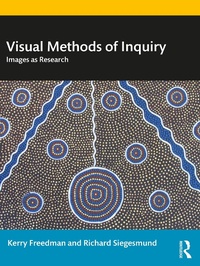
Visual Methods of Inquiry
Images as Research
1st Edition
Published on 12. October 2023
238 pages
978-1-000-96306-9 (ISBN)
Description

Visual Methods of Inquiry: Images as Research presents qualitative researchers in the social sciences with the benefits, applications, and forms of visual research methods. It includes a wide variety of images to illustrate the many uses of visual methods for social research.
Contemporary visual culture theory and practice offers wide-ranging opportunities for methodological advancement in the social sciences. This book covers the basics of image use in visual research methods and explores how these methods can be used effectively in social science research by surveying the conditions of visual forms, materials, and concepts, and the ways these represent and influence social conditions, phenomena, beliefs, and actions. It examines the roles and processes of interpretation in visual research and discusses ethical considerations that arise when using visual research methods.
Students of social science and the visual arts will find this book useful in expanding and improving their methods of inquiry. Artists and researchers already familiar with visual methods will find that this book clarifies the ways the visual works in various research contexts and provides helpful language to describe and explain those methods.
Contemporary visual culture theory and practice offers wide-ranging opportunities for methodological advancement in the social sciences. This book covers the basics of image use in visual research methods and explores how these methods can be used effectively in social science research by surveying the conditions of visual forms, materials, and concepts, and the ways these represent and influence social conditions, phenomena, beliefs, and actions. It examines the roles and processes of interpretation in visual research and discusses ethical considerations that arise when using visual research methods.
Students of social science and the visual arts will find this book useful in expanding and improving their methods of inquiry. Artists and researchers already familiar with visual methods will find that this book clarifies the ways the visual works in various research contexts and provides helpful language to describe and explain those methods.
Reviews / Votes
"In this book, Kerry Freedman and Richard Siegesmund brilliantly demonstrate the benefits, applications and forms of critical visual research methods in the humanities and social sciences. It is a must read. Visual research comes of age with this book. It challenges artists and inquirers to embrace uncertainty, to organize disruption, to empower resistance, to work without the guardrails of methodology, to find that cliff where they fly to new horizons." -- Norman K. Denzin, Emeritus Professor of Sociology, Communications, and Cinema Studies, University of Illinois"Visual Methods of Inquiry: Images as Research is a must-read. This comprehensive, accessible text is a theoretically informed introduction to the increasingly popular domain of visual research. Offering striking imagery and wide-ranging practical strategies with ethical considerations, this cross-disciplinary book will be highly influential for researchers, and students alike, who wish to enhance their knowledge and understanding of qualitative visual research methodologies." -- Wanda B. Knight, Ph.D., Professor of Art Education, African American Studies, and Women's, Gender, and Sexuality Studies, and Bioethics, Penn State University, United States. President of the National Art Education Association.
"From images as data records to images as reports: this book covers it all, with respect for the diversity in epistemological positions taken in different disciplines. It makes a convincing case for how visual evidence can be produced, processed, interpreted and judged for quality in relation to other types of research data. How can one not recognize the value of images to capture and transfer complex layers of information that language struggles to reveal? Consider this book a purposeful invitation to move from intertextuality to intergraphicality." -- Karin Hannes, Ph.D. Professor, Urban Studies Institute, Faculty of Social Sciences, KU Leuven, Belgium. Chair, European Network of Qualitative Inquiry.
"Visual Methods of Inquiry: Images as Research is a groundbreaking book that explores and critically analyzes visual research methods, offering an innovative perspective for students and researchers across disciplines. As an excellent introductory text, it expertly draws connections between the visual arts and social sciences with its lucid writing and rich visuals. It is an indispensable resource providing students and researchers with the knowledge and tools to better understand how visuals work in research." -- Juan Carlos Castro, Ph.D., Professor, Art Education, Concordia University, Canada
More details
Edition
1. Auflage
Language
English
Place of publication
London
United Kingdom
Publishing group
Taylor & Francis Ltd
Target group
College/higher education
Professional and scholarly
Product notice
Reflowable
Illustrations
4 Tables, color; 1 Line drawings, color; 76 Halftones, color; 77 Illustrations, color
ISBN-13
978-1-000-96306-9 (9781000963069)
Copyright in bibliographic data and cover images is held by Nielsen Book Services Limited or by the publishers or by their respective licensors: all rights reserved.
Schweitzer Classification
Other editions
Additional editions
Book
10/2023
1st Edition
Routledge
€167.13
Shipment within 15-20 days
Book
10/2023
1st Edition
Routledge
€74.80
Shipment within 15-20 days
Persons
Kerry Freedman is a professor and coordinator of Doctoral Programs in Art and Design Education at Northern Illinois University, USA. She is the author and editor of several books and many articles, and has won numerous awards for her work.
Richard Siegesmund is a professor of art and design education at Northern Illinois University, USA. He is the co-author (with Melisa Cahnmann-Taylor) of Arts-Based Research in Education: Foundations for Practice, second edition (Routledge, 2018).
Richard Siegesmund is a professor of art and design education at Northern Illinois University, USA. He is the co-author (with Melisa Cahnmann-Taylor) of Arts-Based Research in Education: Foundations for Practice, second edition (Routledge, 2018).
Content
1. Visual Research Methods Across the Disciplines 2. Visual Perception and Conceptions of Visual Research 3. Visual Qualities and the Functions of Images in Research 4. Visuality in Social Science Research 5. Description of Visual Methods: The Research Image Framework 6. Making Judgements: Analyzing the Visual as Evidence 7. Ethics of Practice for Visual Research Methods
