

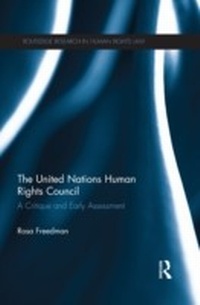
The United Nations Human Rights Council
A critique and early assessment
1st Edition
Published on 12. March 2013
344 pages
978-1-135-11515-9 (ISBN)
Description

The United Nations Human Rights Council was created in 2006 to replace the UN Commission on Human Rights. The Council's mandate and founding principles demonstrate that one of the main aims, at its creation, was for the Council to overcome the Commission's flaws. Despite the need to avoid repeating its predecessor's failings, the Council's form, nature and many of its roles and functions are strikingly similar to those of the Commission.
This book examines the creation and formative years of the United Nations Human Rights Council and assesses the extent to which the Council has fulfilled its mandate. International law and theories of international relations are used to examine the Council and its functions. Council sessions, procedures and mechanisms are analysed in-depth, with particular consideration given to whether the Council has become politicised to the same extent as the Commission. Whilst remaining aware of the key differences in their functions, Rosa Freedman compares the work of the Council to that of treaty-based human rights bodies. The author draws on observations from her attendance at Council proceedings in order to offer a unique account of how the body works in practice.
The United Nations Human Rights Council will be of great interest to students and scholars of human rights law and international relations, as well as lawyers, NGOs and relevant government agencies.
This book examines the creation and formative years of the United Nations Human Rights Council and assesses the extent to which the Council has fulfilled its mandate. International law and theories of international relations are used to examine the Council and its functions. Council sessions, procedures and mechanisms are analysed in-depth, with particular consideration given to whether the Council has become politicised to the same extent as the Commission. Whilst remaining aware of the key differences in their functions, Rosa Freedman compares the work of the Council to that of treaty-based human rights bodies. The author draws on observations from her attendance at Council proceedings in order to offer a unique account of how the body works in practice.
The United Nations Human Rights Council will be of great interest to students and scholars of human rights law and international relations, as well as lawyers, NGOs and relevant government agencies.
Reviews / Votes
[Rosa Freedman] does not allow geopolitical considerations or regional alliances to get in the way. Her approach resembles that of such leading non-governmental bodies as Amnesty International and Human Rights Watch.- Aryeh Neier, Open Society Foundations, for Journal of Cold War Studies (Vol. 16, No. 1, 2014)"In 2006, the UN was compelled to wind up its thoroughly discredited Commission on Human Rights, which was replaced by a Human Rights Council. But hopes that the council would not repeat the politically driven failures of the commission have been dashed. Freedman tells us why this is. It is a depressing story, superbly told." - Geoffrey Alderman, University of Buckingham, for The Times Higher Education (10 July 2014)
More details
Series
Edition
1. Auflage
Language
English
Place of publication
London
United Kingdom
Publishing group
Taylor & Francis Ltd
Target group
College/higher education
File size
2,72 MB
ISBN-13
978-1-135-11515-9 (9781135115159)
Copyright in bibliographic data and cover images is held by Nielsen Book Services Limited or by the publishers or by their respective licensors: all rights reserved.
Schweitzer Classification
Other editions
Additional editions
Book
04/2015
1st Edition
Routledge
€64.30
Shipment within 10-20 days
Book
03/2013
1st Edition
Routledge
€232.40
Shipment within 15-20 days
Person
Dr Rosa Freedman is a Lecturer at the University of Birmingham and a member of the English Bar. Specialising in International Law and International Human Rights, she has published articles in, amongst others, the Netherlands Quarterly of Human Rights and the International Journal of Human Rights. She has worked for various NGOs and contributes to The Guardian online
Content
Part 1: The Human Rights Council's Mandate 1. Background: From Commission to Council 2. Reforming the UN Principal Charter-Based Human Rights Body 3. Creation and Mandate Part 2: Criteria for Assessing the Council 4. International Relations Theories 5. Roles and Functions of International Organisations 6. Politicisation of International Organisations 7. The United States and the Human Rights Council 8. The Council's Inaction on Darfur 9. Innovative Mechanisms 10. Conclusion
