

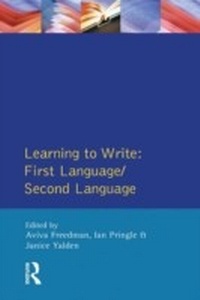
Learning to Write
First Language/Second Language
1st Edition
Published on 25. September 2014
312 pages
978-1-317-86932-0 (ISBN)
Description

First published in 1983. The present volume holds the selected papers of a symposium on CCTE Conference, held in 1979 in Ottawa, Canada. The content provides an introduction and a review of major themes in Writing research and pedagogy. This is in part achieved by the papers themselves, and in part by the introductions the Editors offer to each of the four Parts. Second, the reader is continually presented with a characteristic applied linguistic interplay of research and practice, each affecting the other, in a mutual and interactive manner. Third, the issues of 'Writing as Product versus Writing as Process', or 'The Teaching of Writing Skills versus the Development of Writing Abilities' or 'The Use of Writing for Learning and Knowing' are not merely issues affecting Writing alone but language learning and teaching as a whole, and one might add, the entire process of education.
More details
Series
Language
English
Place of publication
London
United Kingdom
Publishing group
Taylor & Francis Ltd
Target group
College/higher education
Product notice
Reflowable
File size
1,96 MB
ISBN-13
978-1-317-86932-0 (9781317869320)
Copyright in bibliographic data and cover images is held by Nielsen Book Services Limited or by the publishers or by their respective licensors: all rights reserved.
Schweitzer Classification
Other editions
Additional editions
Book
03/1983
1st Edition
Routledge
€36.90
Shipment within 10-20 days
Persons
Edited by Aviva Freedman, Ian Pringle, Janice Yalden
Content
Contents
Preface
Introduction
Part One: The writing process: three orientations
1. Shaping at the point of utterance James Britton
2. Does learning to write have to be so difficult? Carl Bereitter and Marlene Scardamalia
3. New starts and different kids of failure H. G. Widdowson
Part Two: The development of writing abilities
4. The growth and development of first-grade writers Donald H. Graves
5. Assessing language development: the Crediton project Andrew Wilkinson
6. Toward a theory of development rhetoric Daniel R. Kirby and Kenneth J. Kantor
7. Redefining maturity in writing Lee Odell
Part Three: Text and discourse
8. A pluralistic synthesis fo four contemporary models for teaching composition James L. Kinneavy
9. Contrastive rhetorics: some implications for the writing process Robert B. Kaplan
10. Syntactic skill and ESL writing quality Patrick T. Kameen
11. The reliability of mean T-unit length: some questions for research in written composition Stephen P. Witte
Part Four: Implications for teaching
12. Writers and their writing, 15 to 17 Bruce Bennett
13. Scope for intentions Nancy Martin
14. Writing in response to literature John Dixon
15. Instructional focus and the teaching of writing James R. Squire
16. From classroom practice into psycholinguistic theory W. Ross Winterowd
17. Communicative writing practice and Aristotelian rhetoric Keith Johnson
18. Anguish as a second language? Remedies for composition teachers Ann Raimes
Bibliography
Index
Preface
Introduction
Part One: The writing process: three orientations
1. Shaping at the point of utterance James Britton
2. Does learning to write have to be so difficult? Carl Bereitter and Marlene Scardamalia
3. New starts and different kids of failure H. G. Widdowson
Part Two: The development of writing abilities
4. The growth and development of first-grade writers Donald H. Graves
5. Assessing language development: the Crediton project Andrew Wilkinson
6. Toward a theory of development rhetoric Daniel R. Kirby and Kenneth J. Kantor
7. Redefining maturity in writing Lee Odell
Part Three: Text and discourse
8. A pluralistic synthesis fo four contemporary models for teaching composition James L. Kinneavy
9. Contrastive rhetorics: some implications for the writing process Robert B. Kaplan
10. Syntactic skill and ESL writing quality Patrick T. Kameen
11. The reliability of mean T-unit length: some questions for research in written composition Stephen P. Witte
Part Four: Implications for teaching
12. Writers and their writing, 15 to 17 Bruce Bennett
13. Scope for intentions Nancy Martin
14. Writing in response to literature John Dixon
15. Instructional focus and the teaching of writing James R. Squire
16. From classroom practice into psycholinguistic theory W. Ross Winterowd
17. Communicative writing practice and Aristotelian rhetoric Keith Johnson
18. Anguish as a second language? Remedies for composition teachers Ann Raimes
Bibliography
Index
