

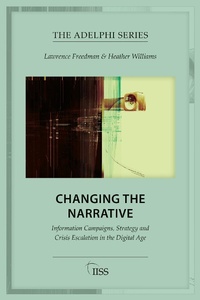
Changing the Narrative
Information Campaigns, Strategy and Crisis Escalation in the Digital Age
1st Edition
Published on 13. October 2023
164 pages
978-1-003-85745-7 (ISBN)
Description

Narratives provide the storylines of conflict and in doing so become an arena of conflict themselves. When states mount information campaigns against each other, they are trying to change the narrative. The digital platforms of the new information environment have been identified by various analysts as a significant factor in contemporary strategy and crisis management. But while social media is noisier and more chaotic than traditional media, and unprecedented in its immediacy and accessibility, has it thus far been a game changer in strategic affairs?
In this Adelphi book, Sir Lawrence Freedman and Heather Williams examine the impact of state-led digital information - or disinformation - campaigns in four contexts: the India-Pakistan crisis over Kashmir in 2019; the heightened tensions between the United States and Iran following the assassination of Qasem Soleimani in 2020; China's messaging in response to the COVID-19 pandemic from 2020-22; and the Russia-Ukraine crisis from 2013-23. While noting the meaningful consequences of digital information campaigns, in each case the authors call for a sense of perspective. Such campaigns are only one aspect of wider political struggles. They are also difficult for their initiators to control, and less likely to influence foreign audiences than domestic ones. Overall, the authors argue, there is little evidence so far to suggest such campaigns will have as much influence over contemporary crises as the classical instruments of military and economic power.
In this Adelphi book, Sir Lawrence Freedman and Heather Williams examine the impact of state-led digital information - or disinformation - campaigns in four contexts: the India-Pakistan crisis over Kashmir in 2019; the heightened tensions between the United States and Iran following the assassination of Qasem Soleimani in 2020; China's messaging in response to the COVID-19 pandemic from 2020-22; and the Russia-Ukraine crisis from 2013-23. While noting the meaningful consequences of digital information campaigns, in each case the authors call for a sense of perspective. Such campaigns are only one aspect of wider political struggles. They are also difficult for their initiators to control, and less likely to influence foreign audiences than domestic ones. Overall, the authors argue, there is little evidence so far to suggest such campaigns will have as much influence over contemporary crises as the classical instruments of military and economic power.
Reviews / Votes
'The headline for me of this fascinating study is "a tweet alone cannot escalate a crisis" - other political and military factors must be in play. But the authors do show clearly how social media campaigns can achieve strategic goals: after the brutal Russian invasion in 2022, for example, Ukraine quickly was able to shape Western narratives about a country "needing all the help it could get". Wonderful insights from two highly experienced observers of the security scene.'Rose Gottemoeller, Steven C. Hazy Lecturer at the Center for International Security and Cooperation and Research Fellow at the Hoover Institution, Stanford University; former Deputy Secretary General of NATO
'Freedman and Williams usefully deflate much of the hype over recent Russian, Chinese and other social-media disinformation campaigns, and provide an important warning of the danger of leaders becoming trapped by their own aggressive narratives.'
Professor Sir David Omand, King's College London; former UK Security and Intelligence Coordinator
'This book is a compelling and timely exploration of the evolving landscape of information campaigns in the digital age. The authors meticulously dissect case studies ranging from the India-Pakistan crisis to the Russia-Ukraine conflict, offering invaluable insights into how state-led information campaigns can shape international relations and crisis escalation. With its rigorous analysis and thought-provoking content, this book is an essential read for policymakers, scholars and anyone seeking to understand the intricate interplay between social media, information campaigns and geopolitical strategies.'
Eliot Higgins, founder and Creative Director of Bellingcat
More details
Series
Edition
1. Auflage
Language
English
Place of publication
London
United Kingdom
Publishing group
Taylor & Francis Ebooks
ISBN-13
978-1-003-85745-7 (9781003857457)
Copyright in bibliographic data and cover images is held by Nielsen Book Services Limited or by the publishers or by their respective licensors: all rights reserved.
Schweitzer Classification
Other editions
Additional editions
Lawrence Freedman | Heather Williams
Changing the Narrative
Information Campaigns, Strategy and Crisis Escalation in the Digital Age
Book
09/2023
1st Edition
Routledge
€31.30
Shipment within 10-20 days
Persons
Sir Lawrence Freedman is Emeritus Professor of War Studies, King's College London, where he was Professor of War Studies from 1982 to 2014 and Vice-Principal from 2003 to 2013. He was educated at Whitley Bay Grammar School and the universities of Manchester, York and Oxford. He previously held research appointments at the IISS, Nuffield College Oxford and Chatham House. Elected a Fellow of the British Academy in 1995, he was appointed Official Historian of the Falklands Campaign in 1997. In June 2009 he was appointed to serve as a member of the official inquiry into Britain's role in the 2003 Iraq War.
Dr Heather Williams is the director of the Project on Nuclear Issues and a senior fellow in the International Security Program at the Center for Strategic and International Studies (CSIS). She is also an associate fellow with the Project on Managing the Atom in the Belfer Center for Science and International Affairs at the Harvard Kennedy School. Until 2022 she was a senior lecturer in defence studies at King's College London.
Dr Heather Williams is the director of the Project on Nuclear Issues and a senior fellow in the International Security Program at the Center for Strategic and International Studies (CSIS). She is also an associate fellow with the Project on Managing the Atom in the Belfer Center for Science and International Affairs at the Harvard Kennedy School. Until 2022 she was a senior lecturer in defence studies at King's College London.
Content
a. Acknowledgements b. Introduction 1. Understanding narratives and information campaigns 2. India-Pakistan, 2019 3. US-Iran, 2020 4. China and the COVID-19 pandemic, 2020-22 5. Russia and the Ukraine crisis, 2013-23 c. Conclusion d. Notes e. Index
