

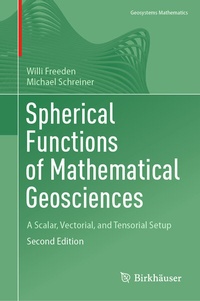
Spherical Functions of Mathematical Geosciences
Description

This book is an enlarged second edition of a monograph published in the Springer AGEM2-Series, 2009. It presents, in a consistent and unified overview, a setup of the theory of spherical functions of mathematical (geo-)sciences. The content shows a twofold transition: First, the natural transition from scalar to vectorial and tensorial theory of spherical harmonics is given in a coordinate-free context, based on variants of the addition theorem, Funk-Hecke formulas, and Helmholtz as well as Hardy-Hodge decompositions. Second, the canonical transition from spherical harmonics via zonal (kernel) functions to the Dirac kernel is given in close orientation to an uncertainty principle classifying the space/frequency (momentum) behavior of the functions for purposes of data analysis and (geo-)application. The whole palette of spherical functions is collected in a well-structured form for modeling and simulating the phenomena and processes occurring in the Earth's system. The result is a work which, while reflecting the present state of knowledge in a time-related manner, claims to be of largely timeless significance in (geo-)mathematical research and teaching.
More details
Other editions
Additional editions
Persons
Willi Freeden born in 1948 in Kaldenkirchen/Germany, Studies in Mathematics, Geography, and Philosophy at the RWTH Aachen, 1971 'Diplom' in Mathematics, 1972 'Staatsexamen' in Mathematics and Geography, 1975 PhD in Mathematics, 1979 'Habilitation' in Mathematics, 1981/1982 Visiting Research Professor at the Ohio State University, Columbus (Department of Geodetic Sciences and Surveying), 1984 Professor of Mathematics at the RWTH Aachen (Institute of Pure and Applied Mathematics), 1989 Professor of Technomathematics, 1994 Head of the Geomathematics Group, 2002-2006 Vice-president for Research and Technology at the University of Kaiserslautern.
Michael Schreiner born in 1966 in Mertesheim/Germany, Studies in Industrial Mathematics, Mechanical Engineering, and Computer Science at the University of Kaiserslautern, 1991 'Diplom' in Industrial Mathematics, 1994 PhD in Mathematics, 2004 'Habilitation' in Mathematics. 1997-2001 researcher and project leader at the Hilti Corp. Schaan,Liechtenstein, 2002 Professor for Industrial Mathematics at the University of Buchs NTB, Buchs, Switzerland. 2004 Head of the Department of Mathematics of the University of Buchs, 2004 also Lecturer at the University of Kaiserslautern.
