

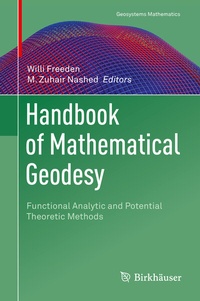
Handbook of Mathematical Geodesy
Description

Written by leading experts, this book provides a clear and comprehensive survey of the "status quo" of the interrelating process and cross-fertilization of structures and methods in mathematical geodesy. Starting with a foundation of functional analysis, potential theory, constructive approximation, special function theory, and inverse problems, readers are subsequently introduced to today's least squares approximation, spherical harmonics reflected spline and wavelet concepts, boundary value problems, Runge-Walsh framework, geodetic observables, geoidal modeling, ill-posed problems and regularizations, inverse gravimetry, and satellite gravity gradiometry. All chapters are self-contained and can be studied individually, making the book an ideal resource for both graduate students and active researchers who want to acquaint themselves with the mathematical aspects of modern geodesy.
Reviews / Votes
"The Handbook of Mathematical Geodesy presents for the mathematicians a wealth of applications and for the geodesists a solid embedding of the fundamental concepts of physical geodesy into approximation theory." (Karl-Rudolf Koch, Journal of Geodesy, Vol. 93, 2019)
"The Handbook of Mathematical Geodesy presents a remarkable achievement. The book bridges the gap between the abstract work of the mathematicians and the practically oriented measurements of the geodesists. . the book is broadly planned, and it presents the present state of knowledge." (Karl-Rudolf Koch, International Journal on Geomathematics GEM, Vol. 10, 2019)
More details
Other editions
Additional editions
Persons
Zuhair Nahed is Professor at the University of Central Florida, Orlando, USA
Content
Introduction.- Gauss as Scientific Mediator between Mathematics and Geodesy from the Past to the Present.- An Overview on Tools from Functional Analysis.- Operator-Theoretic and Regularization Approaches to Ill-Posed Problems.- Geodetic Observables and Their Mathematical Treatment in Multiscale Framework.- The Analysis of Geodetic Boundary Value Problem: State and Perspectives.- Oblique Stochastic Boundary Value Problem.- About the Importance of the Runge-Walsh Concept for Gravitational Field Determination.- Geomathematical Advances in Satellite Gravity Gradiometry.- Parameter Choices for Fast Harmonic Spline Approximation.- Gravimetry as an Ill-Posed Problem in Mathematical Geodesy.- Gravimetry and Exploration.- On the Non-Uniqueness of Gravitational and Magnetic Field Data Inversion.- Spherical Harmonics Based Special Function Systems and Constructive Approximation Methods.- Spherical Potential Theory: Tools and Applications.- A combination of Downward Continuation and LocalApproximation for Harmonic Potentials.- Joint Inversion of Multiple Observation.
