

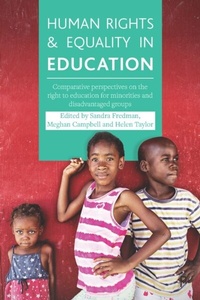
Human Rights and Equality in Education
Comparative Perspectives on the Right to Education for Minorities and Disadvantaged Groups
1st Edition
Published on 20. June 2018
192 pages
978-1-4473-3765-2 (ISBN)
Description

Thousands of children from minority and disadvantaged groups will never cross the threshold of a classroom. What can human rights contribute to the struggle to ensure that every learner is able to access high quality education?
This brilliant interdisciplinary collection explores how a human rights perspective offers new insights and tools into the current obstacles to education. It examines the role of private actors, the need to hold states to account for the quality of education, how to strike a balance between religion, culture and education, the innovative responses needed to guarantee girls' right to education and the role of courts.
This unique book draws together contributors who have been deeply involved in this field from both developing and developed countries which enriches the understanding and remedial approaches to tackle current obstacles to universal education.
This brilliant interdisciplinary collection explores how a human rights perspective offers new insights and tools into the current obstacles to education. It examines the role of private actors, the need to hold states to account for the quality of education, how to strike a balance between religion, culture and education, the innovative responses needed to guarantee girls' right to education and the role of courts.
This unique book draws together contributors who have been deeply involved in this field from both developing and developed countries which enriches the understanding and remedial approaches to tackle current obstacles to universal education.
More details
Edition
First Edition
Language
English
Place of publication
Bristol
United Kingdom
Publishing group
Bristol University Press
Target group
Professional and scholarly
Illustrations
1 s/w Abbildung
1 Illustrations, black and white
File size
0,71 MB
ISBN-13
978-1-4473-3765-2 (9781447337652)
Copyright in bibliographic data and cover images is held by Nielsen Book Services Limited or by the publishers or by their respective licensors: all rights reserved.
Schweitzer Classification
Other editions
Additional editions
Sandra Fredman | Meghan Campbell
Human Rights and Equality in Education
Comparative Perspectives on the Right to Education for Minorities and Disadvantaged Groups
Book
06/2018
1st Edition
Policy Press
€105.10
Shipment within 15-20 days
Sandra Fredman | Meghan Campbell
Human Rights and Equality in Education
Comparative Perspectives on the Right to Education for Minorities and Disadvantaged Groups
E-Book
06/2018
1st Edition
Policy Press
€231.99
Available for download
Persons
Sandra Fredman is Rhodes Professor of the Laws of the British Commonwealth and the USA at Oxford University. She is a QC and Fellow of the British Academy. She has acted as an expert adviser on equality law and labour legislation in the EU, Northern Ireland, the UK, India, South Africa, Canada and the UN; and founded the Oxford Human Rights Hub, of which she is the Director. She has written and published widely on anti-discrimination law, human rights law and labour law.
Meghan Campbell is a Lecturer in Law at the University of Birmingham and Deputy-Director of the Oxford Human Rights Hub. She holds a DPhil from Oxford University. Her forthcoming monograph Women, Poverty and Equality: The Role of CEDAW (Hart Publishing) investigates how the preeminent treaty on women's rights can addresses gender-based poverty. She has lectured on human rights, labour, administrative and constitutional law and worked as a consultant for the International Labour Organization.
Helen Taylor studied BA Honours (English Literature) and LLB at the University of Stellenbosch, South Africa, before coming to Oxford as a Rhodes Scholar. Her DPhil research considers the role of courts in crafting remedies for enforcing the state's positive duties in human rights. Helen is the Research Director at the Oxford Human Rights Hub, working extensively on projects relating to the right to education. She was also member of the executive committee of Oxford Pro Bono Publico.
Meghan Campbell is a Lecturer in Law at the University of Birmingham and Deputy-Director of the Oxford Human Rights Hub. She holds a DPhil from Oxford University. Her forthcoming monograph Women, Poverty and Equality: The Role of CEDAW (Hart Publishing) investigates how the preeminent treaty on women's rights can addresses gender-based poverty. She has lectured on human rights, labour, administrative and constitutional law and worked as a consultant for the International Labour Organization.
Helen Taylor studied BA Honours (English Literature) and LLB at the University of Stellenbosch, South Africa, before coming to Oxford as a Rhodes Scholar. Her DPhil research considers the role of courts in crafting remedies for enforcing the state's positive duties in human rights. Helen is the Research Director at the Oxford Human Rights Hub, working extensively on projects relating to the right to education. She was also member of the executive committee of Oxford Pro Bono Publico.
Content
Foreword ~ Kishore Singh
Introduction ~ Sandra Fredman, Meghan Campbell and Helen Taylor
Part I: The role of public and private actors in education
Public rights and private schools: state accountability for violations of rights in education ~ Conor O'Mahony
The dynamics of regulating low-fee private schools in Kenya ~ Gilbert Mitullah Omware
Education at the margins: the potential benefits of private educational initiatives for disadvantaged groups ~ Melanie Smuts
Part II: Balancing the right to freedom of religion and culture and the right to education
Calling the farce on minority schools ~ Jayna Kothari
The challenge of Afrikaans language rights in South African education ~ Michael Bishop
Part III: Gender equality in education: moving beyond access to primary education
Women and education: the right to substantive equality ~ Sandra Fredman
Equality and the right to education: let's talk about sex education ~ Meghan Campbell
Part IV: Litigating for quality and equality in education
Conceptualising and enforcing the right to quality education for minorities and disadvantaged groups: reflections of the Campaign for Fiscal Equity litigation ~ Helen Taylor
From the classroom to the courtroom: litigating education rights in South Africa ~ Jason Brickhill and Yana van Leeve
Human rights and equality in education: Conclusion ~ Sandra Fredman, Meghan Campbell and Helen Taylor
Introduction ~ Sandra Fredman, Meghan Campbell and Helen Taylor
Part I: The role of public and private actors in education
Public rights and private schools: state accountability for violations of rights in education ~ Conor O'Mahony
The dynamics of regulating low-fee private schools in Kenya ~ Gilbert Mitullah Omware
Education at the margins: the potential benefits of private educational initiatives for disadvantaged groups ~ Melanie Smuts
Part II: Balancing the right to freedom of religion and culture and the right to education
Calling the farce on minority schools ~ Jayna Kothari
The challenge of Afrikaans language rights in South African education ~ Michael Bishop
Part III: Gender equality in education: moving beyond access to primary education
Women and education: the right to substantive equality ~ Sandra Fredman
Equality and the right to education: let's talk about sex education ~ Meghan Campbell
Part IV: Litigating for quality and equality in education
Conceptualising and enforcing the right to quality education for minorities and disadvantaged groups: reflections of the Campaign for Fiscal Equity litigation ~ Helen Taylor
From the classroom to the courtroom: litigating education rights in South Africa ~ Jason Brickhill and Yana van Leeve
Human rights and equality in education: Conclusion ~ Sandra Fredman, Meghan Campbell and Helen Taylor
