

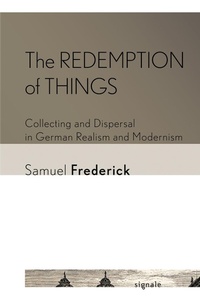
The Redemption of Things
Collecting and Dispersal in German Realism and Modernism
Published on 15. January 2022
348 pages
978-1-5017-6157-7 (ISBN)
Description

Collecting is usually understood as an activity that bestows permanence, unity, and meaning on otherwise scattered and ephemeral objects. In The Redemption of Things, Samuel Frederick emphasizes that to collect things, however, always entails displacing, immobilizing, and potentially disfiguring them, too. He argues that the dispersal of objects, seemingly antithetical to the collector's task, is essential to the logic of gathering and preservation.
Through analyses of collecting as a dialectical process of preservation and loss, The Redemption of Things illustrates this paradox by focusing on objects that challenge notions of collectability: ephemera, detritus, and trivialities such as moss, junk, paper scraps, dust, scent, and the transitory moment. In meticulous close readings of works by Gotthelf, Stifter, Keller, Rilke, Glauser, and Frisch, and by examining an experimental film by Oskar Fischinger, Frederick reveals how the difficulties posed by these fleeting, fragile, and forsaken objects help to reconceptualize collecting as a poetic activity that makes the world of scattered things uniquely palpable and knowable.
Through analyses of collecting as a dialectical process of preservation and loss, The Redemption of Things illustrates this paradox by focusing on objects that challenge notions of collectability: ephemera, detritus, and trivialities such as moss, junk, paper scraps, dust, scent, and the transitory moment. In meticulous close readings of works by Gotthelf, Stifter, Keller, Rilke, Glauser, and Frisch, and by examining an experimental film by Oskar Fischinger, Frederick reveals how the difficulties posed by these fleeting, fragile, and forsaken objects help to reconceptualize collecting as a poetic activity that makes the world of scattered things uniquely palpable and knowable.
Reviews / Votes
This quietly engaging and eloquent book challenges dominant conceptions about collectability by analyzing the collecting of material things whose immateriality, ephemerality, and presumable undesirability would seem to deter if not defy the very act of collecting. [...] Those appreciative of Austrian and Swiss literature along with scholars interested in material culture, collecting, and nonfunctional or "marginal" objects will likely be most attracted to Frederick's book.(Goethe Yearbook) Frederick's second book presents a carefully arranged and brilliantly written collection of case studies, encompassing the works of canonical authors of German Realism (Adalbert Stifter, Jeramias Gotthelf, Gottfried Keller) as well as a fairly diverse set of 20th century writers and one filmmaker (Oskar Fischinger, Max Frisch, Friedrich Glauser).
(The German Quarterly)
More details
Series
Language
English
Place of publication
Ithaca
United States
Publishing group
Cornell University Press
Product notice
Reflowable
Illustrations
5 b&w halftones - 5 Halftones, black and white
ISBN-13
978-1-5017-6157-7 (9781501761577)
Copyright in bibliographic data and cover images is held by Nielsen Book Services Limited or by the publishers or by their respective licensors: all rights reserved.
Schweitzer Classification
Other editions
Additional editions
Book
01/2022
Cornell University Press and Cornell University Library
€55.89
Shipment within 15-20 days
Book
01/2022
Cornell University Press and Cornell University Library
€172.33
Shipment within 15-20 days
Person
Samuel Frederick is Associate Professor of German at Pennsylvania State University. He is the author of Narratives Unsettled and the coeditor of Robert Walser and Information, a volume of keywords.
Content
Introduction
1. Theorizing Collecting
Part I Ephemera
2. Moss (Stifter)
3. The Photographic Instant (Fischinger)
Part II Catastrophic Detritus
4. Divine Debris (Gotthelf)
5. Maculature / Zettel (Frisch)
Part III Triviality
6. Junk and Containers (Keller)
7. Dust (Glauser)
Conclusion
1. Theorizing Collecting
Part I Ephemera
2. Moss (Stifter)
3. The Photographic Instant (Fischinger)
Part II Catastrophic Detritus
4. Divine Debris (Gotthelf)
5. Maculature / Zettel (Frisch)
Part III Triviality
6. Junk and Containers (Keller)
7. Dust (Glauser)
Conclusion
