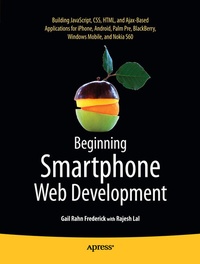
Beginning Smartphone Web Development
Description

Today's Web 2.0 applications (think Facebook and Twitter) go far beyond the confines of the desktop and are widely used on mobile devices. The mobile Web has become incredibly popular given the success of the iPhone and BlackBerry, the importance of Windows Mobile, and the emergence of Palm Pre (and its webOS platform). At Apress, we are fortunate to have Gail Frederick of the well-known training site Learn the Mobile Web offer her expert advice in Beginning Smartphone Web Development . In this book, Gail teaches the web standards and fundamentals specific to smartphones and other feature-driven mobile phones and devices.
- Shows you how to build interactive mobile web sites using web technologies optimized for browsers in smartphones
- Details markup fundamentals, design principles, content adaptation, usability, and interoperability
- Explores cross-platform standards and best practices for the mobile Web authored by the W3C, dotMobi, and similar organizations
- Dives deeps into the feature sets of the most popular mobile browsers, including WebKit, Chrome, Palm Pre webOS, Pocket IE, Opera Mobile, and Skyfire
By the end of this book, you'll have the training, tools, and techniques for creating robust mobile web experiences on any of these platforms for your favorite smartphone or other mobile device.
More details
Other editions
Additional editions