

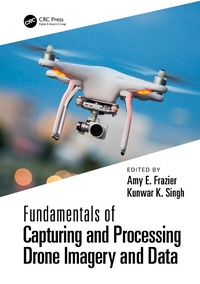
Fundamentals of Capturing and Processing Drone Imagery and Data
1st Edition
Published on 27. July 2021
386 pages
978-1-000-40195-0 (ISBN)
Description

Unmanned aircraft systems (UAS) are rapidly emerging as flexible platforms for capturing imagery and other data across the sciences. Many colleges and universities are developing courses on UAS-based data acquisition. Fundamentals of Capturing and Processing Drone Imagery and Data is a comprehensive, introductory text on how to use unmanned aircraft systems for data capture and analysis. It provides best practices for planning data capture missions and hands-on learning modules geared toward UAS data collection, processing, and applications.
FEATURES
Lays out a step-by-step approach to identify relevant tools and methods for UAS data/image acquisition and processing.
Provides practical hands-on knowledge with visual interpretation, well-organized and designed for a typical 16-week UAS course offered on college and university campuses.
Suitable for all levels of readers and does not require prior knowledge of UAS, remote sensing, digital image processing, or geospatial analytics.
Includes real-world environmental applications along with data interpretations and software used; exercises in chapters 8 through 19 have support materials for free download.
Combines the expertise of a wide range of UAS researchers and practitioners across the geospatial sciences.
This book provides a general introduction to drones along with a series of hands-on exercises that students and researchers can engage with to learn to integrate drone data into real-world applications. No prior background in remote sensing, GIS, or drone knowledge is needed to use this book. Readers will learn to process different types of UAS imagery for applications (such as precision agriculture, forestry, urban landscapes) and apply this knowledge in environmental monitoring and land-use studies.
FEATURES
Lays out a step-by-step approach to identify relevant tools and methods for UAS data/image acquisition and processing.
Provides practical hands-on knowledge with visual interpretation, well-organized and designed for a typical 16-week UAS course offered on college and university campuses.
Suitable for all levels of readers and does not require prior knowledge of UAS, remote sensing, digital image processing, or geospatial analytics.
Includes real-world environmental applications along with data interpretations and software used; exercises in chapters 8 through 19 have support materials for free download.
Combines the expertise of a wide range of UAS researchers and practitioners across the geospatial sciences.
This book provides a general introduction to drones along with a series of hands-on exercises that students and researchers can engage with to learn to integrate drone data into real-world applications. No prior background in remote sensing, GIS, or drone knowledge is needed to use this book. Readers will learn to process different types of UAS imagery for applications (such as precision agriculture, forestry, urban landscapes) and apply this knowledge in environmental monitoring and land-use studies.
More details
Edition
1. Auflage
Language
English
Place of publication
London
United Kingdom
Publishing group
Taylor & Francis Ltd
Target group
College/higher education
Illustrations
23 Tables, black and white; 29 Line drawings, color; 151 Halftones, color; 180 Illustrations, color
ISBN-13
978-1-000-40195-0 (9781000401950)
Copyright in bibliographic data and cover images is held by Nielsen Book Services Limited or by the publishers or by their respective licensors: all rights reserved.
Schweitzer Classification
Other editions
Additional editions
Amy Frazier | Kunwar Singh
Fundamentals of Capturing and Processing Drone Imagery and Data
Book
09/2023
1st Edition
CRC Press
€64.00
Shipment within 10-20 days
Amy Frazier | Kunwar Singh
Fundamentals of Capturing and Processing Drone Imagery and Data
Book
07/2021
1st Edition
CRC Press
€142.59
Shipment within 15-20 days
Book
07/2021
CRC Press
Unfortunately, price unknown
Available (delivery time upon request)
Persons
Amy E. Frazier is an Assistant Professor in the School of Geographical Sciences and Urban Planning at Arizona State University. She has over 10 years of experience in remote sensing data acquisition, processing, and analysis and has been working with UAS for the past 5 years. She holds her FAA Part 107 UAS Pilot's license and has experience with both fixed wing and rotor aircraft. Most recently, she has been part of a multi-institutional team funded by the U.S. National Science Foundation that are developing systems and integrated sensors onboard UAS to better understand severe weather from formation through damage assessment.
Kunwar K. Singh is a Geospatial Scientist at AidData research lab and an Affiliate Faculty in the Center for Geospatial Analysis at the College of William & Mary. He has extensive experience in remote sensing data acquisition, processing, and analysis, including the application of LiDAR (light detection and ranging) and UAS to measure, map, and model landscape characteristics and resources. His research focuses on land and vegetation dynamics and their impacts on natural resources.
Kunwar K. Singh is a Geospatial Scientist at AidData research lab and an Affiliate Faculty in the Center for Geospatial Analysis at the College of William & Mary. He has extensive experience in remote sensing data acquisition, processing, and analysis, including the application of LiDAR (light detection and ranging) and UAS to measure, map, and model landscape characteristics and resources. His research focuses on land and vegetation dynamics and their impacts on natural resources.
Content
Part I: Getting Started with Drone Imagery and Data 1. Introduction to Capturing and Processing Drone Imagery and Data 2. An Introduction to Drone Remote Sensing and Photogrammetry 3. Choosing a Sensor for UAS Imagery Collection 4. Mission Planning for Capturing UAS Imagery 5. Drone Regulations: What You Need to Know before You Fly 6. Structure from Motion (SfM) Workflow for Processing Drone Imagery 7. Aerial Cinematography with UAS Part II: Hands-On Applications Using Drone Imagery and Data 8. Planning Unoccupied Aircraft Systems (UAS) Missions 9. Aligning and Stitching Drone-Captured Images 10. Counting Wildlife from Drone-Captured Imagery Using Visual and Semi-Automated Techniques 11. Terrain and Surface Modeling of Vegetation Height Using Simple Linear Regression 12. Assessing the Accuracy of Digital Surface Models of an Earthen Dam Derived from SfM Techniques 13. Estimating Forage Mass from Unmanned Aircraft Systems in Rangelands 14. Applications of UAS-Derived Terrain Data for Hydrology and Flood Hazard Modeling 15. Comparing UAS and Terrestrial Laser Scanning Methods for Change Detection in Coastal Landscapes 16. Digital Preservation of Historical Heritage Using 3D Models and Augmented Reality 17. Identifying Burial Mounds and Enclosures Using RGB and Multispectral Indices Derived from UAS Imagery 18. Detecting Scales of Drone-Based Atmospheric Measurements Using Semivariograms 19. Assessing the Greenhouse Gas Carbon Dioxide in the Atmospheric Boundary Layer
