

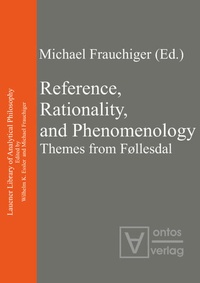
Reference, Rationality, and Phenomenology
Description

Having its seeds in the 2nd International Lauener Symposium held in honour of Dagfinn Føllesdal , the present collection contains a rich, kaleidoscopic ensemble of previously unpublished contributions by leading authors, representing diverse approaches to a variety of philosophical themes on which Føllesdal has had a longstanding, formative impact . Føllesdal himself contributes an orientating essay - continuing to develop his pioneering theory of reference - as well as in-depth commentaries on each of the other authors' elaborated papers plus candid answers in the added interview . The volume assembles a wealth of original articles containing in part direct discussions of Føllesdal's work and covering a broad range of topics like subjectivity, intersubjectivity, objectivity, rationality, logics and mathematics, choice theory, values, modalities, intentionality, individuation, perception, communication, meaning, reference, the slingshot, one- and two-sorted semantics, evidence, neuropsychology, space and time, science and society, methodology, fallibilism, the relative a priori, justification, holism, the life-world, reflective equilibrium, empathy, and ethics. Moreover the book includes an incisive memoir of Føllesdal the philosopher as well as a spanning interview with him, which are both critically directing toward Føllesdal's subtly differentiated understanding of the dynamic philosophical horizon he shares in.
With contributions from Dagfinn Føllesdal, Charles Parsons, Patrick Suppes, Jon Elster, John Perry, Michael Friedman, Dag Prawitz, Wilhelm K. Essler, David Woodruff Smith, Olav Gjelsvik, Graciela De Pierris, Nils Roll-Hansen, Christian Beyer, Øystein Linnebo, Michael Frauchiger.
More details
Other editions
Additional editions
Content
2 - Preface [Seite 7]
3 - Dagfinn Føllesdal: A Personal Memoir [Seite 11]
4 - Reference, neither Causal nor Apostolic, but Normative [Seite 19]
5 - Essays. Part I. Phenomenology [Seite 37]
5.1 - Neuropsychological Foundations of Phenomenology: Is It Possible? [Seite 39]
5.2 - Consciousness, Modality, and Inner Awareness [Seite 55]
5.3 - Noema and Reference [Seite 79]
5.4 - Transcendental Philosophy and Modern Physics: Neo-Kantianism, Logical Empiricism, and Phenomenology [Seite 95]
5.5 - Hume's Phenomenological Conception of Space, Time and Mathematics [Seite 113]
6 - Essays. Part II. Science [Seite 127]
6.1 - On Solidity and Rigidity. Some Notes on a Paper of Dagfinn Føllesdal [Seite 129]
6.2 - Some Remarks on the Distinction between Basic (Theoretical) and Applied (Practical) Science and Its Importance in the Politics of Science [Seite 143]
7 - Essays. Part III. Logic and Rationality [Seite 157]
7.1 - Some Consequences of the Entanglement of Logic and Mathematics [Seite 159]
7.2 - Validity of Inferences [Seite 185]
7.3 - Reason and Rationality [Seite 211]
8 - Essays. Part IV. Meaning [Seite 225]
8.1 - On "Meaning and Experience" [Seite 227]
9 - Essays. Part V. Reference [Seite 241]
9.1 - Føllesdal and Quine's Slingshot [Seite 243]
9.2 - Føllesdal and Frege on Reference [Seite 265]
10 - Comments on the Essays [Seite 287]
10.1 - Comments on Suppes, Smith, Beyer, Friedman and De Pierris [Seite 289]
10.2 - Comment on Essler [Seite 303]
10.3 - Comment on Roll-Hansen [Seite 305]
10.4 - Comment on Parsons [Seite 309]
10.5 - Comment on Prawitz [Seite 312]
10.6 - Comment on Elster [Seite 317]
10.7 - Comment on Gjelsvik [Seite 320]
10.8 - Comment on Perry [Seite 326]
10.9 - Comment on Linnebo [Seite 331]
11 - Interview with Dagfinn Føllesdal [Seite 341]
12 - About the Editor [Seite 368]
