

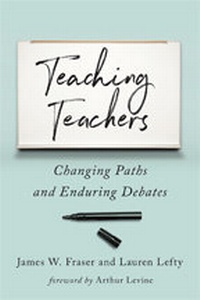
Teaching Teachers
Changing Paths and Enduring Debates
Published on 26. November 2018
248 pages
978-1-4214-2636-5 (ISBN)
Description

Teacher education in America has changed dramatically in the past thirty years-with major implications for how our kids are taught.
As recently as 1990, if a person wanted to become a public school teacher in the United States, he or she needed to attend an accredited university education program. Less than three decades later, the variety of routes into teaching is staggering. In Teaching Teachers, education historians James W. Fraser and Lauren Lefty look at these alternative programs through the lens of the past.
Fraser and Lefty explain how, beginning in 1986, an extraordinary range of new teaching programs emerged, most of which moved teacher education out of universities. In some school districts and charter schools, superintendents started their own teacher preparation programs-sometimes in conjunction with universities, sometimes not. Other teacher educators designed blended programs, creating collaboration between university teacher education programs and other parts of the university, linking with school districts and independent providers, and creating a range of novel options.
Fraser and Lefty argue that three factors help explain this dramatic shift in how teachers are trained: an ethos that market forces were the solution to social problems; long-term dissatisfaction with the inadequacies of university-based teacher education; and the frustration of school superintendents with teachers themselves, who can seem both underprepared and too quick to challenge established policy. Surveying which programs are effective and which are not, this book also examines the impact of for-profit teacher training in the classroom. Casting light on the historical and social forces that led to the sea change in the ways American teachers are prepared, Teaching Teachers is a substantial and unbiased history of a controversial topic.
As recently as 1990, if a person wanted to become a public school teacher in the United States, he or she needed to attend an accredited university education program. Less than three decades later, the variety of routes into teaching is staggering. In Teaching Teachers, education historians James W. Fraser and Lauren Lefty look at these alternative programs through the lens of the past.
Fraser and Lefty explain how, beginning in 1986, an extraordinary range of new teaching programs emerged, most of which moved teacher education out of universities. In some school districts and charter schools, superintendents started their own teacher preparation programs-sometimes in conjunction with universities, sometimes not. Other teacher educators designed blended programs, creating collaboration between university teacher education programs and other parts of the university, linking with school districts and independent providers, and creating a range of novel options.
Fraser and Lefty argue that three factors help explain this dramatic shift in how teachers are trained: an ethos that market forces were the solution to social problems; long-term dissatisfaction with the inadequacies of university-based teacher education; and the frustration of school superintendents with teachers themselves, who can seem both underprepared and too quick to challenge established policy. Surveying which programs are effective and which are not, this book also examines the impact of for-profit teacher training in the classroom. Casting light on the historical and social forces that led to the sea change in the ways American teachers are prepared, Teaching Teachers is a substantial and unbiased history of a controversial topic.
More details
Language
English
Place of publication
Baltimore
United States
Target group
Professional and scholarly
Illustrations
3 s/w Photographien bzw. Rasterbilder
3 Halftones, black and white
File size
2,15 MB
ISBN-13
978-1-4214-2636-5 (9781421426365)
DOI
10.1353/book.60739
Copyright in bibliographic data and cover images is held by Nielsen Book Services Limited or by the publishers or by their respective licensors: all rights reserved.
Schweitzer Classification
Other editions
Additional editions
Book
11/2018
Johns Hopkins University Press
€41.50
Article not available at the moment
Persons
James W. Fraser is a professor of history and education at New York University. He is the author or editor of twelve books, including Between Church and State: Religion and Public Education in a Multicultural America and Teach: A Question of Teaching. Lauren Lefty is a doctoral candidate in the History of Education program at New York University.
Content
Foreword, by Arthur Levine
Acknowledgments
Introduction: Considering the Future of Teacher Preparation in Light of the Past
Chapter 1. The Emergence of Alternative Routes to Teaching
Chapter 2. Transforming University Programs
Chapter 3. The New Hybrids
Conclusion: Lessons Learned
Notes
Index
Acknowledgments
Introduction: Considering the Future of Teacher Preparation in Light of the Past
Chapter 1. The Emergence of Alternative Routes to Teaching
Chapter 2. Transforming University Programs
Chapter 3. The New Hybrids
Conclusion: Lessons Learned
Notes
Index
