

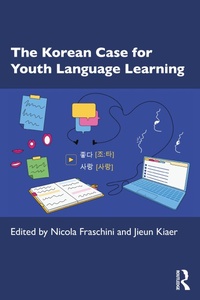
The Korean Case for Youth Language Learning
Published on 4. December 2025
254 pages
978-1-040-45164-9 (ISBN)
Description

The Korean Case for Youth Language Learning is a collection of chapters which address the complexities at the intersection of Korean language learning, the global popularity of Korean culture, and Generation Z learners' characteristics.
The chapters included in this volume portray learning contexts spread across five continents and adopt a wide array of research methodologies, including but not limited to thematic analysis, discourse analysis, and Q methodology, to touch on important topics such as policy and curricular constraints, pedagogical approaches, and Generation Z language learners' identity, motivation, and emotions. This volume serves as a springboard for further policy-focused, pedagogical, and empirical investigations into what the local setting, in terms of socio-cultural environment and educational infrastructure, brings into young learners' experience of learning the Korean language.
This book is a valuable guide for global teachers of Korean who seek to understand learners' behaviour and preferences in the K-wave era, as well as policymakers within language learning education.
The chapters included in this volume portray learning contexts spread across five continents and adopt a wide array of research methodologies, including but not limited to thematic analysis, discourse analysis, and Q methodology, to touch on important topics such as policy and curricular constraints, pedagogical approaches, and Generation Z language learners' identity, motivation, and emotions. This volume serves as a springboard for further policy-focused, pedagogical, and empirical investigations into what the local setting, in terms of socio-cultural environment and educational infrastructure, brings into young learners' experience of learning the Korean language.
This book is a valuable guide for global teachers of Korean who seek to understand learners' behaviour and preferences in the K-wave era, as well as policymakers within language learning education.
More details
Language
English
Place of publication
London
United Kingdom
Publishing group
Taylor & Francis Ltd
Target group
Professional and scholarly
College/higher education
Illustrations
32 Tables, black and white; 19 Line drawings, black and white; 19 Illustrations, black and white
File size
4,47 MB
ISBN-13
978-1-040-45164-9 (9781040451649)
Copyright in bibliographic data and cover images is held by Nielsen Book Services Limited or by the publishers or by their respective licensors: all rights reserved.
Schweitzer Classification
Other editions
Additional editions
Nicola Fraschini | Jieun Kiaer
The Korean Case for Youth Language Learning
Book
approx. 12/2025
1st Edition
Routledge
€207.80
Not yet published
Nicola Fraschini | Jieun Kiaer
The Korean Case for Youth Language Learning
Book
approx. 12/2025
1st Edition
Routledge
€57.60
Not yet published
Persons
Nicola Fraschini is Senior Lecturer at the University of Melbourne Asia Institute, where he is Head of Program of Korean Studies and Director of the Global Korea Research Hub. His research focuses on the psychology of language teaching and learning and Q methodology.
Jieun Kiaer is YBM-KF Professor of Korean Language and Linguistics at the University of Oxford and a Senior Research Fellow at Hertford College. Her research focuses on multilingualism, translanguaging, and language education in digital contexts. She works closely with policymakers, including the UK Department for Education, to support language education and curriculum innovation.
Jieun Kiaer is YBM-KF Professor of Korean Language and Linguistics at the University of Oxford and a Senior Research Fellow at Hertford College. Her research focuses on multilingualism, translanguaging, and language education in digital contexts. She works closely with policymakers, including the UK Department for Education, to support language education and curriculum innovation.
Content
Introduction: Generation Z and Korean language learning.
Part 1. Policies, curricula, and assessment
1. Learning Korean in high school: The Year 11 and 12 Korean language syllabi in Victoria and Western Australia.
2. Flourishing but with challenges: Korean language education for young Vietnamese learners.
3. Teaching Korean in Japanese High Schools: Structure, materials and assessments.
4. Korean language at the secondary level in Taiwan: Learners, policies, and resources.
Part 2. Teaching methods and learning practices
5. The impact of the Korean Wave on Korean language studies in Israel.
6. Transcending educational boundaries: The impact of eTandem virtual exchange among generation Z learners of Korean.
7. From the classroom to variety shows, films, and web-novels: Korean language learning in Kenya.
8. Korean Wave and informal language learning: Learners' perspectives in online spaces.
9. Korean language learning beyond the classroom in young Korean Australians.
Part 3. Learners' individual differences
10. Young learner perspectives on semi-formal, extracurricular Korean language learning in the UK.
11. Transitioning from high school: Chinese students' triggers to major in Korean Language and Literature at university.
12. Korean language learning among Turkish students: Young learners' perspectives, motivation and vision.
13. Enjoyment in learning Korean as a foreign language: Learner subjectivity in Thailand.
Part 1. Policies, curricula, and assessment
1. Learning Korean in high school: The Year 11 and 12 Korean language syllabi in Victoria and Western Australia.
2. Flourishing but with challenges: Korean language education for young Vietnamese learners.
3. Teaching Korean in Japanese High Schools: Structure, materials and assessments.
4. Korean language at the secondary level in Taiwan: Learners, policies, and resources.
Part 2. Teaching methods and learning practices
5. The impact of the Korean Wave on Korean language studies in Israel.
6. Transcending educational boundaries: The impact of eTandem virtual exchange among generation Z learners of Korean.
7. From the classroom to variety shows, films, and web-novels: Korean language learning in Kenya.
8. Korean Wave and informal language learning: Learners' perspectives in online spaces.
9. Korean language learning beyond the classroom in young Korean Australians.
Part 3. Learners' individual differences
10. Young learner perspectives on semi-formal, extracurricular Korean language learning in the UK.
11. Transitioning from high school: Chinese students' triggers to major in Korean Language and Literature at university.
12. Korean language learning among Turkish students: Young learners' perspectives, motivation and vision.
13. Enjoyment in learning Korean as a foreign language: Learner subjectivity in Thailand.
