

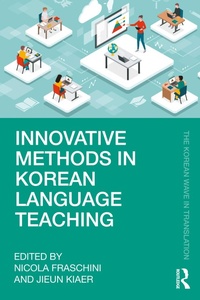
Innovative Methods in Korean Language Teaching
1st Edition
Published on 30. December 2024
214 pages
978-1-040-26222-1 (ISBN)
Description

Innovative Methods in Korean Language Teaching showcases research-based and experience-based contributions and reflections on the potential of adopting technological and non-technological innovations to promote Korean language students' learning.
The chapters included in this book consider a wide range of innovative technologies and approaches, such as large language models, virtual reality solutions, metaverse platforms, multimodal teaching, and critical pedagogy, and represent a variety of geographical learning contexts from North America to Europe, from Korea to the broader Asia-Pacific region. Overall, these contributions make the case for embracing new technologies instead of banning them and for accepting pedagogical shifts that take into consideration contemporary understandings of the communication, teaching, and learning processes.
This book will be of interest to graduate students, researchers, and practitioners of Korean language education and to those working on language teaching and learning in general, to inform future teaching practices through careful consideration of contemporary technologies and teaching approaches.
The chapters included in this book consider a wide range of innovative technologies and approaches, such as large language models, virtual reality solutions, metaverse platforms, multimodal teaching, and critical pedagogy, and represent a variety of geographical learning contexts from North America to Europe, from Korea to the broader Asia-Pacific region. Overall, these contributions make the case for embracing new technologies instead of banning them and for accepting pedagogical shifts that take into consideration contemporary understandings of the communication, teaching, and learning processes.
This book will be of interest to graduate students, researchers, and practitioners of Korean language education and to those working on language teaching and learning in general, to inform future teaching practices through careful consideration of contemporary technologies and teaching approaches.
More details
Series
Edition
1. Auflage
Language
English
Place of publication
London
United Kingdom
Publishing group
Taylor & Francis Ltd
Target group
College/higher education
Professional and scholarly
Illustrations
18 Tables, black and white; 9 Line drawings, black and white; 29 Halftones, black and white; 38 Illustrations, black and white
ISBN-13
978-1-040-26222-1 (9781040262221)
Copyright in bibliographic data and cover images is held by Nielsen Book Services Limited or by the publishers or by their respective licensors: all rights reserved.
Schweitzer Classification
Other editions
Additional editions
Nicola Fraschini | Jieun Kiaer
Innovative Methods in Korean Language Teaching
Book
12/2024
1st Edition
Routledge
€196.00
Shipment within 10-20 days
Nicola Fraschini | Jieun Kiaer
Innovative Methods in Korean Language Teaching
Book
12/2024
1st Edition
Routledge
€52.90
Shipment within 10-20 days
Persons
Nicola Fraschini is a senior lecturer at the University of Melbourne Asia Institute, where he is convener of the Korean Studies program and director of the Global Korea Research Hub. His research interests are the psychology of language learners and teachers and Q methodology.
Jieun Kiaer is the YBMK KF Professor of Korean Linguistics in the University of Oxford's Asian and Middle Eastern Studies Faculty. She publishes widely on linguistics, Asian studies, and translation. Her recent research covers the future of human language, social media behaviors, big data, and AI linguistics. Wearing the hats of linguist, pragmatist, and Asian specialist, she is uniquely positioned to respond to the recent developments in AI.
Jieun Kiaer is the YBMK KF Professor of Korean Linguistics in the University of Oxford's Asian and Middle Eastern Studies Faculty. She publishes widely on linguistics, Asian studies, and translation. Her recent research covers the future of human language, social media behaviors, big data, and AI linguistics. Wearing the hats of linguist, pragmatist, and Asian specialist, she is uniquely positioned to respond to the recent developments in AI.
Content
Introduction: Innovative methods for global Korean language teaching
NICOLA FRASCHINI AND JIEUN KIAER
PART I: Large language models and Korean language education
1 AI-powered writing assistance: Korean language students' and teachers' views and experiences
INHYE LEE
2 Students' perceptions of utilizing AI chatbots as conversation partners for Korean speaking practice: Acceptance, benefits,
and challenges
NA-YOUNG RYU
3 Large language models for Korean grammar and spelling corrections: comparative evaluation of Bard, Bing, ChatGPT, CLOVA X, and Perplexity AI
NARAE JUNG
4 The potential of generative AI in writing feedback for Korean L2 learners: an analysis on grammar error correction by ChatGPT-3.5 for TOPIK II writing tasks
KUKJIN KIM
PART II: VR, metaverse, and other technology-based approaches to Korean language teaching
5 Virtual interactions in Seoul: implementation of highimmersion virtual reality (HiVR) technology in a Korean language class
JIYOUNG KIM AND SOYEON KIM
6 Exploring the possibilities and limits of metaverse as a Korean teaching resource: the case of the Sejong Institute's metaverse proposal
ALVARO TRIGO MALDONADO
7 Using a YouTube channel as a supplementary language teaching and learning platform
MYOUNGHEE CHO
PART III: Moving beyond technology for innovation in Korean language teaching
8 Excitement and confusion: an emotion-based approach to Korean language teaching
NICOLA FRASCHINI AND YU TAO
9 Multimodal approaches to Korean language teaching
LUCIEN BROWN
10 Transformative learning through critical pedagogy in Korean language education
YOUNG-MEE YU CHO AND HEE CHUNG CHUN
NICOLA FRASCHINI AND JIEUN KIAER
PART I: Large language models and Korean language education
1 AI-powered writing assistance: Korean language students' and teachers' views and experiences
INHYE LEE
2 Students' perceptions of utilizing AI chatbots as conversation partners for Korean speaking practice: Acceptance, benefits,
and challenges
NA-YOUNG RYU
3 Large language models for Korean grammar and spelling corrections: comparative evaluation of Bard, Bing, ChatGPT, CLOVA X, and Perplexity AI
NARAE JUNG
4 The potential of generative AI in writing feedback for Korean L2 learners: an analysis on grammar error correction by ChatGPT-3.5 for TOPIK II writing tasks
KUKJIN KIM
PART II: VR, metaverse, and other technology-based approaches to Korean language teaching
5 Virtual interactions in Seoul: implementation of highimmersion virtual reality (HiVR) technology in a Korean language class
JIYOUNG KIM AND SOYEON KIM
6 Exploring the possibilities and limits of metaverse as a Korean teaching resource: the case of the Sejong Institute's metaverse proposal
ALVARO TRIGO MALDONADO
7 Using a YouTube channel as a supplementary language teaching and learning platform
MYOUNGHEE CHO
PART III: Moving beyond technology for innovation in Korean language teaching
8 Excitement and confusion: an emotion-based approach to Korean language teaching
NICOLA FRASCHINI AND YU TAO
9 Multimodal approaches to Korean language teaching
LUCIEN BROWN
10 Transformative learning through critical pedagogy in Korean language education
YOUNG-MEE YU CHO AND HEE CHUNG CHUN
