

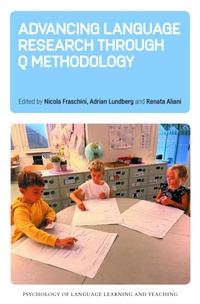
Advancing Language Research through Q Methodology
Published on 16. July 2024
268 pages
978-1-80041-981-0 (ISBN)
Description

This volume investigates the ways in which Q methodology can uncover and foreground new perspectives and contribute to language education and language policy research. It demonstrates the flexibility of this research methodology in addressing dynamic and complex language issues across a variety of educational topics and geographical contexts. The chapter authors use Q methodology to explore topics such as identity, motivation, cognition, emotion, pre-service and in-service teacher beliefs and to evaluate language programmes, curricula and policies. These contributions highlight Q methodology's potential to inform theoretical developments by revealing fresh perspectives on contemporary issues and generating new hypotheses. They foster further Q methodology research, demonstrating how it can contribute to a science of subjectivity and allow researchers to value the perspectives of all stakeholders for more inclusive research. This book will be of interest to graduate students and researchers in language education and language policy research and those in the broader field of social sciences looking to expand their knowledge of the methodology and how it can be used to study contemporary, dynamic and complex issues.
Reviews / Votes
This inspiring, well-edited collection pulls off a hat-trick in language studies: authors marshal multifaceted scholarship, engage with the practical import of studying some of the pervasive complexities in language learning and teaching, and accurately convey the subtleties, richness and potential of Q methodology for researchers seeking deeper insights in their fields. * Amanda Wolf, Victoria University of Wellington, New Zealand * The authors have illuminated and revitalized the entire field of language acquisition by demonstrating the role that subjectivity plays and by presenting sophisticated evidence through applications of Q methodology, enabling others to follow their well-marked trail. Their holistic approach to these complex issues will command attention and stimulate future research. * Steven R. Brown, Kent State University, USA * At last, a collection of top-tier chapters showcasing the influential role of Q methodology in deepening our understanding of language learning, teaching, and policy. Spanning diverse global contexts, this book serves as a valuable resource for researchers, whether junior or senior, aiming to enhance their qualitative approaches. * Asta Haukas, University of Bergen, Norway * ...a ground-breaking work in using Q in language and education research [...] Topics such as, but notlimited to, students' beliefs, anxiety, and language use could all be studied using Q. Moreover, this book could also be useful for Q methodologists or researchers in fields other than language and education, as it provides the format and structure of how to publish Q research in journals, including how to interpret factors in the results section and how much detail should be given in the methodology section in publications [...] it is indeed a milestone in language and education research. * Zichen Guan and Lawrence Jun Zhang, The University of Auckland, New Zealand, System 125, 2024 *
More details
Series
Language
English
Place of publication
Bristol
United Kingdom
Target group
College/higher education
Product notice
Reflowable
ISBN-13
978-1-80041-981-0 (9781800419810)
Copyright in bibliographic data and cover images is held by Nielsen Book Services Limited or by the publishers or by their respective licensors: all rights reserved.
Schweitzer Classification
Other editions
Additional editions
Nicola Fraschini | Adrian Lundberg | Renata Aliani
Advancing Language Research through Q Methodology
Book
approx. 06/2026
Multilingual Matters
€50.00
Shipment within 3-4 weeks
Nicola Fraschini | Adrian Lundberg | Renata Aliani
Advancing Language Research through Q Methodology
Book
07/2024
Multilingual Matters
€161.30
Shipment within 10-20 days
Persons
Nicola Fraschini is a Senior Lecturer at the University of Melbourne Asia Institute, Australia, where he teaches Korean language. His research interests include foreign language learner and teacher emotions, motivation and Q methodology. His research has been published in journals such as the Modern Language Journal and Annual Review of Applied Linguistics.
Adrian Lundberg is a Senior Lecturer in the Department of School Development and Leadership at Malmoe University, Sweden. His research focuses on investigating stakeholders' subjective viewpoints about educational issues at the crossroads of multilingualism, equity and policy. His Q methodology research has been published in Learning and Instruction, Educational Research Review and Current Issues in Language Planning.
Renata Aliani is a researcher within the Faculty of Education at the University of Melbourne, Australia. Her research interests focus primarily on Italian, bilingual education, teacher training and leadership. She has been the convener of the Melbourne-based online Q Research Group since its inception in 2016.
Adrian Lundberg is a Senior Lecturer in the Department of School Development and Leadership at Malmoe University, Sweden. His research focuses on investigating stakeholders' subjective viewpoints about educational issues at the crossroads of multilingualism, equity and policy. His Q methodology research has been published in Learning and Instruction, Educational Research Review and Current Issues in Language Planning.
Renata Aliani is a researcher within the Faculty of Education at the University of Melbourne, Australia. Her research interests focus primarily on Italian, bilingual education, teacher training and leadership. She has been the convener of the Melbourne-based online Q Research Group since its inception in 2016.
Content
Contributors
Joseph Lo Bianco: Foreword: A Teaching and Learning Journey with Q
Nicola Fraschini, Adrian Lundberg and Renata Aliani: Introduction: Q Methodology, Subjectivity and Language Research
Part 1: Q Methodology to Open a Window on Cognition, Motivation, Identity and Emotions
Chapter 1. Gary Bonar, Ruth Fielding and Meihui Wang: Exploring Pre-Service Language Teacher Identity Negotiation Using Q Methodology
Chapter 2. Marinella Caruso and Nicola Fraschini: Vision and Motivation of Adolescent Language Learners in Australia
Chapter 3. Akiko Fukuda: Understanding Self-Regulated Language Learning in the Context of Japanese University Students' Self-Study
Chapter 4. Nicola Fraschini and Adrian Lundberg: Australian-Korean Multicultural Family Members' Emotions about their Family Language Policy
Part 2: Q Methodology to Expand Research on In-Service and Pre-Service Teacher Beliefs
Chapter 5. Nicola Morea: An Investigation into Pre-Service Teachers' Beliefs about Multilingualism Before and After Participating in an Identity-Oriented Course on Multilingualism
Chapter 6. Christof Chesini, Lukas Bleichenbacher, Mara De Zanet, Robert Hilbe and Anna Schroeder-Sura: Pre-Service Teachers' Beliefs on Crosslinguistic Teacher Education in Switzerland
Chapter 7. Chengwen Yuan: The Post-Sort Interviews in Q Methodology: L2 Chinese Teachers' Beliefs about Motivational Teaching
Chapter 8. Yining Yang and Ke Zhao: Chinese University Teachers' Beliefs about and Pedagogical Responses to Bilingual Teaching
Part 3: Q Methodology to Evaluate Language Education Policies and Programmes
Chapter 9. Athip Thumvichit: Q Evaluation: Potential Applications in Language Education
Chapter 10. Hyunjin Park: A Q Methodology Evaluation of a Training Programme for Community Interpreters and Translators
Chapter 11. Renata Aliani: Investigating School Principals' Viewpoints on Languages Education
Nicola Fraschini, Adrian Lundberg and Renata Aliani: Conclusion: Thoughts on the Contribution of Q Methodology to Language Research and Looking Forward
Index
Joseph Lo Bianco: Foreword: A Teaching and Learning Journey with Q
Nicola Fraschini, Adrian Lundberg and Renata Aliani: Introduction: Q Methodology, Subjectivity and Language Research
Part 1: Q Methodology to Open a Window on Cognition, Motivation, Identity and Emotions
Chapter 1. Gary Bonar, Ruth Fielding and Meihui Wang: Exploring Pre-Service Language Teacher Identity Negotiation Using Q Methodology
Chapter 2. Marinella Caruso and Nicola Fraschini: Vision and Motivation of Adolescent Language Learners in Australia
Chapter 3. Akiko Fukuda: Understanding Self-Regulated Language Learning in the Context of Japanese University Students' Self-Study
Chapter 4. Nicola Fraschini and Adrian Lundberg: Australian-Korean Multicultural Family Members' Emotions about their Family Language Policy
Part 2: Q Methodology to Expand Research on In-Service and Pre-Service Teacher Beliefs
Chapter 5. Nicola Morea: An Investigation into Pre-Service Teachers' Beliefs about Multilingualism Before and After Participating in an Identity-Oriented Course on Multilingualism
Chapter 6. Christof Chesini, Lukas Bleichenbacher, Mara De Zanet, Robert Hilbe and Anna Schroeder-Sura: Pre-Service Teachers' Beliefs on Crosslinguistic Teacher Education in Switzerland
Chapter 7. Chengwen Yuan: The Post-Sort Interviews in Q Methodology: L2 Chinese Teachers' Beliefs about Motivational Teaching
Chapter 8. Yining Yang and Ke Zhao: Chinese University Teachers' Beliefs about and Pedagogical Responses to Bilingual Teaching
Part 3: Q Methodology to Evaluate Language Education Policies and Programmes
Chapter 9. Athip Thumvichit: Q Evaluation: Potential Applications in Language Education
Chapter 10. Hyunjin Park: A Q Methodology Evaluation of a Training Programme for Community Interpreters and Translators
Chapter 11. Renata Aliani: Investigating School Principals' Viewpoints on Languages Education
Nicola Fraschini, Adrian Lundberg and Renata Aliani: Conclusion: Thoughts on the Contribution of Q Methodology to Language Research and Looking Forward
Index
