

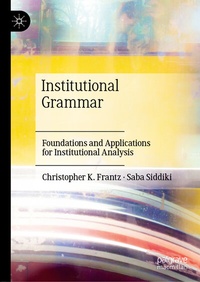
Institutional Grammar
Description

Reviews / Votes
" Institutional Grammar is a must read for social scientists and legal scholars who study the complex interplay between institutional arrangements and actors' behavior, as well as scholars interested in the semantics of institutions. Beginning with a careful exposition of Elinor Ostrom's Institutional Analysis and Development Framework and its affiliated grammar of institutions (aka IG 1.0), the authors present IG 2.0, identifying how it corrects the shortcomings of IG 1.0, as well as substantively expanding it to allow for the coding of regulative and constitutive institutional statements at different levels of granularity. Importantly, the authors include guidance on how to implement IG 2.0 and analyze the coded data, making the grammar accessible and highlighting its practical value. This book represents the definitive text on the grammar of institutions." (Edella Schlager, Professor, University of Arizona, USA)
"Frantz and Siddiki summarize the Institutional Grammar 2.0 for the systematic analysis of institutions. In doing so, their book revolutionizes the study of institutions and provides a sturdy foundation for building knowledge about them. This book is without peers, and its impact on the analysis of institutions will stretch across disciplines and extend far into the future." (Christopher M. Weible, Professor, University of Colorado Denver, USA)
"Institutions are ubiquitous, but can be challenging to study. With their development and description of the Institutional Grammar 2.0, Frantz and Siddiki provide a de-facto open standard for a new field we might call 'Computational Institutional Analysis'. This is a must-read for anyone interested in contributing to this emerging area of social science." (Charlie Schweik, Professor, University of Massachusetts Amherst, USA)
"The institutional grammar is an important and promising framework in institutional analysis that makes it possible to turn policy text into data;a bridge from raw policy texts to formal institutional representation. A collaboration between a policy scholar and computer scientist, Frantz and Siddiki's contributions to the framework are a major advance, and are already being adopted by institutional analysts across disciplines. While this work details the form and use of their technical contributions, it is as much a primer on that work as a roadmap for the future of the technique. Scholars eager to push institutional analysis further than it has ever gone will find no shortage of ideas and opportunities. The field is wide open, and with the guidance of Frantz and Siddiki, the institutional grammaticist is sure to find something new." (Seth Frey, Assistant Professor, University of California, Davis, USA)
" Institutional Grammar represents the end of a long journey that started with the famous paper 'A Grammar of Institutions' published in 1995. In this book, the authors provide a much-needed overview of the state of the art in the scholarship and suggest some interesting new developments. One of the main contributions of the book is the discussion of complexity, embedded in the 'grammar'. Although complexity has been a central topic in political economy and political science since the 1980s, the literature has yet to find a comprehensive framework that speaks across disciplines. In this book, scholars will find exactly what they were looking for: a theoretically compelling and empirically valid approach to complexity." (Matia Vannoni, Lecturer in Public Policy, Department of Political Economy, King's College London, United Kingdom)
More details
Other editions
Additional editions
Persons
Christopher K. Frantz is Associate Professor of Computational Social Science at the Norwegian University of Science and Technology (NTNU), Norway. His work focuses on computational approaches to institutional analysis, with specific focus on agent-based modelling techniques. A particular interest lies in analyzing socio-institutional phenomena in artificial societies, including their emergence and lifecycle dynamics, as well as establishing explanatory linkages to the underlying behavioral processes. A conceptual refinement of his work was the systematic introduction of nesting principles into the Institutional Grammar aimed at improving the Grammar's conceptual validity to represent institutions of arbitrary type and complexity.
Saba Siddiki is Associate Professor of Public Administration and International Affairs at Syracuse University, USA. Her research focuses on institutional design, particularly, policy design. She studies the structure/content of policy design as well asthe behavioral and policy implications of policy design. In connection with research foci, she has been involved in the theoretical and methodological advancement of the Institutional Grammar. She has specifically focused on empirically validating how the Institutional Grammar can be used to operationalize various policy relevant theoretical constructs and expanding the syntactic structure upon which the Institutional Grammar is based.Content
Chapter 1. Introduction.- Chapter 2. Review of Institutional Grammar Research: Overview, Opportunities, Challenges.- Chapter 3. Motivation for a New Institutional Grammar.- Chapter 4. Institutional Grammar 2.0: Conceptual Foundations and General Syntax.- Chapter 5. Institutional Grammar 2.0: Deep Structural Parsing and Hybrid Institutional Statements.- Chapter 6. Institutional Grammar 2.0: Semantic Features and Analytical Linkages.- Chapter 7. Methodological Guidance for Encoding Institutional Information.- Chapter 8. Institutional Analysis and Applications.- Chapter 9. Contextualization and Future Development of the Institutional Grammar.
