

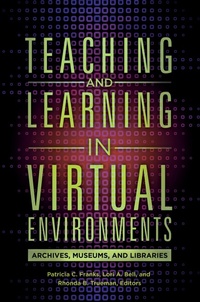
Teaching and Learning in Virtual Environments
Archives, Museums, and Libraries
1st Edition
Published on 26. September 2016
262 pages
979-8-216-15302-3 (ISBN)
Description

Useful to school librarians, teachers, and faculty, this book explains the range of possibilities for creating immersive learning experiences through the use of virtual worlds, virtual simulations, virtual collections, exhibits by libraries and museums, and archives.
There is a renaissance occurring in education with immersive learning via virtual applications and environments, even at the elementary school level. This widespread new movement is happening over more platforms than before-Second Life, Open Sim, Unity3D, Curio, and others. Teaching and Learning in Virtual Environments: Archives, Museums, and Libraries presents readers with the scope of possibilities for education in virtual environments today. Written from the perspective of the practitioner, it provides a wealth of teaching tips for virtual environments and for combining virtual environments with other emerging technologies for libraries and education.
Chapters describe how recent developments in technology have made web-based virtual worlds more accessible for teaching and learning and discuss the unique benefits and affordances of educating in virtual environments as well as their applications to different subjects. The teaching applications cover the primary and secondary school levels, higher education and graduate-level environments, and even beyond formal education into building immersive "information experiences" for professional training applications, library users, and the general public. The text provides an up-to-date overview for educators, academic and public librarians, and archives and museum staff on recent developments with immersive learning; presents innovative programs and teaching ideas; covers administrative issues; and addresses the student's perspective as well.
There is a renaissance occurring in education with immersive learning via virtual applications and environments, even at the elementary school level. This widespread new movement is happening over more platforms than before-Second Life, Open Sim, Unity3D, Curio, and others. Teaching and Learning in Virtual Environments: Archives, Museums, and Libraries presents readers with the scope of possibilities for education in virtual environments today. Written from the perspective of the practitioner, it provides a wealth of teaching tips for virtual environments and for combining virtual environments with other emerging technologies for libraries and education.
Chapters describe how recent developments in technology have made web-based virtual worlds more accessible for teaching and learning and discuss the unique benefits and affordances of educating in virtual environments as well as their applications to different subjects. The teaching applications cover the primary and secondary school levels, higher education and graduate-level environments, and even beyond formal education into building immersive "information experiences" for professional training applications, library users, and the general public. The text provides an up-to-date overview for educators, academic and public librarians, and archives and museum staff on recent developments with immersive learning; presents innovative programs and teaching ideas; covers administrative issues; and addresses the student's perspective as well.
More details
Edition
1. Auflage
Language
English
Place of publication
New York
United States
Publishing group
Bloomsbury Publishing Plc
Target group
Interest Age: From 7 to 17 years
Illustrations
32 bw illus
ISBN-13
979-8-216-15302-3 (9798216153023)
Copyright in bibliographic data and cover images is held by Nielsen Book Services Limited or by the publishers or by their respective licensors: all rights reserved.
Schweitzer Classification
Other editions
Additional editions
Patricia C. Franks | Lori A. Bell | Rhonda B. Trueman
Teaching and Learning in Virtual Environments
Archives, Museums, and Libraries
Book
09/2016
Libraries Unlimited Inc
€74.50
Shipment within 10-20 days
Persons
Patricia C. Franks, PhD, is program coordinator for the Master's Degree in Archives and Records Administration at the School of Information at San Jose State University.
Lori A. Bell is adjunct lecturer with San Jose State School of Information and the University of Hawaii Graduate School of Library and Information Science.
Rhonda B. Trueman is acquisitions and access services librarian at Northwest Florida State College.
Lori A. Bell is adjunct lecturer with San Jose State School of Information and the University of Hawaii Graduate School of Library and Information Science.
Rhonda B. Trueman is acquisitions and access services librarian at Northwest Florida State College.
Content
Illustrations
Foreword
Sandra Hirsh
Preface
SECTION I
Chapter 1: Digital Reality: An Education Renaissance
Mark Driskill
Chapter 2: Skilling Up for Teaching in 2D Online and 3D Virtual Environments
Leticia De Leon
Chapter 3: Building a Business in Second Life-A Case Study
Jennifer Crummey and Chris Nelson
Chapter 4: Professional Education and Library Connections in Virtual Worlds
Beth S. O'Connell
Chapter 5: Virtually Abroad in Second Life: The Use of Immersive Technology to Develop Intercultural Competence
Sandra Hirsh and Heidi Jakal
SECTION II
Chapter 6: Immersive Education in Second Life-A Case Study
Lori A. Bell
Chapter 7: Augmenting Reality: Experiencing the Past through Digital Technologies
Bryan Carter
Chapter 8: Virtual Worlds, Real Lives: Using Immersive Environments in the Classroom
Cara Coffina and John Howard
Chapter 9: Learning in Three Dimensions: From "Pretty" to "Participation"
John Jamison
Chapter 10: The Story of Science during the Scientific Revolution: Designing an Educational Exhibit
Marie Vans
Chapter 11: Crowdsourcing the Fictive Experience: Virtual-World Emergent Narrative from a Collections Perspective
JJ Jacobson
SECTION III
Chapter 12: Museums and Virtual Worlds
Geoff Giglierano
Chapter 13: Riding the Hype Cycle: Community Virtual Library Turns 10
Rhonda B. Trueman and Pat Alderman
Chapter 14: MOOCs, Virtual Environments, and Librarians
Valerie Hill, Ilene Frank, and Joe Floyd
Chapter 15: Building Community through Extracurricular Activities in Second Life: A VCARA Case Study
Patricia C. Franks
Chapter 16: Community and Education in the Virtual Environment: Lessons Learned
Mary-Carol Lindbloom
Chapter 17: The Future of Libraries in the Digital Age
Valerie Hill
Index
About the Editors and Contributors
Foreword
Sandra Hirsh
Preface
SECTION I
Chapter 1: Digital Reality: An Education Renaissance
Mark Driskill
Chapter 2: Skilling Up for Teaching in 2D Online and 3D Virtual Environments
Leticia De Leon
Chapter 3: Building a Business in Second Life-A Case Study
Jennifer Crummey and Chris Nelson
Chapter 4: Professional Education and Library Connections in Virtual Worlds
Beth S. O'Connell
Chapter 5: Virtually Abroad in Second Life: The Use of Immersive Technology to Develop Intercultural Competence
Sandra Hirsh and Heidi Jakal
SECTION II
Chapter 6: Immersive Education in Second Life-A Case Study
Lori A. Bell
Chapter 7: Augmenting Reality: Experiencing the Past through Digital Technologies
Bryan Carter
Chapter 8: Virtual Worlds, Real Lives: Using Immersive Environments in the Classroom
Cara Coffina and John Howard
Chapter 9: Learning in Three Dimensions: From "Pretty" to "Participation"
John Jamison
Chapter 10: The Story of Science during the Scientific Revolution: Designing an Educational Exhibit
Marie Vans
Chapter 11: Crowdsourcing the Fictive Experience: Virtual-World Emergent Narrative from a Collections Perspective
JJ Jacobson
SECTION III
Chapter 12: Museums and Virtual Worlds
Geoff Giglierano
Chapter 13: Riding the Hype Cycle: Community Virtual Library Turns 10
Rhonda B. Trueman and Pat Alderman
Chapter 14: MOOCs, Virtual Environments, and Librarians
Valerie Hill, Ilene Frank, and Joe Floyd
Chapter 15: Building Community through Extracurricular Activities in Second Life: A VCARA Case Study
Patricia C. Franks
Chapter 16: Community and Education in the Virtual Environment: Lessons Learned
Mary-Carol Lindbloom
Chapter 17: The Future of Libraries in the Digital Age
Valerie Hill
Index
About the Editors and Contributors
