

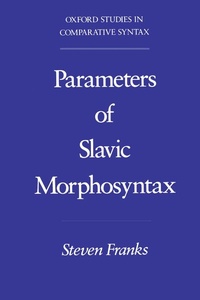
Parameters of Slavic Morphosyntax
1st Edition
Published on 11. May 1995
426 pages
978-0-19-535826-1 (ISBN)
Description

Focusing on issues of case theory and comparative grammar, this study treats selected problems in the syntax of the Slavic languages from the perspective of Government-Binding theory. Steven Franks seeks to develop parametric solutions to related constructions among the various Slavic languages. A model of case based loosely on Jakobson's feature system is adapted to a variety of comparative problems in Slavic, including across-the-board constructions, quantification, secondary predication, null subject phenomena, and voice. Solutions considered make use of recent approaches to phrase structure, including the VP-internal subject hypothesis and the DP hypothesis. The book will serve admirably as an introduction to GB theory for Slavic linguists as well as to the range of problems posed by Slavic for general syntacticians.
More details
Other editions
Additional editions
Book
07/1995
Oxford University Press Inc
€232.80
Shipment within 15-20 days

Steven Franks
Parameters of Slavic Morphosyntax
Book
05/1995
Oxford University Press
€88.03
Article exhausted; check different version
Content
- Intro
- CONTENTS
- 1. Introduction
- 1.1. Theoretical Preliminaries
- 1.1.1. The Modular Conception of Grammar
- 1.1.2. Levels and Components
- 1.1.3. Subsystems of Principles
- 1.1.4. The Categorial Component
- 1.2. Case Theory
- 1.2.1. Principles of Abstract Case
- 1.2.2. Case Assignment
- 2. Matrices, Indices, and Morphosyntactic Features
- 2.1. A Model of Morphological Case
- 2.1.1. Case Submatrices
- 2.1.2. Coindexation
- 2.1.3. Phase Structural Case
- 2.2. Russian Case Features
- 2.2.1. Excursus on Jakobson's Features
- 2.2.2. Revising Jakobson's System
- 3. Across-the-Board Dependencies
- 3.1. Case-Matching
- 3.2. Parallelism in Prominence
- 3.2.1. The Nature of the Parallelism
- 3.2.2. The Scope of Prominence Effects
- 3.2.3. Some Possible Extensions
- 3.3. The Parasitic Gap Analysis
- 3.3.1. Similarities
- 3.3.2. Differences
- 3.4. Conclusion
- 4. Quantified Structures: Russian versus Serbo-Croatian
- 4.1. Case Properties of Numeral Phrases
- 4.1.1. Babby's Analysis of Russian
- 4.1.2. Extending the Analysis: Gen(Q) Is Inherent in Serbo-Croatian
- 4.1.3. Characterizing the Structural/Inherent Dichotomy
- 4.2. The Category of Numeral Phrases
- 4.2.1. Pesetsky's Analysis of Russian
- 4.2.2. Extending the Analysis: Serbo-Croatian Numeral Phrases Are NPs
- 4.2.3. Some Semantic Issues
- 4.3. The Distribution of Numeral Phrases
- 4.3.1. The Internal Subject Hypothesis
- 4.3.2. The NP/QP Dichotomy Revisited
- 5. Quantified Structures: Polish and Other Puzzles
- 5.1. West Slavic and the Accusative Restriction
- 5.1.1. Polish Numeral Phrases
- 5.1.2. Numeral Phrases in Other Languages
- 5.2. More Quantified Expressions
- 5.2.1. Distributive Po-Phrases and the Structure of DP
- 5.2.2. Approximative Inversion
- 5.2.3. Frozen Quantifiers
- 5.3. Bare Genitives
- 5.3.1. Empty Quantifier Structures
- 5.3.2. The Genitive of Negation
- 6. Secondary Predication
- 6.1. Predicate Adjectives
- 6.1.1. Three Types of Predicate Adjective
- 6.1.2. On Agreement
- 6.1.3. Clausal Functional Projections
- 6.2. Secondary Predication and Control
- 6.2.1. Case Transmission
- 6.2.2. Factors Blocking Case Transmission
- 6.2.3. Control Theory and Agreement
- 6.3. The Second Dative
- 6.3.1. The Agreement Analysis
- 6.3.2. A Phrase Structural Analysis
- 6.3.3. Gerunds and Participles
- 6.4. Parametric Variation
- 6.4.1. Non-Agreeing Semipredicatives
- 6.4.2. Dative Subjects
- 6.4.3. Secondary Predication in Polish
- 7. Null Subject Phenomena
- 7.1. The "Pro-Drop" Parameter
- 7.1.1. Types of Null Subjects
- 7.1.2. Parametric Approaches
- 7.1.3. Summary of Slavic Facts
- 7.1.4. Two Sides of Visibility
- 7.2. Null Thematic Subjects
- 7.2.1. Case and Agreement
- 7.2.2. Ellipsis
- 7.2.3. Why Russian Is Different
- 7.3. Expletives and Visibility
- 7.3.1. Null Expletives Do Not Need Case
- 7.3.2. Overt Expletives Need Case at S-Structure
- 7.3.3. Different Kinds of Null Expletives
- 7.4. Overt Expletives in Slavic
- 7.4.1. Russian
- 7.4.2. South and West Slavic
- 7.5. Conclusion: Arbitrary Third Plural Subjects
- 8. Voice Alternations
- 8.1. Voice
- 8.1.1. Predicate-Argument Structure
- 8.1.2. Standard Passive Constructions
- 8.2. Null Subjects and Passive
- 8.2.1. Si-Constructions in Italian
- 8.2.2. Some Slavic Variations
- 8.3. Passive Morphology, Case, and Theta-Theory
- 8.3.1. Expletive Subjects and Passive
- 8.3.2. Case Absorption Issues
- 8.3.3. Theta-Theoretic Issues
- 8.3.4. Phrase Structure Issues
- 8.4. Epilogue: The Dispositional Reflexive Construction
- 9. Summary and Conclusions
- REFERENCES
- NAME INDEX
- A
- B
- C
- D
- F
- G
- H
- J
- K
- L
- M
- N
- O
- P
- R
- S
- T
- U
- V
- W
- Y
- Z
- SUBJECT INDEX
- A
- B
- C
- D
- E
- F
- G
- H
- I
- J
- L
- M
- N
- O
- P
- Q
- R
- S
- T
- U
- V
- W
- X
