

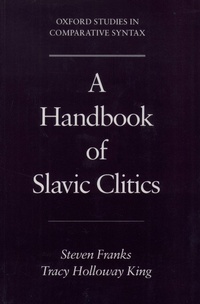
A Handbook of Slavic Clitics
Published on 23. March 2000
420 pages
978-0-19-972942-5 (ISBN)
Description

Clitics are grammatical elements that are treated as independent words in syntax but form a phonological unit with the word that precedes or follows it. This volume brings together the facts about clitics in the Slavic languages, where they have become a focal points of recent research. The authors draw relevant generalizations across the Slavic languages and highlight the importance of these phenomena for linguistic theory.
More details
Other editions
Additional editions
Steven Franks | Tracy Holloway King
A Handbook of Slavic Clitics
Book
04/2000
Oxford University Press Inc
€187.20
Shipment within 15-20 days

Steven Franks
A Handbook of Slavic Clitics
Book
03/2000
Oxford University Press Inc
€74.28
Article exhausted; check different version
Content
- Intro
- Contents
- Abbreviations and Tables
- 1 Introduction
- 1.1 Overview of This Volume
- 1.2 Some Basic Facts and Questions
- 1.2.1 Prosodic issues
- 1.2.2 Morphosyntactic status
- 1.3 Clitic Types in Slavic
- 1.3.1 Verbal auxiliary clitics
- 1.3.2 Pronominal clitics
- 1.3.3 Other clausal domain clitics
- 1.3.4 Other clitic-like elements
- 1.4 Contents and Issues Addressed
- 1.4.1 Description of part I
- 1.4.2 Description of part II
- 1.4.3 Description of part III
- I: Major Slavic Clitic Phenomena
- 2 South Slavic
- 2.1 Serbian/Croatian
- 2.2 Slovenian
- 2.3 Bulgarian
- 2.4 Macedonian
- 3 West Slavic
- 3.1 Czech
- 3.2 Slovak
- 3.3 Polish
- 3.4 Sorbian
- 4 East Slavic
- 4.1 Russian
- 4.2 Ukrainian and Belarusian
- 4.3 Summary
- II: Selected Problems
- 5 Patterns in the Ordering of Clitics
- 5.1 Internal Organization of the Clitic Cluster
- 5.2 Ordering of the Pronominal Clitics
- 5.3 Reflexive Clitics
- 5.4 Third Person Auxiliary Clitics
- 5.5 Summary
- 6 The Position of the Clitic Cluster
- 6.1 Wackernagel Position Clitics
- 6.2 Strictly Verb-Adjacent Clitics
- 6.3 Clitic Climbing
- 6.4 Summary
- 7 Clitic Doubling
- 7.1 The Phenomenon of Clitic Doubling
- 7.2 Semantic Licensing
- 7.3 Syntactic Analyses
- 7.4 Summary
- 8 Other Clausal Domain Clitics
- 8.1 Interrogatives
- 8.2 by/bi Modals and Clitics
- 8.3 Interactions with Negation
- 8.4 Summary
- 9 The Nominal Domain
- 9.1 Pronominal Clitics inside NPs
- 9.2 The Status of Postpositive Demonstratives
- 9.3 Summary
- III: Theory and Analyses
- 10 Survey of Recent Analyses
- 10.1 Purely Prosodic Accounts
- 10.2 Nonderivational Accounts
- 10.3 Purely Syntactic Accounts
- 10.4 Mixed Accounts
- 10.5 Summary
- 11 Slavic Clitics as Heads
- 11.1 X[sup(0)] vs. X[sup(max)]
- 11.2 Clitic Locations
- 11.3 Clitic Cluster Formation
- 11.4 Nonclustering Clitics
- 11.5 Some Compromises
- 12 Apparent Last-Resort Effects
- 12.1 Interrogative li
- 12.2 Split NP and PP Constructions
- 12.3 Long Head Movement
- 12.4 Summary
- 13 Summary
- 13.1 Clitics as Functional Heads
- 13.2 The Nature of Variation
- 13.3 The Prosody/Syntax Interaction
- Bibliography
- Subject Index
- A
- B
- C
- D
- E
- F
- G
- H
- I
- J
- K
- L
- M
- N
- O
- P
- R
- S
- T
- V
- W
- X
- Name Index
- A
- B
- C
- D
- E
- F
- G
- H
- I
- J
- K
- L
- M
- N
- O
- P
- R
- S
- T
- U
- V
- W
- Y
- Z
