

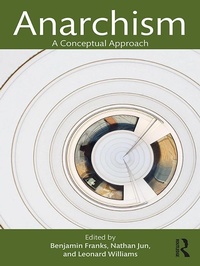
Anarchism
A Conceptual Approach
1st Edition
Published on 14. March 2018
254 pages
978-1-317-40682-2 (ISBN)
Description

Anarchism is by far the least broadly understood ideology and the least studied academically. Though highly influential, both historically and in terms of recent social movements, anarchism is regularly dismissed. Anarchism: A Conceptual Approach is a welcome addition to this growing field, which is widely debated but poorly understood.
Occupying a distinctive position in the study of anarchist ideology, this volume - authored by a handpicked group of established and rising scholars - investigates how anarchists often seek to sharpen their message and struggle to determine what ideas and actions are central to their identity. Moving beyond defining anarchism as simply an ideology or political theory, this book examines the meanings of its key concepts, which have been divided into three categories: Core, Adjacent, and Peripheral concepts. Each chapter focuses on one important concept, shows how anarchists have understood the concept, and highlights its relationships to other concepts.
Although anarchism is often thought of as a political topic, the interdisciplinary nature of Anarchism: A Conceptual Approach makes it of interest to students and scholars across the social sciences, liberal arts, and the humanities.
Occupying a distinctive position in the study of anarchist ideology, this volume - authored by a handpicked group of established and rising scholars - investigates how anarchists often seek to sharpen their message and struggle to determine what ideas and actions are central to their identity. Moving beyond defining anarchism as simply an ideology or political theory, this book examines the meanings of its key concepts, which have been divided into three categories: Core, Adjacent, and Peripheral concepts. Each chapter focuses on one important concept, shows how anarchists have understood the concept, and highlights its relationships to other concepts.
Although anarchism is often thought of as a political topic, the interdisciplinary nature of Anarchism: A Conceptual Approach makes it of interest to students and scholars across the social sciences, liberal arts, and the humanities.
Reviews / Votes
'This path-breaking book, with its multiple yet integrated perspectives and insights, is by far the most sophisticated analysis to have been written on anarchism as an ideology. It sets a new standard for understanding and analyzing anarchism's complexities and nuances that all future scholarship on the subject will have to respect and incorporate.' - Michael Freeden, Emeritus Professor of Politics, University of Oxford'Franks, Jun and Williams' pioneering application of Michael Freeden's approach to ideology gives us a rigorous, sharp and fresh account of anarchism. Showing how anarchists have interpreted key concepts, contributors to the volume explain the distinctiveness of anarchist analysis, exploding some entrenched myths about the inconsistencies of anarchist political thought in the process. The editors' arrangement of these contributions creates an invigorating picture of anarchist ideology. If it's possible to imagine alternative conceptual mappings, it is because they have demonstrated how anarchism can be constructed and re-constructed in its own terms.' - Ruth Kinna, Professor of Political Theory, Loughborough University
'This book provides both a vision of anarchism as a distinct political ideology as well as describing the current debates in anarchist thought and practice. On top of being useful to those engaged in anarchist studies and research it will very useful for those interested in political ideologies and philosophy more widely.' - Jon Bigger, anarchist activist, writer and researcher 'Franks, Jun and Williams' pioneering application of Michael Freeden's approach to ideology gives us a rigorous, sharp and fresh account of anarchism. Showing how anarchists have interpreted key concepts, contributors to the volume explain the distinctiveness of anarchist analysis, exploding some entrenched myths about the inconsistencies of anarchist political thought in the process. The editors' arrangement of these contributions creates an invigorating picture of anarchist ideology. If it's possible to imagine alternative conceptual mappings, it is because they have demonstrated how anarchism can be constructed and re-constructed in its own terms.'- Ruth Kinna, Professor of Political Theory, Loughborough University
More details
Edition
1. Auflage
Language
English
Place of publication
London
United Kingdom
Publishing group
Taylor & Francis Ltd
Target group
College/higher education
Illustrations
1 s/w Zeichnung, 1 s/w Abbildung
1 Line drawings, black and white; 1 Illustrations, black and white
File size
2,30 MB
ISBN-13
978-1-317-40682-2 (9781317406822)
Copyright in bibliographic data and cover images is held by Nielsen Book Services Limited or by the publishers or by their respective licensors: all rights reserved.
Schweitzer Classification
Other editions
Additional editions
Book
03/2018
1st Edition
Routledge
€193.50
Shipment within 10-20 days
Book
03/2018
1st Edition
Routledge
€56.00
Shipment within 10-20 days
Persons
Benjamin Franks is Lecturer in Social and Political Philosophy at the University of Glasgow's Dumfries campus. He is the author of Rebel Alliances and co-editor of Anarchism and Moral Philosophy. His work has appeared in The Journal of Political Ideologies, Capital and Class, and Anarchist Studies.
Nathan Jun is Associate Professor and Coordinator of the Philosophy Program at Midwestern State University. He is the author of Anarchism and Political Modernity. He has published several edited volumes and journal articles on political theory, the history of political thought, and contemporary European philosophy.
Leonard Williams is Professor of Political Science at Manchester University in North Manchester, Indiana. He is the author of American Liberalism and Ideological Change. His writings on anarchism have appeared in New Political Science, the Journal for the Study of Radicalism, and Anarchist Developments in Cultural Studies.
Nathan Jun is Associate Professor and Coordinator of the Philosophy Program at Midwestern State University. He is the author of Anarchism and Political Modernity. He has published several edited volumes and journal articles on political theory, the history of political thought, and contemporary European philosophy.
Leonard Williams is Professor of Political Science at Manchester University in North Manchester, Indiana. He is the author of American Liberalism and Ideological Change. His writings on anarchism have appeared in New Political Science, the Journal for the Study of Radicalism, and Anarchist Developments in Cultural Studies.
Content
Introduction [Benjamin Franks, Nathan Jun, and Leonard Williams] Part 1: Core Concepts 1. Anti-Hierarchy [Randall Amster] 2. Prefiguration [Benjamin Franks] 3. Freedom [Nathan Jun] 4. Agency [David Bates] 5. Direct Action [Vicente Ordonez] 6. Revolution [Uri Gordon] Part 2: Adjacent Concepts 7. Horizontalism [Mark Bray] 8. Organisation [Iain McKay] 9. Micropolitics [Laura Portwood-Stacer] 10. Economy [Deric Shannon] Part 3: Peripheral Concepts 11. Intersectionality [Hillary Lazar] 12. Reform [Leonard Williams] 13. Work [Ekaterina Chertkovskaya and Konstantin Stoborod] 14. DIY [Sandra Jeppesen] 15. Ecocentrism [Sean Parson]
