

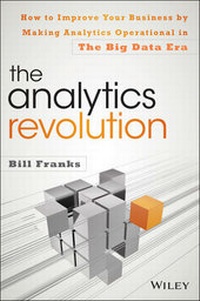
The Analytics Revolution
Description

The topics of big data and analytics continue to be among the most discussed and pursued in the business world today. While a decade ago many people still questioned whether or not data and analytics would help improve their businesses, today virtually no one questions the value that analytics brings to the table. The Analytics Revolution focuses on how this evolution has come to pass and explores the next wave of evolution that is underway. Making analytics operational involves automating and embedding analytics directly into business processes and allowing the analytics to prescribe and make decisions. It is already occurring all around us whether we know it or not.
The Analytics Revolution delves into the requirements for laying a solid technical and organizational foundation that is capable of supporting operational analytics at scale, and covers factors to consider if an organization is to succeed in making analytics operational. Along the way, you'll learn how changes in technology and the business environment have led to the necessity of both incorporating big data into analytic processes and making them operational. The book cuts straight through the considerable marketplace hype and focuses on what is really important. The book includes:
* An overview of what operational analytics are and what trends lead us to them
* Tips on structuring technology infrastructure and analytics organizations to succeed
* A discussion of how to change corporate culture to enable both faster discovery of important new analytics and quicker implementation cycles of what is discovered
* Guidance on how to justify, implement, and govern operational analytics
The Analytics Revolution gives you everything you need to implement operational analytic processes with big data.
All prices
More details
Other editions
Additional editions
Person
Content
Preface xv
Acknowledgments xxv
PART I The Revolution Has Begun 1
Chapter 1 Understanding Operational Analytics 3
Defining Operational Analytics 4
Welcome to Analytics 3.0 10
How Analytics Are Changing Business 20
Putting Operational Analytics in Perspective 26
Wrap-Up 30
Notes 31
Chapter 2 More Data . . . More Data . . . Big Data! 33
Cutting through the Hype 33
Preparing for Big Data 39
Putting Big Data in Context 48
Wrap-Up 58
Notes 59
Chapter 3 Operational Analytics in Action 61
Improving Customer Experiences 62
Time Is of the Essence 68
Making Us Safer 71
Increasing Operational Efficiency 74
Improving Our Lives in the Future 77
Finding Unexpected Value in Data 79
Wrap-Up 83
Notes 84
PART II Laying the Foundation 87
Chapter 4 Want Budget? Build the Business Case! 89
Setting the Priorities 89
Choosing the Right Decision Criteria 93
Business Case Framework to Consider 101
Tips for Creating a Winning Business Case 108
Wrap-Up 115
Notes 116
Chapter 5 Creating an Analytic Platform 117
Planning 118
Building 123
Using 140
Wrap-Up 143
Notes 145
Chapter 6 Governance and Privacy 147
Setting the Stage for Governance 148
Deciding Where Analytics Happen 154
Governing Operational Analytics 158
Privacy 165
Wrap-Up 172
Notes 173
PART III Making Analytics Operational 175
Chapter 7 The Analytics 177
Creating Operational Analytics Processes 177
Expanding into New Analytics Disciplines 181
Focusing Analytics Efforts 187
Comparing Analytics Approaches 193
Lessons from the Past 198
Wrap-Up 204
Notes 205
Chapter 8 The Analytics Organization 207
A Major Shift Has Occurred 207
Staffing 209
Organizing 218
Succeeding 225
Wrap-Up 234
Notes 235
Chapter 9 The Analytics Culture 237
Instilling the Proper Mind-set 237
Implementing Effective Policies 245
Facilitating Success 250
Enabling and Handling the Right Failures 256
Wrap-Up 261
Notes 262
Conclusion Join the Revolution! 263
About the Author 267
Index 269
Preface
Like manufacturing in the 1800s, the field of analytics needs to go through its own industrial revolution. Analytics processes today are usually created in an artisanal fashion with a lot of care and customization. That's okay in many cases, and the artisanal approach often still is appropriate. However, we must also push analytics forward to another level of scale and impact. The industrial revolution took manufacturing processes from an artisanal practice to a modern technological marvel that is able to manufacture quality items at massive scale. The same type of revolution must happen with analytics.
Centuries ago, if a bowl was needed, then a visit to a potter was necessary. A potter can make a custom bowl to fit any need. The problem is that such an approach isn't scalable. The limited pool of potters can create only so many bowls in a day. Today most bowls are created on a large scale in manufacturing plants. Although it is still possible to purchase a custom bowl from a potter, it isn't cost effective to use that approach except for special situations. Besides cost considerations, people today also often prefer the consistency of a mass-manufactured product. However, even in today's world, bowls don't magically appear. Someone still has to come up with a design, build initial prototypes, create a mold, and validate that the mold will produce the right bowl time and time again. Only then is an assembly line turned on to manufacture the bowl at scale.
A similar process is required for operational analytics. Framing and designing each new analysis is still necessary. Building a prototype of the analysis and testing multiple iterations of it to make sure everything works correctly is still necessary. Only at that point can the analytics process be promoted to an operational process, turned on, and executed in an automated fashion. After being turned on, the performance of the analytics process must be monitored constantly just like a real assembly line is monitored.
Making analytics operational doesn't remove any of the steps historically required to build an analytics process. Rather, it takes the process further. Operational analytics deploys analytics at industrial scale just like traditional manufacturing processes enable bowls to be produced at scale.
Operational analytics is about embedding analytics within business processes and automating decisions so that thousands or millions of decisions every day are made by analytics processes without any human intervention. Whether those decisions directly touch customers or simply optimize an organization's actions behind the scenes, the impact can be substantial.
If an organization doesn't begin to move toward operational analytics, it will struggle as its competitors drive analytics deeper into their business processes. The myriad operational analytics opportunities available to businesses today are driven by increased data availability, increased analytics processing horsepower, and increased accessibility of robust analytics techniques.
Whether we realize it or not, operational analytics is already at work around us every day and impacting our lives. In many cases, these analytics are no longer hidden behind the scenes. Consumers today are often both aware of the analytics that are occurring and even expect it. Let's briefly look at some ways that operational analytics is now impacting our daily routine to set the stage for what is to come in the book:
- Airlines automatically reroute customers when a flight is delayed in order to limit travel disruption and raise customer satisfaction. The analytics take into account a lot of facts about each customer, other passengers, and the status of alternative flight options.
- When people visit their favorite websites, the sites make recommendations as to what else they might like based on what they've viewed, what search terms they use, and what details seem most important to them based on the patterns of their behavior. Often this includes taking into account every action up to the last click.
- When a customer service agent is contacted to help with an issue, the agent often understands the caller's history and is guided by analytics to the best actions to resolve the issue. The recommended actions account for many factors about the customer and the product or service the customer is discussing.
- Social media sites are able to identify, and connect people with, long-lost friends or colleagues through analysis of extended social networks. Within seconds of linking to a friend, more recommendations are found.
- People can go into a store and instantly obtain credit based on an assessment of the current state of their creditworthiness, as determined by analysis of a wide range of historical credit history data.
- Banks and credit card issuers constantly use analysis to protect us from fraud. Behind the scenes, banks are constantly reviewing accounts for behavioral anomalies that indicate fraud and are able to quickly freeze an account until the purchases are verified with the customer.
These are just a few examples of where operational analytics impacts us daily, where we determine the analytics to be valuable, and where we have come to expect even more. Later, we also discuss a variety of examples where people are largely unaware of the analytics occurring around them.
Many of the technologies and architectures that supported traditional methods of developing and deploying analytics processes won't work for today's complex requirements. The classic systems and architectures, as well as historical analytics methods, have started to groan under the weight of the requirements of operational analytics. Companies must adapt and change the way they store and analyze data as well as how they deploy the results. That's going to necessitate changing not only infrastructure and analytics methodologies but corporate policies as well. If an organization tries to squeeze rapid, high-volume operational analytics into systems and processes that were created and architected to support only batch requirements, it will have a very difficult time.
We can expect to see continued disruption of business models and competitive environments as the analytics arms race continues. Twenty years ago, many organizations used little or no analytics. Today, most organizations use a fair amount of analytics. Having data that was weeks old and analytics processes that were executed infrequently in a batch environment used to be good enough. That is no longer true as the leaders in the analytics realm make analytics operational.
Five to ten years from now, virtually no business will remain untouched by this trend. Resistance is futile. Your organization needs to implement operational analytics, and this book will help you get started. Watch for the continuing transformation of businesses in the coming years as analytics continue to become truly a critical, operational component of a business rather than simply a nice add-on. This book focuses on how this evolution has come to pass and what is required to understand and implement operational analytics in your organization.
Sit back, get comfortable, and let's go!
Who Should Read This Book?
This book is intended to provide readers with a working knowledge of what operational analytics is, what an organization needs to know, and how an organization must act in order to succeed with operational analytics. The book comes from a strategic and conceptual level, not a technical and tactical level.
Although this book is accessible to anyone regardless of background, those who will find it most interesting are the executives and managers whose roles will touch operational analytics. Professionals involved in creating operational analytics processes will also find the book to be valuable.
If you read my book Taming the Big Data Tidal Wave (John Wiley & Sons, 2012) and you liked it, you'll like this one too. Although the subject matter is different, I have followed the same general tone and structure. While most of the focus is on totally new topics, sometimes this book builds on the themes from my earlier book. At the same time, the content of this book can stand alone, and familiarity with Taming the Big Data Tidal Wave is not a prerequisite.
Who Should Not Read This Book?
This book is a business book; it is not a technical book. Readers looking for deep technical details, mathematical formulas, or examples of code will not find what they are looking for and should consider a different book.
This book avoids specific product, service, and platform recommendations. Instead, it focuses on product classes and general architectures so that readers will know what to look for when they search for products and services. Readers looking for specific recommendations that include company and product names won't find those here.
Last, this book does presume some working knowledge of the analytics space. Those looking for a review of fundamental analytics concepts won't find it here. Instead of taking time to define every term, I assume that common terms and approaches are already understood.
What's in This Book?
This book consists of nine chapters divided into three parts. The first part of the book sets the stage by describing the market trends driving operational analytics, defining the topic, and providing examples to illustrate the concepts being discussed. The second part of the book covers how...
