

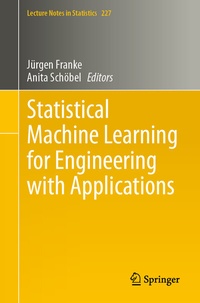
Statistical Machine Learning for Engineering with Applications
Description

This book offers a leisurely introduction to the concepts and methods of machine learning. Readers will learn about classification trees, Bayesian learning, neural networks and deep learning, the design of experiments, and related methods. For ease of reading, technical details are avoided as far as possible, and there is a particular emphasis on applicability, interpretation, reliability and limitations of the data-analytic methods in practice. To cover the common availability and types of data in engineering, training sets consisting of independent as well as time series data are considered. To cope with the scarceness of data in industrial problems, augmentation of training sets by additional artificial data, generated from physical models, as well as the combination of machine learning and expert knowledge of engineers are discussed.
The methodological exposition is accompanied by several detailed case studies based on industrial projects covering a broad range of engineering applications from vehicle manufacturing, process engineering and design of materials to optimization of production processes based on image analysis.
The focus is on fundamental ideas, applicability and the pitfalls of machine learning in industry and science, where data are often scarce. Requiring only very basic background in statistics, the book is ideal for self-study or short courses for engineering and science students.
More details
Other editions
Additional editions
Persons
Jürgen Franke has been a professor of Applied Mathematical Statistics and the speaker of the interdisciplinary Center for Mathematical and Computational Modelling (CM)² at the University of Kaiserslautern. Since his retirement from teaching, he joined the Fraunhofer Institute for Industrial Mathematics (ITWM) as a scientific consultant on statistics. His research focuses on nonlinear time series analysis, nonparametric statistics and statistical learning with applications in engineering and finance.
Anita Schöbel is professor of Applied Mathematics at the University Kaiserslautern-Landau and head of the Fraunhofer Institute for Industrial Mathematics (ITWM). Currently she is also president of the Association of European Operational Research Societies (EURO). At Fraunhofer Society she is responsible for the strategic research area Next Generation Computing and vice spokesperson for the quantum computing competence network. Her research focuses on discrete optimization and on robust and multi-objective optimization with applications in transportation.
Content
- An Introduction of Statistical Learning for Engineers.- Machine Learning for Inline Surface Inspection Systems - Challenges, Approaches, and Application Example.- Gaussian Process Regression for the Prediction of Cable Bundle Characteristics.- Machine Learning for Predictive Maintenance in Production Environments.- Detecting Healthcare Fraud Using Hybrid Machine Learning for Document Digitization.- Cracks in concrete.- Machine learning methods for prediction of breakthrough curves in reactive porous media.- Segmentation and Aggregation in Text Classification.- Hardware-aware Neural Architecture Search.- Optimal Experimental Design Supported by Machine Learning Regression Models.- Data Analytics, Artificial Intelligence and Machine Learning in Mobility and Vehicle Engineering.
