

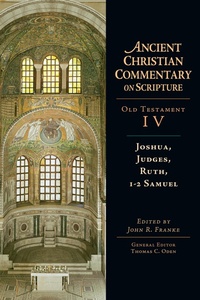
Joshua, Judges, Ruth, 1-2 Samuel
Description

The history of the entry into the Promised Land followed by the period of the Judges and early monarchy may not appear to readers today as a source for expounding the Christian faith. But the church fathers readily found parallels, or types, in the narrative that illumined the New Testament. An obvious link was the similarity in name between Joshua, Moses' successor, and Jesus-indeed, in Greek the names are identical. Thus Joshua was consistently interpreted as a type of Christ. So too was Samuel. David was recognized as an ancestor of Jesus, and parallels between their two lives were readily explored. And Ruth, in ready fashion, was seen as a type of the church.
Among the most important sources for commentary on these books are the homilies of Origen, most of which are known to us through the Latin translations of Rufinus and Jerome. Only two running commentaries exist-one from Gregory of Nazianzus, one of the famous Cappadocian theologians, the other from Bede the Venerable.
Another key source for the selections found here derives from question-and-answer format, such as Questions on the Heptateuch from Augustine, Questions on the Octateuch from Theodoret of Cyr, and Thirty Questions on 1 Samuel from Bede. The remainder of materials come from a wide variety of occasional and doctrinal writings, which make mention of these biblical texts to support their arguments.
Readers will find a rich treasure trove of ancient wisdom, some of which appear here for the first time in English translation, speaking with eloquence and powerful spiritual insight to the church today.
More details
Other editions
Additional editions
Person
John R. Franke (DPhil, Oxford) is associate professor of theology at Biblical Theological Seminary in Hatfield, Pennsylvania. With Stanley J. Grenz, he is coauthor of Beyond Foundationalism: Shaping Theology in a Postmodern Context.
Thomas C. Oden (1931-2016), was the general editor of the Ancient Christian Commentary on Scripture and the Ancient Christian Doctrine series as well as the author of Classic Christianity, a revision of his three-volume systematic theology. His books also include The African Memory of Mark, Early Libyan Christianity, and How Africa Shaped the Christian Mind. He was the director of the Center for Early African Christianity at Eastern University in Pennsylvania and he also served as the Henry Anson Buttz Professor of Theology at the Graduate School and The Theological School of Drew University in Madison, New Jersey.
Content
General Introduction A Guide to Using This Commentary Abbreviations Introduction to Joshua Through 2 Samuel Commentary on Joshua Commentary on Judges Commentary on Ruth Commentary on 1 Samuel Commentary on 2Samuel Appendix: Early Christian Writers and the Documents Cited Biographical Sketches Timeline of Writers of the Patristic Period Bibliography of Works in Original Languages Bibliography of Works in English Translation Authors/Writings Index Subject Index Scripture Index
