

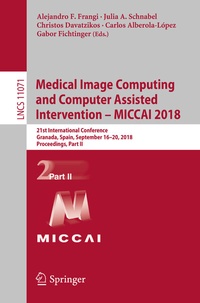
Medical Image Computing and Computer Assisted Intervention - MICCAI 2018
Description

The four-volume set LNCS 11070, 11071, 11072, and 11073 constitutes the refereed proceedings of the 21st International Conference on Medical Image Computing and Computer-Assisted Intervention, MICCAI 2018, held in Granada, Spain, in September 2018.
The 373 revised full papers presented were carefully reviewed and selected from 1068 submissions in a double-blind review process. The papers have been organized in the following topical sections:
Part I: Image Quality and Artefacts; Image Reconstruction Methods; Machine Learning in Medical Imaging; Statistical Analysis for Medical Imaging; Image Registration Methods.
Part II:
Optical and Histology Applications:
Optical Imaging Applications; Histology Applications; Microscopy Applications; Optical Coherence Tomography and Other Optical Imaging Applications.
Cardiac, Chest and Abdominal Applications:
Cardiac Imaging Applications: Colorectal, Kidney and Liver Imaging Applications; Lung Imaging Applications; Breast Imaging Applications; Other Abdominal Applications.
Part III:
Diffusion Tensor Imaging and Functional MRI:
Diffusion Tensor Imaging; Diffusion Weighted Imaging; Functional MRI; Human Connectome.
Neuroimaging and Brain Segmentation Methods:
Neuroimaging; Brain Segmentation Methods.
Part IV:
Computer Assisted Intervention:
Image Guided Interventions and Surgery; Surgical Planning, Simulation and Work Flow Analysis; Visualization and Augmented Reality.
Image Segmentation Methods:
General Image Segmentation Methods, Measures and Applications; Multi-Organ Segmentation; Abdominal Segmentation Methods; Cardiac Segmentation Methods; Chest, Lung and Spine Segmentation; Other Segmentation Applications.
More details
Other editions
Additional editions
Content
Part I: Image Quality and Artefacts; Image Reconstruction Methods; Machine Learning in Medical Imaging; Statistical Analysis for Medical Imaging; Image Registration Methods.
Part II:
Optical and Histology Applications:
Optical Imaging Applications; Histology Applications; Microscopy Applications; Optical Coherence Tomography and Other Optical Imaging Applications.
Cardiac, Chest and Abdominal Applications:
Cardiac Imaging Applications: Colorectal, Kidney and Liver Imaging Applications; Lung Imaging Applications; Breast Imaging Applications; Other Abdominal Applications.
Part III: Diffusion Tensor Imaging and Functional MRI: Diffusion Tensor Imaging; Diffusion Weighted Imaging; Functional MRI; Human Connectome. Neuroimaging and Brain Segmentation Methods: Neuroimaging; Brain Segmentation Methods.
Part IV: Computer Assisted Intervention: Image Guided Interventions and Surgery; Surgical Planning, Simulation and Work Flow Analysis;Visualization and Augmented Reality. Image Segmentation Methods: General Image Segmentation Methods, Measures and Applications; Multi-Organ Segmentation; Abdominal Segmentation Methods; Cardiac Segmentation Methods; Chest, Lung and Spine Segmentation; Other Segmentation Applications.
