

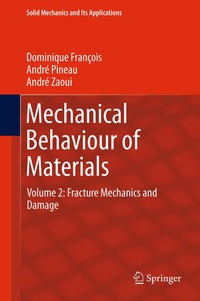
Mechanical Behaviour of Materials
Description

Designing new structural materials, extending lifetimes and guarding against fracture in service are among the preoccupations of engineers, and to deal with these they need to have command of the mechanics of material behaviour. This ought to reflect in the training of students. In this respect, the first volume of this work deals with elastic, elastoplastic, elastoviscoplastic and viscoelastic behaviours; this second volume continues with fracture mechanics and damage, and with contact mechanics, friction and wear. As in Volume I, the treatment links the active mechanisms on the microscopic scale and the laws of macroscopic behaviour. Chapter I is an introduction to the various damage phenomena. Chapter II gives the essential of fracture mechanics. Chapter III is devoted to brittle fracture, chapter IV to ductile fracture and chapter V to the brittle-ductile transition. Chapter VI is a survey of fatigue damage. Chapter VII is devoted to hydrogen embrittlement and to environment assisted cracking, chapter VIII to creep damage. Chapter IX gives results of contact mechanics and a description of friction and wear mechanisms. Finally, chapter X treats damage in non metallic materials: ceramics, glass, concrete, polymers, wood and composites. The volume includes many explanatory diagrams and illustrations. A third volume will include exercises allowing deeper understanding of the subjects treated in the first two volumes.
More details
Other editions
Additional editions

Previous edition
Content
Foreword.- Acknowledgements.- 1. Various Types of Damage.- 2. Fracture Mechanics.- 3. Brittle Fracture.- 4. Ductile Fracture.- 5. Ductile-Brittle Transition.- 6. Fatigue.- 7. Environment Assisted Cracking.- 8. Creep-Fatigue-Oxidation Interactions.- 9. Contact Mechanics; Friction and Wear.- 10. Damage and Fracture of Non-metallic Materials.-Appendix A: Diffusion Coefficients.- Author Index.- Subject Index.
