

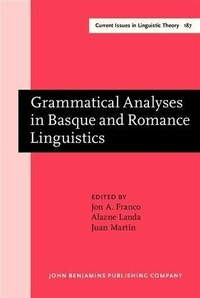
Grammatical Analyses in Basque and Romance Linguistics
Papers in honor of Mario Saltarelli
1st Edition
Published on 15. September 1999
VIII, 306 pages
978-90-272-8378-8 (ISBN)
Description

This volume contains fifteen articles on current theoretical issues in Basque and Romance linguistics. Even though Basque and Romance languages are typologically different and have different genetic origins, one thousand years of coexistence have shown certain parallelisms in their respective grammars. It is Mario Saltarelli that first offered a formal linguistic account of phonological and syntactic phenomena that occur in these two language groups. Thus, this compilation of articles in both Basque and Romance linguistics not only pays tribute to Saltarelli's work by acknowledging his formalization of this relational insight, but also comprises state of the art research on languages with strong geographical and historical kinship.Fifteen reviewed articles written by sixteen top scholars in the field provide fresh analyses of long standing challenging phenomena in Romance and Basque linguistics such as geminates, the evolution of Basque plosives, clitic doubling, clitic clustering, directionality of clitization, the role of agreement, focus, the interaction of voice and aspect, unaccusativity, semantic interpretation and syntactic structure of Determiner Phrases, obviation, control, and anaphoric and pronominal binding. This variety of topics however is unified by limiting the contributions to the four major formal areas of linguistics, and to one single framework, Generative Grammar, although in some of its many incarnations such as Minimalism, Optimality Theory, and Relational Grammar. All this, along with the number of languages covered by the authors (Aragonese, Basque, Catalan, French, Galician, Gascon, Italian and many of its dialects (Ligurian, Piedmontese, Tuscan.), Classical and Late Latin, Occitan, Brazilian and European Portuguese, Romanian, Old and Modern Spanish among others), makes the book of great value to any linguist working in Romance or Basque linguistics.
More details
Other editions
Additional editions
Jon A. Franco | Alazne Landa | Juan Martin
Grammatical Analyses in Basque and Romance Linguistics
Papers in honor of Mario Saltarelli
Book
09/1999
John Benjamins Publishing Co
€127.20
Shipment within 10-15 days
Persons
Content
- GRAMMATICAL ANALYSESIN BASQUE AND ROMANCE LINGUISTICS
- Editorial page
- Title page
- Copyright page
- Table of contents
- Preface
- ANAPHORA AND SOFT CONSTRAINTS
- 0. Introduction
- 1. Hierarchy 1: referential economy
- 2. Hierarchy 2: optimal agreement
- 3. Hierarchy 3: blocks and antecedents
- 4. Hierarchy 4: avoid structure
- 5. Interacting hierarchies
- 6. The handle on cross-linguistic variation
- 7. Conclusion
- REFERENCES
- PASSIVECONSTRUCTIONS AND PARTITIVE CASE CHECKING IN SPANISH
- 0. Introduction
- 1. Previous analyses
- 2. The Spanish passive auxiliary and the past participle as a complex verbal unit
- 3. English vs. Spanish existential passives
- 4. Definite subject in Spanish passive constructions
- 5. Concluding remarks
- REFERENCES
- DECONSTRUCTING WEAK CROSSOVER
- 0. Introduction
- 1. The status of Quantifier Raising
- 2. Previous approaches
- 3. The embedding problem
- 4. The determinateness problem
- 5. Supporting evidence
- 6. Reconsidering the embedding problem
- REFERENCES
- A MINIMAL ACCOUNT OF SPANISH ADJECTIVE POSITION AND INTERPRETATION
- 0. Introduction
- 1. Prenominai adjectives in DPs
- 2. On Adjective Movement from a small clause to a DEGP
- REFERENCES
- PRE-BASQUE PLOSIVES
- 0. Introduction
- 1. Internal reconstruction
- 2. The treatment of the plosives in the adaptation of borrowings from Latin and Romance
- 3. The standard account: Martinet and Michelena
- 4. Summary
- REFERENCES
- A UNIFIED APPROACH TO CONTROL AND OBVIATION
- 0. Introduction
- 1. Case-marking of CP complements
- 2. Exceptional Case Marking (ECM)
- 3. Obviation in subjunctive complement clauses
- 4. Control in infinitival complements
- 5. Control with double object verbs
- 6. Conclusions
- REFERENCES
- THETA BINDING AND THE SEMANTICS OF NPs IN ROMANCE THE AFFECTEDNESS CONDITION REVISITED
- 0. Introduction
- 1. Previous studies
- 2. Towards a re-interpretation of the Affectedness Constraint
- 3· Affectedness effects in Spanish passive nominals and Quantifier Raising
- REFERENCES
- TUSCAN GEMINATES AND TROCHAIC FEET
- 0. Introduction
- 1. Syncope
- 2. The question of vowel length and the Latin stress rule
- 3. Consequencesf or the metrical foot
- 4. The trimoraic trochee as a phonological domain
- 5. Conclusion
- REFERENCES
- UNACCUSATIVE AND ANTIPASSIVE CONSTRUCTIONS IN BASQUE AND SPANISH
- 0. Introduction
- 1. The unaccusative hyphotesis and reflexive morphology
- 2. Spanish reflexive predicates
- 3. The problem
- 4. Antipassivein Basque
- 5. Towards a solution: reflexive antipassive
- 6. Conclusion
- REFERENCES
- FORCE PHRASES, FOCUS PHRASES AND LEFT HEADS IN BASQUE
- 0. Introduction
- 1. Interrogative ea as an illocutionaryf orce marker
- 2. Cooccurrence restrictions
- 3. Ea as a head
- REFERENCES
- ON AGREEMENT AND CASE
- 0. Introduction
- 1. S/O Agreement and Case in Romance
- 2. Participle Agreement in Romance
- 3. Passive constructions
- 4. Passivization of double object constructions
- 5. Passive in other languages
- 6. Case in Old Greek
- 7. Verb Agreement and Abstract Case in Swahili
- REFERENCES
- DIRECTIONALITY OF CLITICIZATION IN EUROPEAN PORTUGUESE: LEFT OR RIGHT?
- 1. Conflicting data on directionality of attachment
- 2. The landing site of cliticization in EP
- 3. Properties of F in Western Iberian dialects
- 4. F as an enclitic
- 5. F as a morphological host: enclisis
- 6. Portuguese versus Spanish
- 7. Conclusion
- REFERENCES
- CLITIC-DOUBLING OF STRONG PRONOUNS IN SPANISH AN INSTANCE OF OBJECT SHIFT
- 0. Introduction
- 1. (Im)possible clitic-chains with strong pronominals
- 2. The interpretation of strong pronominals
- 3. Crosslinguistic variation and the mapping hypothesis
- 4. CL-doubling Structures
- REFERENCES
- CLITIC CLUSTERS IN ROMANCE A MODEST ACCOUNT
- 1. DEDICATIO
- 2. A marginal problem
- 3. Original perspective
- 4. Dimensions of clitic order
- 5. Principles
- 6. Constructing a solution
- 7. Clitic ordering: why?
- 8. Clitic ordering: how?
- 9. Conclusion
- REFERENCES
- VOICE AND ASPECT
- 0. Introduction
- 1. Lexical aspect, argument mapping and voice
- 2. Aspect and active voice
- 3. Aspect and passive voice
- 4. Conclusions
- REFERENCES
- INDEX OF AUTHORS
- INDEX OF TERMS & CONCEPTS
