

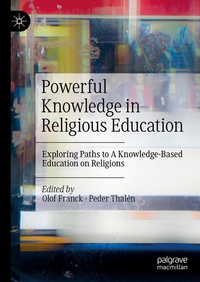
Powerful Knowledge in Religious Education
Description

This book unites and explores different approaches to understand and develop knowledge-based religious education. While the importance of methodological issues in RE is understood and acknowledged, the editors and contributors interrogate what kind of knowledge should be explored, how this knowledge is defined and what the consequences would be. Subsequently, the book focuses on the concept of powerful knowledge which transcends students' everyday experiences, and how it can be incorporated into the RE curriculum. Drawing together international research from RE teaching and learning, the book explores various paths to integrate a truly knowledge-based religious education. The book will appeal to students and scholars of religious education, sociology of education and the philosophy of religion.
More details
Other editions
Additional editions
Persons
Olof Franck is Professor of Subject Matter of Education in the Department of Pedagogical, Curricular and Professional Studies at the University of Gothenburg, Sweden.
Peder Thalén is a professor at the University of Gävle, Sweden.Content
Chapter 1. Powerful Knowledge in Religious Education? Perspectives in conversation with Michael Young and Paulo Freire.- Chapter 2. Powerful Knowledge in Ethics and Existential Questions -Which Discourses, for Which Pupils, in Which Contexts?.- Chapter 3. Powerful Knowledge in Non-denominational Religious Education: Some Considerations on the Relationship Between Curriculum and Pedagogy.- Chapter 4. International Knowledge Transfer in Religious Education and the debate on Powerful Knowledge.- Chapter 5. Knowledge-based teaching about religious diversity: a new approach in the "Culture and citizenship in Québec".- Chapter 6. Powerful knowledge or Big Ideas in Religious Education? Aims and classroom approaches.- Chapter 7. The role of knowledge, knowledge processes and experience in the RE curriculum.- Chapter 8. Religion: a legitimate Anomaly in Education?.- Chapter 9. Subject-specific core knowledge and skills in the academic study of religion(s) and religious education in theory and practice.- Chapter 10. Worldview Literacy as Transformative Knowledge.- Chapter 11. RE and the Complexity of the Knowledge Problem(s).-
