

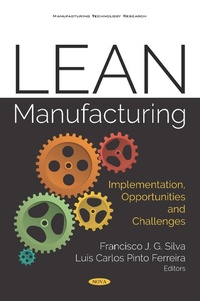
Lean Manufacturing: Implementation, Opportunities and Challenges
Published on 8. July 2019
478 pages
978-1-5361-5726-0 (ISBN)
Description

The paradigm of manufacturing is undergoing a major evolution throughout the world. The use of computers, the Internet and new challenges related to the Industry 4.0 have changed the way we engineer and manufacture products. Improving production with Lean Thinking is an evolution of a traditional approach in order to improve its processes to remain competitive in the global market. Lean Manufacturing is a multidimensional approach that embraces a wide variety of management practices in a unified system. These practices contain, quality systems, teamwork, and supplier management, among others. Nowadays, other practices have been adopted such as human factors and ergonomics. This book presents contributions of Lean Manufacturing applications in the world development and is intended to provide a comprehensive view of issues related to this area, with a specific focus on lean engineering principles; it is full of practical production examples of how Lean Thinking can be applied effectively to production systems. This work was conceptualized for an audience of graduate students mainly; however, it can also be consulted by engineers and company managers who seek state-of-the-art applications on Lean Manufacturing within a wide diversity of scenarios and conditions. The book, organized into 17 chapters, is intended to be an excellent source for dissemination of applied researches, lean concepts, and practices that have been successfully applied in the developing world domain. The book is also an excellent example of academy purpose with collaboration between different institutions from different countries that provide a global approach.
More details
Other editions
Additional editions
Francisco J. G. Silva | Luis Carlos Pinto Ferreira
Lean Manufacturing
Implementation, Opportunities and Challenges
Book
07/2019
Nova Science Publishers Inc
€355.04
Shipment within 15-20 days
Content
- Intro
- Contents
- Foreword
- Acknowledgments
- Chapter 1
- Lean Thinking across the Company: Successful Cases in the Manufacturing Industry
- Abstract
- 1. Introduction
- 2. Theoretical Background
- 2.1. Value-Added Activities and Wastes
- 2.2. Some Lean Methods and Tools
- 2.3. Lean Applied across the Company
- 2.3.1. About Lean in Logistics
- 2.3.2. About Lean in Information Flows
- 2.3.3. About Lean in Ergonomics
- 3. Case Studies Showing Lean Applied across the Company
- 3.1. Introduction and Companies' Contextualization
- 3.2. Cases of Lean Applied to Logistics and Production
- 3.2.1. The Case of Company A
- 3.2.2. The Case of Company B
- 3.2.3. The Case of Company C
- 3.2.4. The Case of Company D
- 3.3. Cases of Lean Applied to Information Flow
- 3.3.1. The Case of Company E
- 3.3.2. The Case of Company F
- 3.3.3. The Case of Company G
- 3.4. Cases of Lean Applied to Ergonomics
- 3.4.1. The Case of Company H.1
- 3.4.2. The case of Company H.2
- 3.4.3. The Case of Company I
- Conclusion and Future Work
- Acknowledgments
- References
- Chapter 2
- From the Factory Floor to New Product Development: Development and Implementation of a Lean Assessment Tool
- Abstract
- 1. Introduction
- 2. Theory: Lean in the Perspective of New Product Development Fundamentals
- 2.1. Some Definitions of Innovation, Product Development and Value
- 2.2. Some Fundamental Differences between Manufacturing and NPD
- 2.3. Lean from the Manufacturing Floor to the Product Developer's Desk
- 2.4. Comparison of Traditional PD and Lean PD
- 3. A Lean Product Development Model
- 4. A Lean Maturity Assessment Tool: Process and Structure
- 5. Case Study: The Impact of Business Context on LPD Gap Identifications
- 5.1. Contextual PD Dimensions
- 5.2. Results from Assessment
- Conclusion
- References
- Chapter 3
- Benefits and Challenges of Lean Manufacturing in Make-to-Order Systems
- Abstract
- 1. Introduction
- 1.1. Background: Lean Manufacturing in MTO Systems
- 2. Labour Flexibility: Benefits and Challenges
- 2.1. Case System 1: Assembly Line
- 2.2. Case System 2: A Job Shop
- 2.3. Certain Models at Certain Workstations
- 2.4. Any Model at Certain Workstations
- 2.5. Certain Models at Any Workstation
- 2.6. Any Model at Any Workstation
- 3. Manufacturing System Flexibility: Benefits and Challenges
- 3.1. Dedicated Machine Systems
- 3.2. Flexible Manufacturing Systems
- 3.3. Reconfigurable Manufacturing Systems
- 3.4. Manufacturing System Layout
- 4. Current Implications for Lean Manufacturing in Make-to-Order Systems
- 4.1. Outlook: Impact of Industry 4.0 and Other Evolving Technologies
- Conclusion
- References
- Chapter 4
- Sustaining Lean in Organizations through the Management of Tensions and Paradoxes
- Abstract
- 1. Introduction
- 2. Types of Organizational Paradoxes
- 3. The Management of Organizational Paradoxes
- 4. Case 1. The Financial Company (Denmark)
- 4.1. The Organizing Paradox
- 4.2. The Belonging Paradox
- 5. Case 2. The Cancer Department at a University Hospital
- 5.1. The Organizing Paradox
- 5.2. The Performing Paradox
- 6. Case 3. The Garment Manufacturer in Bangladesh
- 6.1. Learning Paradox
- 6.2. Performing Paradox
- Conclusion and Recommendations
- References
- Chapter 5
- The Impact of 5S + 1S Methodology on Occupational Health and Safety
- Abstract
- 1. Introduction
- 2. Occupational Safety
- 2.1. Hazards and Risks
- 2.2. Risk Assessment
- 2.3. Industrial Vehicles
- 3. Lean Thinking
- 3.1. 5S
- 3.2. 6S
- 4. Research Methodology
- 5. Case Study
- 5.1. Initial State
- 5.1.1. Sorting Space Safety
- 5.1.2. 5S Implementation
- 5.2. The Impact of 5S on Safety
- Conclusion
- References
- Chapter 6
- Value of Real-Time Data for Cycle Time Optimisation at Wet Tools
- Abstract
- 1. Introduction
- 1.1. Organisation of the Chapter
- 2. Literature Review
- 3. Wet Station Description
- 4. System Modelling
- 4.1. Model Validation
- 5. Assignment Strategies
- 6. Preliminary Findings
- 7. Assignment Strategies Generalisation to More Complex Scenarios
- 8. Results
- 9. Discussion
- Conclusion
- Acknowledgments
- References
- Chapter 7
- The Eighth Waste: Non-Utilized Talent
- Abstract
- 1. Introduction
- 1.1. Background
- 2. Methodology
- 3. Results
- 3.1. Rewards
- 3.2. Recognition
- 3.3. Justice
- 3.4. Motivation
- 3.5. Training and Knowledge
- 3.6. Goals
- 3.7. Evaluation Feedback
- 3.8. Self-Esteem
- 3.9. Resources
- 3.10. Assessment of the Eighth Waste
- Conclusion
- References
- Chapter 8
- Quality and Safety Continuous Improvement through Lean Tools
- Abstract
- 1. Introduction
- 2. Case Study
- 2.1. Presentation of One Company Situation
- 3. The Use of Lean Tools
- 3.1. Value Stream Mapping
- 3.2. A3 - Problem Solving
- 3.3. Daily Kaizen
- 3.4. 5S
- 3.5. Standard Work
- 3.6. On Point Lesson (OPL)
- 3.7. Visual Management
- 3.8. Andon
- 3.9. Heijunka
- 3.10. Kanbans
- 3.11. Jidoka
- 3.12. Poka-Yoke
- 3.13. Milkrun
- 3.14. Overall Equipment Effectiveness (OEE)
- 3.15. Single-Minute Exchange of Die (SMED)
- 3.16. Yokoten
- 3.17. Total Productive Maintenance (TPM)
- 4. TPM and a Connected Industry (Industry 4.0)
- 5. Quality Continuous Improvement - Leading Excellence with TQM and IMS
- 6. Lean Safety - Integrating Lean Production with Safety Management
- Conclusion
- Acknowledgments
- References
- Chapter 9
- Lean Manufacturing Applied to the Production and Assembly Lines of Complex Automotive Parts
- Abstract
- 1. Introduction to Automotive Industry
- 1.1. The Global Context of the Automotive Industry
- 1.2. The Importance of the Automotive Sector in World Economy
- 2. The Manufacture of Components for the Automotive Industry
- 3. Command Cables for Car Vehicles
- 3.1. The Makeup of Command Cables
- 4. Problems and Waste
- 5. Best Lean Tools Devoted to Component Production for the Automotive Industry
- 5.1. Kaizen
- 5.2. VSM
- 5.3. Visual Management
- 5.4. 5S
- 5.5. Standard Work
- 5.6. SMED
- 5.7. PDCA
- 6. Case Study
- 6.1. Definition of the Product
- 6.2. Definition of the lines
- 6.3. Problems and Wastes Identification
- 6.4. Methodology
- 6.5. Applying Lean Tools
- 6.6. Results and Critical Analysis
- Conclusion
- Suggestions for Future Work
- References
- Chapter 10
- SMED Applied to Composed Cork Stoppers
- Abstract
- 1. Introduction
- 2. Cork
- 2.1. Cork as a Natural Material
- 2.2. Cork Stoppers Industry
- 2.3. Types of Cork Stoppers
- 2.4. Composed Stoppers
- 3. Composed Stoppers Manufacturing Process
- 3.1. Work-Flow
- 3.2. Equipment
- 4. The Problem and the Challenge
- 4.1. Wastes Identification Trough VSM Tool
- 4.2. A3 Report
- 4.3. Internal and External Tasks
- 4.4. Equipment Improvements
- 5. Measuring the Benefits
- 6. Start of OEE Calculation
- Conclusion
- References
- Chapter 11
- Lean Production in the Portuguese Textile and Clothing Industry: The Extent of Its Implementation and Role
- Abstract
- 1. Introduction
- 2. Context Study
- 3. Literature Review
- 4. Research Methodology
- 4.1. Questionnaire Design and Implementation
- 4.1.1. Target Population
- 4.1.2. Design, Validation, and Distribution Methodology
- 4.1.3. Objectives of the Main Parts and Sections
- 4.2. Interviews Preparation and Implementation
- 5. Results, Analysis, and Discussion
- 5.1. Questionnaire Results and Discussion
- 5.1.1. Companies' Production Models
- 5.1.2. Awareness of LP and Related Concepts and Tools
- 5.1.3. LP Implementation and Implementation Process
- 5.1.4. Satisfaction Level and Understanding of LP
- 5.2. Follow-Up Interviews Results and Discussion
- 5.3. Discussion and Limitations
- Conclusion
- References
- Chapter 12
- Lean Manufacturing Applied to a Complex Electronic Assembly Line
- Abstract
- 1. Introduction
- 2. Literature Review
- 2.1. Value Stream Mapping (VSM)
- 2.2. Lean Line Design (LLD)
- 2.3. Balancing Line
- 2.4. Single Minute Exchange of Die (Quick Changeover)
- 2.5. DMAIC (Define, Measure, Analyse, Improve and Control)
- 3. Methodology
- 4. Case Study - Current State
- 4.1. Applying Value Stream Mapping (VSM) to Define the Current State
- 4.2. Using Lean Line Design (LLD) to Describe the Current State
- 4.2.1. Current State
- 4.2.1.1. Man
- 4.2.1.2. Machine
- 4.2.1.3. Method
- 4.2.1.4. Environment
- 4.2.1.5. Layout Analysis
- 4.2.1.6. Line Balancing Process Analysis
- 4.2.2. Production Process Optimization
- 4.2.2.1. Assembly Fixtures
- 4.2.2.2. Workstation 01 - Pan Motor Preparation
- 4.2.2.3. Workstation 02 - Tilt Motor Preparation
- 4.2.2.4. Workstation 03 - Wiper Motor Preparation
- 4.2.2.5. Workstation 04 - Pan Stage I Assembly
- 4.2.2.6. Workstation 05 - Pan Stage II Assembly
- 4.2.2.7. Workstation 07 - Tilt Center I Assembly
- 4.2.2.8. Workstation 08 - Tilt Center II Assembly
- 4.2.2.9. Workstation 09 - Camera Module Assembly
- 4.2.2.10. Workstation 10 - Front Shell Assembly
- 4.2.2.11. Workstation 11 - Rear Shell Assembly
- 4.2.2.12. Workstation 12 - Final Assembly
- 4.2.2.13. Workstation 15 - Leak Test
- 4.3. Results and Discussion about the Current State
- 5. Case Study - Improving Solutions
- 5.1. Applying Lean Line Design (LLD)
- 5.1.1. Improvement Solutions
- 5.1.1.1. First Scenario
- 5.1.1.2. Second Scenario
- 5.1.1.3. Third Scenario
- 5.1.1.4. Fourth Scenario
- Properties Collection of Layouts Purpose
- Attributes Table
- Matrix Selection Method
- 5.2. Production Process Optimization
- 5.2.1. Man
- 5.2.2. Machine
- 5.2.3. Method
- 5.2.4. Environment
- 5.3. Improvements Solutions
- 5.3.1. Assembly Fixtures Improvement
- 5.3.1.1. Workstation 01 - Pan Motor Preparation
- 5.3.1.2. Workstation 02 - Tilt Motor Preparation
- 5.3.1.3. Workstation 03 - Wiper Motor Preparation
- 5.3.1.4. Workstation 04 - Pan Stage I Assembly
- 5.3.1.5. Workstation 05 - Pan Stage II Assembly
- 5.3.1.6. Workstation 07 - Tilt Center I Assembly
- 5.3.1.7. Workstation 08 - Tilt Center II Assembly
- 5.3.1.8. Workstation 09 - Camera Module Assembly
- 5.3.1.9. Workstation 10 - Front Shell Assembly
- 5.3.1.10. Workstation 11 - Rear Shell Assembly
- 5.3.1.11. Workstation 12 - Final Assembly
- 5.3.1.12. Workstation 15 - Leak Test
- 6. Results and Discussion
- 6.1. Results and Discussion of the LLD Implementation
- 6.2. Conclusion and Discussion Production Process Optimization
- Conclusion
- References
- Chapter 13
- Karakuri: The Application of Lean Thinking in Low-Cost Automation
- Abstract
- 1. Principles of Lean Production
- 2. Principle of Produce only According to Demand
- 3. Produce on Demand
- 4. Pull System Method
- 4.1. ABC/XYZ Analysis
- 4.2. Just in Time
- 4.3. Kanban
- 4.4. Milk Run
- 4.5. Supermarkets
- 4.6. Vendor Managed Inventory
- 4.7. Karakuri
- 5. Karakuri Technique
- 6. Physics - Mechanical Structures Designed with Simplicity
- 6.1. Inclined Plane
- 6.2. Levers
- 7. Ergonomic Aspects
- 8. Internal Logistics and the Handling of Materials
- 8.1. Productivity
- 8.2. Kaizen Tool
- 9. Karakuri Concepts in Lean Internal Logistics
- 10. Advantages of Karakuri Application
- Conclusion
- References
- Chapter 14
- Lean and Ergonomics: How to Increase the Productivity Improving the Wellbeing of the Workers - A Case Study
- Abstract
- 1. Introduction
- 2. Problem Description
- 2.1. Products: General Description
- 2.2. Products: Specifications
- 2.2.1. Radiators M and H
- 2.3. Integrus (Case/Cabinet)
- 3. Methodology
- 4. Brainstorming
- 5. Ideas Implementation
- 5.1. Radiators
- 5.1.1. Supply
- 5.1.2. Encasing
- 5.1.3. Testing
- 5.1.4. Packing
- 5.1.5. Loading the Supply Car
- 5.2. Integrus Case
- 5.2.1. Unloading the Case onto the Electric Scissor Lifter
- 5.2.2. Textplate/Chargers Assemble
- 5.2.3. Testing
- 5.2.4. Loading the Supply Car
- 5.3. Integrus Cabinet
- 5.3.1. Unloading the Case onto the Electric Scissor Lifter
- 5.3.2. Textplate/Chargers Assemble
- 5.3.3. Testing
- 5.3.4. Loading the Supply Car
- 5.4. DDI
- 6. Results and Discussion
- Conclusion
- References
- Chapter 15
- Measurement of the Level of Implementation of Sociotechnical and Ergonomic Practices and Lean Production Practices: Considerations from a Systematic Review Process
- Abstract
- 1. Introduction
- 2. Methodological Procedures
- 2.1. Methodological Framework
- 2.2. Knowledge Development Process - Construtivist (Proknow-C)
- 2.3. Procedures for Collecting and Analyzing Data
- 2.4. Bibliometric Analysis of the Bibliographic Portfolio (BP)
- 2.5. Systemic Analysis of the Articles in the Bibliographic Portfolio
- 3. Results
- 3.1. PB Bibliometric Analysis
- 3.2. PB Systemic Analysis - Constitutive and Operational Definitions
- 3.2.1. Elements that Compose the Construct for Lean Production Practices (LP)
- 3.2.2 Elements of the Construct for Sociotechnical and Ergonomic Practices (SE)
- 4. Final Remarks
- Appendix A- Bibliographic Portfolio - PB
- References
- Chapter 16
- Lean Manufacturing and Industry 4.0: Facing New Challenges from a Shop-Floor Perspective
- Abstract
- 1. Objectives of This Chapter
- 2. Operational Excellence and Lean Manufacturing: From Japanese Origins to the American Reinterpretation
- 3. Evolution of Lean Manufacturing and Today's Main Challenges
- 4. Information Technology as a Driver of Change
- 5. Cleaner Technologies as a Driver of Change
- 6. Final Reflections
- References
- Chapter 17
- Lean Healthcare in a Cancer Chemotherapy Unit: Implementation and Results
- Abstract
- 1. Introduction
- 2. Literature Review
- 2.1. Lean Healthcare: Fundamental Concepts
- 2.2. The Literature Related to Lean Healthcare
- 3. The Implementation of Lean Healthcare in the Studied Hospital
- 3.1. The Implementation Method
- 3.2. The Studied Hospital
- 3.3. Description of the Implementation Phases
- 3.3.1. Phase 1: Defining the Scope
- 3.3.2. Phase 2: Measuring and Mapping the Initial Situation
- 3.3.3. Phase 3: Analyzing the Current Situation and Developing the Future Situation
- 3.3.4. Phase 4: Implementing the Future Situation
- 3.3.4.1. Kaizen in the APAC Information Stream
- 3.3.4.2. Kaizen in the Blood Exams
- 3.3.4.3. Kaizen in Triage (SIGA and Indications)
- 3.3.4.4. Kaizen in Chemotherapy
- 3.3.5. Phase 5: Controlling the Process
- Conclusion
- References
- About the Editors
- Index
- Blank Page
