

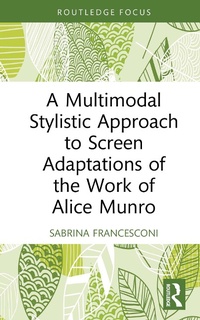
A Multimodal Stylistic Approach to Screen Adaptations of the Work of Alice Munro
1st Edition
Published on 27. December 2022
146 pages
978-1-000-85090-1 (ISBN)
Description

This volume brings together perspectives from multimodal stylistics and adaptation studies for a unified theoretical analysis of adaptations of the work of Alice Munro, demonstrating the affordances of the approach in furthering interdisciplinary research at the intersection of these fields
The book considers films and television programmes as complex multimodal stylistic systems in and of themselves in order to pave the way for a clearer understanding of screen adaptations as expressions of modal, medial, and aesthetic change. In focusing on Munro, Francesconi draws attention to a writer whose body of work has been adapted widely across television and film for an international market over several decades, offering a diachronic overview and insights into the confluence of socio-cultural contexts, audiences, and dynamics of production and distribution across adaptations. The volume complements this perspective with a microanalysis of the adaptations themselves, exploring the varied creative use of audio-visual dimensions, including sound, light, and movement. The book seeks to overcome simplified fidelity-based understandings of screen adaptations more broadly, showcasing creative multi-layered approaches to a creator's oeuvre to effect true transformation across media and modes.
The volume will be of interest to scholars in multimodality, adaptation studies, film studies, and comparative literature.
The book considers films and television programmes as complex multimodal stylistic systems in and of themselves in order to pave the way for a clearer understanding of screen adaptations as expressions of modal, medial, and aesthetic change. In focusing on Munro, Francesconi draws attention to a writer whose body of work has been adapted widely across television and film for an international market over several decades, offering a diachronic overview and insights into the confluence of socio-cultural contexts, audiences, and dynamics of production and distribution across adaptations. The volume complements this perspective with a microanalysis of the adaptations themselves, exploring the varied creative use of audio-visual dimensions, including sound, light, and movement. The book seeks to overcome simplified fidelity-based understandings of screen adaptations more broadly, showcasing creative multi-layered approaches to a creator's oeuvre to effect true transformation across media and modes.
The volume will be of interest to scholars in multimodality, adaptation studies, film studies, and comparative literature.
More details
Series
Edition
1. Auflage
Language
English
Place of publication
London
United Kingdom
Publishing group
Taylor & Francis Ltd
Target group
College/higher education
Professional and scholarly
Product notice
Reflowable
Illustrations
1 Tables, black and white; 3 Line drawings, black and white; 6 Halftones, black and white; 9 Illustrations, black and white
ISBN-13
978-1-000-85090-1 (9781000850901)
Copyright in bibliographic data and cover images is held by Nielsen Book Services Limited or by the publishers or by their respective licensors: all rights reserved.
Schweitzer Classification
Other editions
Additional editions
Sabrina Francesconi
A Multimodal Stylistic Approach to Screen Adaptations of the Work of Alice Munro
Book
08/2024
1st Edition
Routledge
€33.00
Shipment within 10-20 days
Sabrina Francesconi
A Multimodal Stylistic Approach to Screen Adaptations of the Work of Alice Munro
Book
12/2022
1st Edition
Routledge
€71.80
Shipment within 10-20 days
Person
Sabrina Francesconi is Associate Professor of English Linguistics at the University of Trento. Her research interests are tourism and heritage discourses, adaptation studies, Canadian studies, humour studies, multimodal analysis, multimodal genre analysis, multimodal stylistics, and systemic-functional stylistics.
Content
Contents
0. Introduction
Adapting Clothes, Peaches and Stories
A Panoramic Shot over Adaptations
Dissemination of Preliminary Results
Volume Outline
Chapter 1. Adaptation(s)
Towards a Definition
The Limits and Risks of Fidelity
Intertextual Connections
Engaging Readers and Spectators
Adaptation as Process and as Product
Chapter 2. Multimodal Stylistic Analysis
Multimodal Stylistics
A Socio-semiotic Metafunctional Framework
Forms and Functions of Speech
Film Dialogues and the Voice-in
Screen/Story Boundaries and The Voice-over
Lyrics, Volume, Melodies
Words on the Screen
Size of Frame and Angles
Movements
Colour and Light Choices and Changes
Beyond the Shot
Chapter 3. Short Canadian Films
Boys and Girls
Gender and/as Space Representation
Thanks for the Ride
Film Music Framing Theme, Time and Tone
All about Connection
The Voice-over across Time
Chapter 4. Extended Canadian Works
Lives of Girls and Women
Del's Relationship with her Mother
There is a Change Coming
Writing Things down
Struggle for Cohesion
Edge of Madness
"A Wilderness Station" as Historiographic Metafiction
Patterns of Adaptation
Closing in on Madness
Changes in the Film Adaptation
Away from Her: Closeness and Distance
Fiona's Approach to her Illness
Grant as Husband, Caregiver, and Focaliser
The Canadian Culture
Chapter 5. International Screen Adaptations
Bending Fate in Hateship Loveship
Ankle Socks and Robust Shoes: Johanna
Writing Letters as Writing Life
Juliet Travelling to Spain
Almodovar's Story of Adaptation(s)
Julieta's Letter-writing Scenes
Making Logical Connections Clear
From Canada to Canaan: An Iranian Journey
Criss-crossing Characters
A Disturbance, a Definite Picture, a Dream
From Unpainted Houses to the Promised Land
Concluding Remarks
Index
0. Introduction
Adapting Clothes, Peaches and Stories
A Panoramic Shot over Adaptations
Dissemination of Preliminary Results
Volume Outline
Chapter 1. Adaptation(s)
Towards a Definition
The Limits and Risks of Fidelity
Intertextual Connections
Engaging Readers and Spectators
Adaptation as Process and as Product
Chapter 2. Multimodal Stylistic Analysis
Multimodal Stylistics
A Socio-semiotic Metafunctional Framework
Forms and Functions of Speech
Film Dialogues and the Voice-in
Screen/Story Boundaries and The Voice-over
Lyrics, Volume, Melodies
Words on the Screen
Size of Frame and Angles
Movements
Colour and Light Choices and Changes
Beyond the Shot
Chapter 3. Short Canadian Films
Boys and Girls
Gender and/as Space Representation
Thanks for the Ride
Film Music Framing Theme, Time and Tone
All about Connection
The Voice-over across Time
Chapter 4. Extended Canadian Works
Lives of Girls and Women
Del's Relationship with her Mother
There is a Change Coming
Writing Things down
Struggle for Cohesion
Edge of Madness
"A Wilderness Station" as Historiographic Metafiction
Patterns of Adaptation
Closing in on Madness
Changes in the Film Adaptation
Away from Her: Closeness and Distance
Fiona's Approach to her Illness
Grant as Husband, Caregiver, and Focaliser
The Canadian Culture
Chapter 5. International Screen Adaptations
Bending Fate in Hateship Loveship
Ankle Socks and Robust Shoes: Johanna
Writing Letters as Writing Life
Juliet Travelling to Spain
Almodovar's Story of Adaptation(s)
Julieta's Letter-writing Scenes
Making Logical Connections Clear
From Canada to Canaan: An Iranian Journey
Criss-crossing Characters
A Disturbance, a Definite Picture, a Dream
From Unpainted Houses to the Promised Land
Concluding Remarks
Index
