

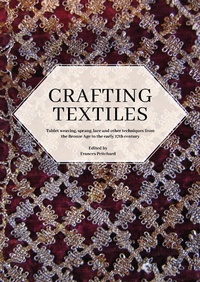
Crafting Textiles
Tablet Weaving, Sprang, Lace and Other Techniques from the Bronze Age to the Early 17th Century
Published on 13. October 2021
240 pages
978-1-78925-760-1 (ISBN)
Description

New research into the techniques of tablet weaving, sprang, braiding, knotting and lace is presented in this lavishly illustrated volume written by leading specialists from Austria, Canada, Denmark, France, Germany, Sweden, Switzerland, the UK, and USA. Drawing inspiration from the pioneering work of Peter Collingwood, this publication explores aspects of these craft skills in the prehistoric, Roman, and medieval world through scientific, object-based analysis and ''research through making''.
Chapters include the growth of patterned tablet weaving for trimming garments in prehistoric Central Europe; recently identified styles of headdress worn in the Roman Rhineland and pre-Islamic Egypt; Viking-age Dublin as a production center for tablet-woven bands; a new interpretation of the weaving technique used to make luxurious gold bands in the twelfth to late thirteenth centuries; and the development out of plaiting of bobbin lace borders in gold and silver threads from the fifteenth to early seventeenth centuries. Practical experiments test methods of hand spinning and the production of figure-hugging hose in ancient Greece and Renaissance Italy. A typology of braid and knotting structures in late medieval Europe is also set out for the first time. Diagrams, illustrations, and photographs enrich each chapter with a wealth of visual source material.
The work is the outcome of recent discoveries of archaeological textile finds from excavations as well as fresh examination of material recovered in the past, or preserved in treasuries. Early textiles form an increasingly popular subject of interest and this publication, which is a landmark in the study of various specialized textile techniques, aims to provide the reader with a better understanding of these virtuoso craft skills in antiquity.
Chapters include the growth of patterned tablet weaving for trimming garments in prehistoric Central Europe; recently identified styles of headdress worn in the Roman Rhineland and pre-Islamic Egypt; Viking-age Dublin as a production center for tablet-woven bands; a new interpretation of the weaving technique used to make luxurious gold bands in the twelfth to late thirteenth centuries; and the development out of plaiting of bobbin lace borders in gold and silver threads from the fifteenth to early seventeenth centuries. Practical experiments test methods of hand spinning and the production of figure-hugging hose in ancient Greece and Renaissance Italy. A typology of braid and knotting structures in late medieval Europe is also set out for the first time. Diagrams, illustrations, and photographs enrich each chapter with a wealth of visual source material.
The work is the outcome of recent discoveries of archaeological textile finds from excavations as well as fresh examination of material recovered in the past, or preserved in treasuries. Early textiles form an increasingly popular subject of interest and this publication, which is a landmark in the study of various specialized textile techniques, aims to provide the reader with a better understanding of these virtuoso craft skills in antiquity.
More details
Other editions
Additional editions
Frances Pritchard
Crafting Textiles
Tablet Weaving, Sprang, Lace and Other Techniques from the Bronze Age to the Early 17th Century
Book
09/2021
Oxbow Books
€67.04
Shipment within 3-4 weeks
Content
- Intro
- Contents
- Acknowledgements
- Introduction
- List of contributors
- In memoriam Peter Collingwood
- Section I Tablet weaving
- Chapter 1 'Tablet weaving is a small byway of textile production.': Bronze and Iron Age tablet bands with stripes, meanders and triangles from the salt mines in Austria
- Chapter 2 The use of weaving tablets in the production of headdresses in Egypt in the Roman and Byzantine periods: A study of a bourrelet from Antinoopolis
- Chapter 3 Evidence of tablet weaving from Viking-age Dublin
- Chapter 4 The so-called 'Palermo bands' and their technique
- Section II Sprang
- Chapter 5 Hairnets with gold tube beads from the Roman Rhineland and their textile technique
- Chapter 6 Sprang hairnets from the necropolis of Fag el-Gamous in the Fayum, Egypt
- Chapter 7 Tight-fitting clothing in antiquity and the Renaissance: Research and experimental reconstruction
- Section III Braiding and lace making
- Chapter 8 Braided strings and Turk's head knots on European secular and religious textiles
- Chapter 9 A unique survival: A woman's fifteenth-century headdress from Lengberg Castle, East Tyrol
- Chapter 10 From narrow four-strand plaits to openwork bobbin-made braids and edgings
- Section IV Spinning
- Chapter 11 The story of twist: Handspinning as a medieval craft
