

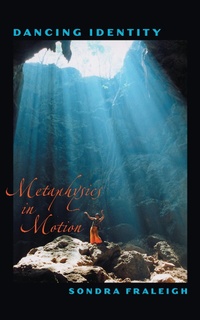
Dancing Identity
Metaphysics In Motion
Published on 12. January 2012
302 pages
978-0-8229-7088-0 (ISBN)
Description

Combining critical analysis with personal history and poetry, Dancing Identity presents a series of interconnected essays composed over a period of fifteen years. Taken as a whole, these meditative reflections on memory and on the ways we perceive and construct our lives represent Sondra Fraleigh's journey toward self-definition as informed by art, ritual, feminism, phenomenology, poetry, autobiography, and-always-dance.
Fraleigh's brilliantly inventive fusions of philosophy and movement clarify often complex philosophical issues and apply them to dance history and aesthetics. She illustrates her discussions with photographs, dance descriptions, and stories from her own past in order to bridge dance with everyday movement. Seeking to recombine the fractured and bifurcated conceptions of the body and of the senses that dominate much Western discourse, she reveals how metaphysical concepts are embodied and presented in dance, both on stage and in therapeutic settings.
Examining the role of movement in personal and political experiences, Fraleigh reflects on her major influences, including Moshe Feldenkrais, Kazuo Ohno, and Twyla Tharp. She draws on such varied sources as philosophers Simone de Beauvoir and Martin Heidegger, the German expressionist dancer Mary Wigman, Japanese Butoh founder Tatsumi Hijikata, Hitler, the Bomb, Miss America, Balanchine, and the goddess figure of ancient cultures. Dancing Identity offers new insights into modern life and its reconfigurations in postmodern dance.
Fraleigh's brilliantly inventive fusions of philosophy and movement clarify often complex philosophical issues and apply them to dance history and aesthetics. She illustrates her discussions with photographs, dance descriptions, and stories from her own past in order to bridge dance with everyday movement. Seeking to recombine the fractured and bifurcated conceptions of the body and of the senses that dominate much Western discourse, she reveals how metaphysical concepts are embodied and presented in dance, both on stage and in therapeutic settings.
Examining the role of movement in personal and political experiences, Fraleigh reflects on her major influences, including Moshe Feldenkrais, Kazuo Ohno, and Twyla Tharp. She draws on such varied sources as philosophers Simone de Beauvoir and Martin Heidegger, the German expressionist dancer Mary Wigman, Japanese Butoh founder Tatsumi Hijikata, Hitler, the Bomb, Miss America, Balanchine, and the goddess figure of ancient cultures. Dancing Identity offers new insights into modern life and its reconfigurations in postmodern dance.
More details
Other editions
Additional editions

Book
10/2004
University of Pittsburgh Press
€53.37
Article exhausted; check different version
Person
Sondra Horton Fraleigh chairs the Department of Dance at the State University of New York, Brockport. She is the author of Dance and the Lived Body and co-editor (with Penelope Hanstein) of Researching Dance: Evolving Modes of Inquiry. Her articles have been published in texts on dance and movement, philosophy, and cognitive development. She has been a guest teacher of dance and somatic therapy in America, Japan, England, and Norway. She has served as president of the Congress of Research in Dance and is a Faculty Exchange Scholar for the State University of New York. Her innovative choreography has been seen on tour in America, Germany, and Japan, where she has also been a visiting scholar at several universities.
Content
- Intro
- Contents
- Preface
- Introduction - Beauty's Ways
- Part I: Beginning
- Chapter 1: Embodying Metaphysics
- Chapter 2: First Sounds
- Chapter 3: Thickening Ambiguity
- Part II: Becoming
- Chapter 4: Anti-Essentialist Trio
- Chpter 5: A Dance of Time Beings
- Chapter 6: Letting the Happen Difference
- Part III: Descen-dance
- Chapter 7: Messy Beauty and Butoh Invalids
- Chapter 8: Existential Haircut
- Chapter 9: The Morality of Joy
- Notes
- Index
