

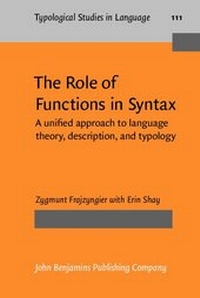
The Role of Functions in Syntax
A unified approach to language theory, description, and typology
1st Edition
Published on 15. March 2016
XII, 303 pages
978-90-272-6728-3 (ISBN)
Description

The main aim of this book is to address a fundamental question in linguistics, namely why languages are similar and why they are different. The study proposes that languages are fundamentally similar when they encode the same meanings in their grammatical systems and that languages are different when they encode different meanings. Even if languages encode the same meaning, they may differ with respect to the formal means used to code those meanings. This approach allows for a typology based on functional domains, subdomains and functions coded in individual languages. The outcome of the study is a unified approach to language theory, linguistic typology, and descriptive linguistics. The argumentation for the hypotheses and the proposed approach is supported by analyses of data from more than a dozen languages, including English, Polish, French, Wandala, Mina, Hdi, and several other Chadic languages. The study is accessible to a wide variety of linguists.
More details
Other editions
Additional editions
Zygmunt Frajzyngier | Erin Shay
The Role of Functions in Syntax
A unified approach to language theory, description, and typology
Book
03/2016
John Benjamins Publishing Co
€104.94
Shipment within 10-15 days
Persons
Content
- Intro
- The Role of Functions in Syntax
- Editorial page
- Title page
- LCC data
- Table of contents
- Acknowledgments
- List of abbreviations
- The importance of meaning for syntax
- 1. The aim of the book
- 2. A sample of open questions
- 3. Significance of the book
- 4. Content of the present volume
- Part I: Theoretical and methodological foundations of the approach
- Part II: Case studies
- Part III: Typology within the proposed approach
- Theoretical foundations of the proposed approach
- 1. Introduction
- 2. Semantic structure, functional domain and subdomain
- 3. Languages differ with respect to functional domains, subdomains, and meanings encoded in the grammatical system
- 4. Progressive aspect in English
- 5. Formal consequences of meaning encoded in the grammatical system
- 5.1 Consequences of the choice of forms
- 5.2 Constraints on lexical insertion
- 6. Factors affecting the realization of a meaning encoded in the grammatical system
- 6.1 Choice of lexical items affecting the realization of the meaning encoded in the grammatical system
- 6.2 Adverbial modification
- 6.3 The meaning of a lexical item and the benefactive predication
- 7. Interaction between two meanings encoded in the grammatical system
- 8. Principle of functional transparency: Its scope and consequences
- 9. Relationship between meaning encoded in the grammatical system and the structure of the lexicon
- 9.1 The motivation for lexical categories
- 9.2 Lexicalization of the categories 'noun' and 'verb'
- 9.3 Adjectives
- 10. Relationships among the meaning encoded in the grammatical system, the lexicon, and co-occurrence with other meanings encoded in the grammatical system
- 11. Similarities and differences across languages
- 12. Situating the present theory in relationship to other theories
- Why the meaning encoded in the grammatical system matters
- 1. Introduction
- 2. Locative predication vs. locative expressions
- 3. The evidence
- 3.1 The coding means in locative predications
- 3.2 Inherently locative predicate and inherently locative complement: Coding through juxtaposition
- 3.3 Inherently locative predicate and non-locative argument: Predicate PREP Noun
- 3.4 Non-locative predicate and inherently locative complement: Predicate á Noun
- 3.5 Non-locative predicate and non-locative complement: Predicate PRED PREP Noun
- 4. Consequences of encoding locative predication in the grammatical system: Genitive predication in the locative phrase
- 5. Conclusions
- 5.1 Conclusions concerning Mina
- 5.2 Theoretical conclusions
- Lexical and morphological coding means and their implications
- 1. Introduction
- 2. Lexical categories, subcategories, and derivational morphology
- 2.1 Lexical categories as a coding means
- 2.2 An open question in lexical categories: Ideophones
- 2.3 Motivation for lexical subcategories
- 3. Verbal extensions
- 4. Conclusions
- Linear orders as coding means
- 1. Introduction
- 2. Linear order in linguistic theory
- 3. Linear order as a formal domain
- 4. Default position for a lexical or grammatical category
- 5. The SV word order in English as a coding means
- 6. Coding by position
- 7. Coding by position in English
- 8. Position before the auxiliary or verb in French
- 9. Alternations in the default linear coding and the coding by position
- 10. Relative order as a coding means
- 11. Linear precedence
- 12. Conclusions
- A methodology for the discovery of meanings encoded in the grammatical system
- 1. Questions the methodology aims to address
- 2. Discovery of coding means
- 2.1 Discovery of lexical items with grammatical functions
- 2.2 Discovery of structures
- 3. Structural function versus meaning
- 3.1 Retention of the word-final vowel in Wandala
- 3.2 Complementizers 'that' in English and ze in Polish
- 4. Discovery of meaning
- 4.1 General principles
- 4.2 Reminder of theoretical assumptions
- 4.3 Discovering the domain: Lack of co-occurrence with other markers
- 4.4 Determining the function of the form: Coordinating conjunctions in English and Polish
- 4.5 The search for the function of the form doesn't have to be haphazard
- 4.6 The test of omission
- 4.7 The study of the distribution of a form
- 5. Search for other structures belonging to the same domain
- 6. The distinctive feature of a function
- 7. Two tools in semantic argumentation: Internal contradiction and tautology
- 8. A practical matter: The role of questionnaires in the discovery of forms and functions
- 9. Conclusions
- The distinction between the meaning encoded in the grammatical system and inferences from utterances
- 1. Aim and scope of the chapter
- 2. 'Affect' and 'affectedness' in linguistic literature
- 3. Background information about the structure of Mina
- 4. The question: A structure whose function is not obvious
- 5. Discourse function of the structure m V-yi
- 6. The semantic role of the subject and the structure m V-yi
- 6.1 Affectedness with intransitive verbs
- 6.2 Affectedness with inherently transitive verbs
- 7. Affectedness predication and the part-whole relationship
- 8. When the affectedness marking cannot be used
- 9. Conclusions and implications
- Indirectly affected argument, benefactive, and malefactive
- 1. Introduction
- 2. State of the art
- 3. Indirectly affected argument predication
- 4. The indirectly affected argument predication in Lele
- 5. English recipient/benefactive function
- 6. Relationship between the benefactive and goal functions in English
- 7. Malefactive predication
- 8. Conclusions
- The clause and the meanings encoded in the grammatical system
- 1. The goal of the chapter
- 2. Clausal structure in linguistic theory
- 3. Functions at the level of the clause
- 4. The category point of view of the subject
- 4.1 Introduction
- 4.2 Arguments against the coreferentiality function
- 4.3 Point of view of the subject and the marker sie
- 4.4 Summary of the point of view of the subject in Polish
- 4.5 Point of view of the subject in Hdi
- 5. Goal orientation
- 5.1 Introduction
- 5.2 Implications of the coding of source/subject orientation and goal in Hdi
- 6. Thetic predication 1 in Polish
- 7. Thetic predication in Wandala: Nominal subject as adjunct
- 8. Constraining the scope of the event: Absence of a goal
- 9. Conclusions
- Clausal predications in English
- 1. The coding means of English
- 2. The existential predications
- 3. Equational predications
- 4. Attributive predication
- 5. The intransitive predications
- 6. Transitive predication
- 7. Passive predication in English
- 8. Benefactive predication
- 9. Thetic predication
- 10. Conclusions
- Clausal predications in Polish
- 1. Introduction: The formal means of coding
- 2. Equational predication
- 3. Identificational predication
- 4. Thetic predication 2
- 5. Intransitive dynamic predication
- 6. Goal and non goal predication
- 7. Indirectly affected argument predication
- 8. Passive predication
- 9. Conclusions about Polish
- Clausal predications in Wandala
- 1. The formal means of Wandala
- 2. Affirmative existential predication
- 3. Negative existential predication
- 4. Possessive predication
- 5. Locative predication
- 6. Equational predication
- 7. Presentative predication
- 8. Grammatical roles of nouns following constituents other than the verb
- 9. Semantic relations of nouns following the verb
- 9.1 The form of the verb
- 9.2 Transitive events under subject control
- 9.3 Non-affected subject non-affected object predication
- 9.4 Affected-subject predication
- 10. The goal marker á and verbal predications
- 11. Indirectly affected argument predication
- 12. The point of view predication
- 13. Conclusions about clausal predication in Wandala
- Towards a non-aprioristic typology of functional categories
- 1. Various uses of typological research
- 2. The object of typology with respect to grammatical categories
- 3. 'Conceptual' or 'cognitive' categories
- 3.1 The basic assumptions
- 3.2 Sources of 'cognitive/conceptual' or 'comparative' categories
- 4. A typology without 'comparative concepts'
- 5. How to determine whether forms in different languages code the same or different functions
- 5.1 The simplest case
- 5.2 The importance of functional domain
- 5.3 The defining feature and properties of the predication
- 5.4 A major issue: How to choose among several features
- 6. What will a typology of functional categories will look like?
- 7. Typology of clausal predications in the three languages
- 8. Discussion and conclusions
- Conclusions, implications, and open questions
- 1. Introduction
- 2. Coding means versus functions
- 3. Semantic structure of individual languages
- 4. Discovery of meaning
- 5. Realization of meaning and the role of syntax
- 6. A few questions and the proposed answers
- 7. Cross-linguistic similarities and differences
- 8. Open questions
- References
- Subject index
- Languages index
- Name index
