

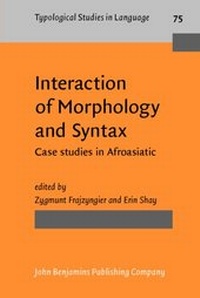
Interaction of Morphology and Syntax
Case studies in Afroasiatic
1st Edition
Published on 21. May 2008
V, 234 pages
978-90-272-9023-6 (ISBN)
Description

The present volume deals with hitherto unexplored issues on the interaction of morphology and syntax. These selected and invited papers mainly concern Cushitic and Chadic languages, the least-described members of the Afroasiatic family. Three papers in the volume explore one or more typological characteristics across an entire language family or branch, while others focus on one or two languages within a family and the implications of their structures for the family, the phylum, or linguistic typology as a whole. The diversity of topics addressed within the present volume reflects the great diversity of language structures and functions within the Afroasiatic phylum.
More details
Other editions
Additional editions
Book
05/2008
John Benjamins Publishing Co
€116.60
Shipment within 10-15 days
Persons
Content
- Interaction of Morphology and Syntax
- Editorial page
- Title page
- LCC data
- Table of contents
- Introduction
- References
- Case-marking, syntactic domains and information structure in Kabyle (Berber)
- Introduction
- 1. Personal affixes and clitics
- 1.1 Personal affixes
- 1.2 Clitics
- 1.3 Syntactic domains
- 2. Word-order and information structure
- 2.1 Informational status of the bare core
- 2.2 Informational status of the prehead slot
- 2.3 Informational status of the extended core
- 2.4 Informational status of the postcore slot
- 2.5 Synthesis
- 3. The case system of Kabyle
- 3.1 Detopicalization and noncanonical subjecthood
- 3.2 The locative-ablative hypothesis
- 3.3 Synthesis on the binary case-system of Kabyle
- Conclusion
- References
- The internal and comparative reconstruction of verb extensions in early Chadic and Afroasiatic
- Chadic verb extensions
- Inferring extensions in Mafa and pre-Mafa
- Comparing the verb extensions across Chadic
- References
- One way of becoming a dative subject
- 1. The problem
- 2. Approaches to dative subjects
- 3. Basic information about Wandala
- 4. Function of the form hè
- 4.1 Punctual function of the suffix hè
- 4.2 Discourse function of the marker hè
- 4.3 Evidence from sentence structure
- 4.4 Systemic evidence
- 4.5 Evidence from discourse structure
- 5. Functions of the preposition g6
- 5.1 The preposition before the dative/benefactive argument
- 5.2 The preposition coding purpose and reason adjuncts
- 5.3 Preposition g6¡ in comparative construction
- 5.4 Preposition g6¡ codes kinship relations
- 6. Switch reference function of the preposition g6
- 7. Conclusions about Wandala
- 8. Implications
- Abbreviations
- References
- Coding the unexpected
- 1. Introduction
- 2. Aim of the present paper
- 3. Subject coding
- 4. Hypothesis
- 5. Previous approaches
- 6. The evidence
- 6.1 Subject suffixes and the domain of the expected
- 6.2 Subject clitics and the domain of the unexpected
- 6.3 Subdomains of the unexpected
- 7. Conclusions
- 8. Evolution of subject marking in East Dangla
- 8.1 Shift to subject-initial order
- 9. Conclusions and implications
- Appendix
- References
- Ergative-active features of the Ethiopian Semitic type
- 1. Introduction
- 2. Twelve features of Ethiopian Semitic
- 2.1 Lexical contrast of consonant length in verbs
- 2.2 Tense distinction of stative and active verbs
- 2.3 Verb of presence with only present-tense interpretation
- 2.4 Lesser differentiation and narrower distribution of prefix subject pronouns
- 2.5 Similarity of the noun-possessive, verb-object, and verb-subject suffixes
- 2.6 Copula conjugated with object or suffix-subject pronouns
- 2.7 Impersonal verbs conjugated by object pronouns
- 2.8 Two causatives suffixes
- 2.9 Exceptional causative verb classes
- 2.10 Object-marked non-objects
- 2.11 Object agreement
- 2.12 Morphological passive-reflexive
- 3. Afroasiatic and Semitic ergativity
- 4. Ergative as a stage of language evolution
- 5. Against ethno-psychological speculation
- References
- Number as an exponent of gender in Cushitic
- 1. Introduction
- 2. Cushitic gender systems
- 2.1 Iraqw gender system
- 2.2 K'abeena gender system
- 3. Properties of number
- 4. Agreement of gender: Domain is the noun phrase
- 5. Agreement of gender: Domain is the clause
- 6. Distribution of feature values
- underived and derived
- across number
- 7. Motivation of gender assignment
- 8. Number and gender interplay
- 9. The Cushitic gender and number system and alternative analyses
- References
- Relativization in Kambaata (Cushitic)
- 1. Typological profile
- 2. Morphology of relative verbs
- 2.1 Affirmative relative verbs
- 2.2 Negative relative verbs
- 3. Syntax
- 3.1 Word order
- 3.2 NP accessibility and relativization strategies
- 3.3 Headless relative clauses
- 4. The ubiquitous relative clause
- 4.1 Locative clauses
- 4.2 Temporal clauses
- 4.3 Concomitance clauses
- 4.4 Reason clauses
- 4.5 Conditional clauses
- 4.6 Manner clauses
- 4.7 Purpose clauses
- 4.8 Complement clauses
- 5. Conclusion
- Abbreviations
- References
- Between coordination and subordination in Gawwada
- 1. The language and its speakers
- 2. Basics on word order and adpositions in Gawwada
- 3. The adpositions in their phrasal context
- 3.1 The Locative case
- 3.2 The Situative adposition =ma
- 3.3 The Partitive adposition =na
- 4. From the phrase to the clause
- 4.1 Juxtaposition
- 4.2 Bare coordination: apa, bØ
- 4.3 Introducing the Consecutive paradigm
- 4.4 Almost a juxtaposition: aØ, bcons
- 4.5 Coordination with a twist: apa, bcons
- 5. The postclausal use of the adpositions
- 5.1 =na: from Partitive to concomitant/immediate action
- 5.2 =ma: from Situative to adversative
- 6. Summary and conclusions
- References
- Author index
- Language index
- Subject index
- The series Typological Studies in Language
