

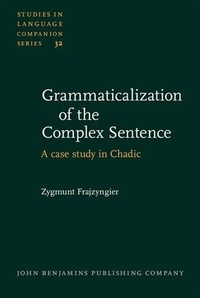
Grammaticalization of the Complex Sentence
A case study in Chadic
1st Edition
Published on 1. April 1996
XVIII, 501 pages
978-90-272-8199-9 (ISBN)
Description

The general objective of the study is systematic examination of the processes involved in the formation and evolution of complex sentence constructions in a group of genetically related languages. The Chadic language group, at about 140 languages, constitutes the largest and most diversified branch of the Afroasiatic family. One of the findings of the present work is that languages starting from the same base may develop quite different morphological and syntactic structures. With respect to issues of general linguistic interest, the book deals with motivations for grammaticalization: It is proposed that one of the most important motivations is satisfaction of the principle of well formedness, that is, that every element in an utterance must have its role transparent to the hearer either by inherent lexical properties or by grammatical means. In the present work both aspects of grammaticalization, viz. the emergence of grammatical constructions and the emergence of grammatical morphemes, are given equal weight. In addition to semantic metaphor and metonymy as mechanisms in the processes of grammaticalization, the present work develops the notion of semiotic metonymy, whereby a part of a sign performs the function of the sign. It is shown that semiotic metonymy plays an important role in the grammaticalization of grammatical morphemes and constructions into other morphemes and constructions. The book also shows that unindirectionality is not a governing principle with respect to the development of grammatical morphemes into other grammatical morphemes; rather, there is considerable evidence and theoretical justification for the bidirectionality principle.
More details
Other editions
Additional editions
Book
04/1996
John Benjamins Publishing Co
€163.24
Shipment within 10-15 days
Person
Content
- GRAMMATICALIZATION OF THE COMPLEX SENTENCE A CASE STUDY IN CHADIC
- Editorial page
- Title page
- Copyright page
- Table of contents
- ACKNOWLEDGMENTS
- ABBREVIATIONS
- 1. INTRODUCTION
- 1.1 Aim and scope of the work
- 1.2 Linguistic framework of the present study
- 1.2.1 The notion of form
- 1.2.1.1 Types of lexical categoríes
- 1.2.1.2 Phrasal categoríes
- 1.2.1.3 Configuration
- 1.2.1.4 Inflectional coding
- 1.2.1.5 Adpositions
- 1.2.1.6 Coding on the verb and other agreement phenomena
- 1.2.1.7 Serial verb constructions
- 1.2.1.8 Intonation and other prosodic means
- 1.2.2 The notion o f function
- 1.2.3 The relationship between the form and function
- 1.2.4 The coding principle
- 1.2.5 Methodology of reconstruction
- 1.3 The range of issues with respect to grammaticalization
- 1.3.1 Motivation
- 1.3.2 Grammatical morphemes versus constructions
- 1.3.3 Processes of grammaticalization
- 1.3.4 Unidirectionality of grammaticalization
- 1.4 Chadic branch
- 1.5 A synopsis of simple sentence structure in Chadic
- 1.6 State of the art with respect to complex sentence in Chadic
- 1.7 A synopsis of complex sentence structure in Chadic
- 1.8 Sources and form of data
- 2. PARATACTIC AND SEQUENTIALCONSTRUCTIONS
- 2.1 The issues and the scope of the chapter
- 2.2 Hypotheses
- 2.3 Was there a sentential coordinating conjunction in PC?
- 2.4 Sources of sentential coordinating conjunctions
- 2.4.1 From nominal to sentential conjunction
- 2.4.2 Functions of the sentential coordinating conjunction
- 2.4.3 From coordinated conjunction to contrastive focus
- 2.4.4 From locative preposition to coordinating conjunction
- 2.4.5 From adverb 'also' to coordinating conjunction
- 2.4.6 Borrowings as sources of sentential conjunction
- 2.5 Functions of sequential and coordinate structures
- 2.5.1 Introduction
- 2.5.2 Functions of sequential clauses
- 2.6 Functions of paratactic clauses
- 2.6.1 Comparison between two types of'structures
- 2.6.2 Paratactic and conjoined constructions: Conclusions
- 2.7 Sources and reconstruction of the P-C sequential marker
- 2.7.1 Associative: Cibak, Lele, and Gidar
- 2.7.2 Nominal conjunction: Bidiya
- 2.7.3 From preposition to sequential: Margi
- 2.7.4 From verb 'to sit' to sequential marker: Kanakuru
- 2.8 Sequential marker as a discourse conjunction
- 2.8.1 Sequential marker at the discourse level
- 2.8.2 An explanation of the discourse-level function
- 2.8.3 Direction of grammaticalization
- 2.9 From sequential to inflectional aspect marker
- 2.10 From 'God' to counterexpectation: A reanalysis
- 2.10.1 The problem
- 2.10.2 The hypothesis and argumentation
- 2.11 Conclusions
- 3. FUNCTIONS OF COMPLEMENTIZERS
- 3.1 Introduction
- 3.2 Modal function
- 3.2.1 Epistemic function of complementizers
- 3.2.2 Deontic function o f complementizers
- 3.3 Complementizer and the coding of grammatical relations
- 3.3.1 The problems and a hypothesis
- 3.3.2 Coding devices for the semantic role of arguments
- 3.4 Identification and grammaticalization of complementizers
- 3.5 The complementizers in Masa: An open problem
- 3.6 Conclusions
- 4. COMPLEMENTS OF VERBS OF SAYING
- 4.1 Introduction
- 4.2 Verbs of saying
- 4.3 Clausal structure of sentences with verbs of saying
- 4.3.1 Clausal order matrix-embedded
- 4.3.2 Clausal order embedded-matrix
- 4.3.3 Word order in the matríx clause
- 4.4 Omission of verbs of saying
- 4.4.1 The phenomenon
- 4.4.2 Absence of the verb and case assignment
- 4.4.3 Verb omission and problems of reconstruction
- 4.4.4 An explanation of verb omission
- 4.4.5 Verb omission and verb replacement
- 4.5 De dicto complementizers
- 4.5.1 Issues and questions
- 4.5.2 Position of complementizers
- 4.6 Origin of de dicto complementizers
- 4.6.1 Complementizers from verbs of saying
- 4.6.1.2 Phonological evidence
- 4.6.1.3 The mechanics of grammaticalization of complementizers from verbsof saying
- 4.6.2 Complementizers and previous reference markers
- 4.6.3 Complementizers and sequential markers
- 4.7 Absence of complementizer: deletion or omission
- 4.8 Argument marking in the embedded clause
- 4.9 Direct versus indirect speech
- 4.9.1 The problems
- 4.9.1 Use of complementizer in the two types of discourse
- 4.9.2 Two Chadic solutions
- 4.10 Doubt-in-truth modality
- 4.10.1 Doubt in truth through tonal means
- 4.10.2 Doubt m truth through complementizers
- 4.10.3 Doubt in truth through adverbial expressions
- 4.11 Deontic modalities after verbs of saying
- 4.11.1 Means of encoding obligation
- 4.11.2 Inflectional means
- 4.11.3 De dicto complementizers and inflectional means
- 4.11.4 Mood of obligation through a deontic complementizer
- 4.12 Cross-reference disjoint-reference coding. Logophoricity
- 4.13 Conclusions
- 5. EMBEDDED INTERROGATIVES
- 5.1 Introduction
- 5.2 The interrogative verbs
- 5.3 Interrogative complements in de dicto domain
- 5.3.1 De dicto complementizers
- 5.3.2 Order of clsuses as avidence of de disco domain
- 5.4 Interrogative complementizers
- 5.5 Yes/no questions and interrogative particles
- 5.6 Specific (WH) questions
- 5.7 Deontic complements after verbs of asking
- 5.8 Conclusions
- 6. COMPLEMENTS OF VOLITIONAL VERBS
- 6.1 Issues and scope of the chapter
- 6.2 The problem of the infinitival complements
- 6.3 De dicto complementizer with volitional verbs
- 6.4 Subjunctive mood in the embedded clause
- 6.5 Deontic complementizers
- 6.6 Same-subject coding
- 6.6.1 Types of constructions
- 6.6.2 Hypothesis: Types of volitional predicates and overt same subject
- 6.7 Volitional predicates in Chadic
- 6.7.1 Evidence for the hypothesis: No overt coding of the same subject
- 6.7.2 Type III lexicalization (two verbs, two meanings)
- 6.7.3 Type II lexicalization (one verb, two meanings)
- 6.7.4 Overt coding of the subject of the complement clause: Type I
- 6.8 Complements of the verb 'please'
- 6.9 Different subject
- 6.9.1 Role of complementizer
- 6.9.2 Deontic modality and different subjects
- 6.10 Third person subject inclusion and exclusion
- 6.10.1 Subject inclusion in Lele
- 6.10.2 Subject inclusion in Mina
- 6.11 Problem of 'raising'
- 6.11.1 'Raising ' or embedded subject coding in the matrix clause
- 6.11.2 Raising-a means or a result
- 6.12 Conclusions
- 7. COMPLEMENTS OF VERBS OF PERCEPTION
- 7.1 Verbs of perception and complementation: state of the art
- 7.2 Theoretical claims: 'Raising to object' as a coding device
- 7.3 De dicto and de re complementizers and subject raising: Lele
- 7.3.1 Coding of the subject of embedded clause in the matrix clause
- 7.3.2 The de re complementizer go
- 7.3.3 The de dicto complementizer na
- 7.4 Subject raising and the role of complementizer in Mandara
- 7.5 Conclusions
- 8. COMPLEMENTS OF COGNITIVE VERBS
- 8.1 Introduction
- 8.2 The origin of verbs of knowing
- 8.3 Coding of the modality of knowing
- 8.4 Undifferentiated complementation
- 8.5 Conclusions
- 9. TEMPORAL CLAUSES
- 9.1 Issues to be discussed
- 9.2 The order of clauses
- 9.3 Temporal clauses through juxtaposition
- 9.4 The relative position of temporal markers
- 9.5 Sources of the general protasis markers
- 9.5.1 The synchronic picture
- 9.5.2 'Time' as source of general protasis markers
- 9.5.2.1 Two type of constructions involving 'time'
- 9.5.2.2 The marker *dV
- 9.5.3 From verb 'go' to protasis marker?
- 9.5.4 From conditional to temporal protasis marker
- 9.5.4.1 Temporal protasis marker *ma
- 9.5.4.2 Conclusions regarding the temporal function of ma
- 9.5.4.3 The marker m? in Mina
- 9.5.5 From sequential marker to general protasis marker
- 9.5.6 Copula as a general protasis marker
- 9.5.7 Demonstratives/definite marker as temporal markers
- 9.5.7.1 Evidence that some protasis markers are demonstratives
- 9.5.7.2 Constituent status of demonstratives
- 9.5.7.3 From relativo clause to demonstrative to temporal protasis marker
- 9.5.7.3.1 Hypothesis
- 9.5.7.3.2 Evidence
- 9.5.8 From locative preposition to temporal markers
- 9.5.9 De dicto complementizer as general protasis marker
- 9.5.10 Unknown lexical sources
- 9.6 The specific temporal clauses ('before', 'after')
- 9.6.1 General marker plus specific marker
- 9.6.2 Specific coding through prepositions and adverbs
- 9.6.3 Specific temporal coding through interplay of tenses
- 9.7 Functions of apodosis markers vs. sequential markers
- 9.8 Sources of apodosis markers
- 9.8.1 An attempt of reconstruction
- 9.8.2 From demonstrative to apodosis marker: Hausa
- 9.8.3 From protasis to apodosis markers
- 9.8.4 De dicto complementizer as a source of the apodosis marker
- 9.9 Conclusions
- 10. CONDITIONAL SENTENCES
- 10.1 Issues to be discussed
- 10.2 Origin of the protasis markers
- 10.2.1 Temporal markers as conditionals
- 10.2.2 The marker ma
- 10.2.3 Sources of conditional ma
- 10.2.4 'Interrogative ' markers as sources of conditionals
- 10.2.5 Conditional markers from locative prepositions
- 10.2.6 Demonstratives/definite markers as conditional markers
- 10.2.7 From 'hand' to conditional marker
- 10.2.8 De dicto complementizer as a protasis marker
- 10.2.9 Other sources of protasis markers
- 10.3 Functions of apodosis markers
- 10.4 Sources of apodosis markers
- 10.4.1 De dicto complementizers as a source of apodosis markers
- 10.4.2 Sequential markers as a source of apodosis markers
- 10.4.3 Demonstratives/definite markers as a source of apodosis markers
- 10.4.4 Apodosis markers from conjunctions
- 10.5 Conclusions
- 11. THE RELATIVE CLAUSE
- 11.1 Introduction
- 11.2 Major constituents of the relative clause
- 11.3 The relative markers
- 11.3.1 The functions of the relative markers
- 11.3.2 Presence versus absence of the relative marker
- 11.4 Existential status of the head noun
- 11.4.1 Existential status coding through two relative markers
- 11.4.2 Existential status coding and the use of relative markers
- 11.5 Existential status coding through postrelative markers
- 11.5.1 The relationship between the definite head and postrelatives
- 11.5.2 Functions of the postrelative markers
- 11.6 Coding the role of the head noun phrase
- 11.6.1 Coding of the role through distinction in the relative markers
- 11.6.2 Coding of the role through resumptive pronouns
- 11.7 Other grammatical categories of relative markers
- 11.7.1 Gender and number
- 11.7.2 The semantic class
- 11.8 Sources of relative markers
- 11.8.1 Demonstratives and definite markers as a source of relative markers
- 11.8.2 Indefinite pronouns as a source of relative markers
- 11.8.3 Associative markers as a source of relative markers
- 11.8.4 De dicto complementizers as a source of relative markers
- 11.9 Sources of postrelative markers
- 11.10 'Relative tenses'
- 11.11 Reconstruction of the relative clause in Proto-Chadic
- 11.11.1 The form of the relative clause
- 11.11.2 The relativo markers
- 11.11.3 The relative tenses
- 11.11.4 The postrelative markers
- 11.12 Conclusions
- 12. SUMMARY AND IMPLICATIONS
- 12.1 Introduction
- 12.2 Implications for the study of language structure
- 12.2.1 Typology of complex sentences
- 12.2.2 Verb omission and argument marking
- 12.2.3 Subject-to-object raising
- 12.2.4 Word order in matrix and embedded clauses
- 12.2.5 Position of subordinating particles
- 12.2.6 Two types of relative clauses
- 12.2.7 The nature of complementizers
- 12.2.8 Modal functions of the clausal order
- 12.3 Implications for the study of grammaticalization
- 12.3.1 Methodology and unidirectionality
- 12.3.2 Semiotic metonymy as a source of polysemy
- 12.3.3 Motivation for grammaticalization: the need and opportunity
- 12.3.4 Origin of complementizers
- 12.3.5 Origin of protasis and apodosis markers
- 12.3.6 Orìgin of relative clause markers
- 12.4 Conclusions
- REFERENCES
- INDEX OF TERMS
- INDEX OF LANGUAGES
- INDEX OF NAMES
