

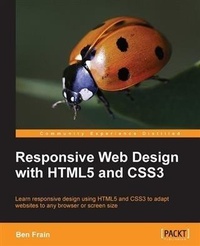
Responsive Web Design with HTML5 and CSS3
Web pages that respond immediately to different screen sizes and devices is one of today's essentials. Packed with screenshots and examples, this book will teach you the professional approach using just HTML5 and CSS3.
1st Edition
Published on 3. June 2024
324 pages
978-1-84969-319-6 (ISBN)
Description

Web pages that respond immediately to different screen sizes and devices is one of today s essentials. Packed with screenshots and examples, this book will teach you the professional approach using just HTML5 and CSS3.Key Features - Everything needed to code websites in HTML5 and CSS3 that are responsive to every device or screen size
- Learn the main new features of HTML5 and use CSS3's stunning new capabilities including animations, transitions and transformations
- Real world examples show how to progressively enhance a responsive design while providing fall backs for older browsers
Book DescriptionTablets, smart phones and even televisions are being used increasingly to view the web. There's never been a greater range of screen sizes and associated user experiences to consider. Web pages built to be responsive provide the best possible version of their content to match the viewing devices of not just today's devices but tomorrow's too.Learn how to design websites according to the new "responsive design"ù methodology, allowing a website to display beautifully on every screen size. Follow along, building and enhancing a responsive web design with HTML5 and CSS3. The book provides a practical understanding of these new technologies and techniques that are set to be the future of front-end web development. Starting with a static Photoshop composite, create a website with HTML5 and CSS3 which is flexible depending on the viewer's screen size.With HTML5, pages are leaner and more semantic. A fluid grid design and CSS3 media queries means designs can flex and adapt for any screen size. Beautiful backgrounds, box-shadows and animations will be added ñ all using the power, simplicity and flexibility of CSS3.Responsive web design with HTML5 and CSS3 provides the necessary knowledge to ensure your projects won't just be built "right" for today but also the future.What you will learn - Responsive web design is the hottest topic in web design. Understand what it is and why it s essential to master
- HTML5 is leaner, faster and more semantically rich. You ll learn how to write HTML5 and understand all the key features
- CSS3 media queries allow different styles for different media, learn how to integrate them into a design
- Make web pages and the media within them "fluid" - allowing them to flex when needed
- Ditch images and use CSS3 to create background gradients, text shadows, box shadows and more
- Use CSS3 3D transformations to flip elements in 3D space. Animate elements with CSS3 keyframes
- Create smooth CSS3 transitions between default and hover states with differing durations and timing functions
- Conquer forms ñ add validation and useful interface elements like date pickers and range sliders with HTML5 alone
Who this book is forAre you writing two websites ñ one for mobile and one for larger displays? Or perhaps you've heard of Responsive Design but are unsure how to bring HTML5, CSS3, or responsive design all together. If so, this book provides everything you need to take your web pages to the next level ñ before all your competitors do!
- Learn the main new features of HTML5 and use CSS3's stunning new capabilities including animations, transitions and transformations
- Real world examples show how to progressively enhance a responsive design while providing fall backs for older browsers
Book DescriptionTablets, smart phones and even televisions are being used increasingly to view the web. There's never been a greater range of screen sizes and associated user experiences to consider. Web pages built to be responsive provide the best possible version of their content to match the viewing devices of not just today's devices but tomorrow's too.Learn how to design websites according to the new "responsive design"ù methodology, allowing a website to display beautifully on every screen size. Follow along, building and enhancing a responsive web design with HTML5 and CSS3. The book provides a practical understanding of these new technologies and techniques that are set to be the future of front-end web development. Starting with a static Photoshop composite, create a website with HTML5 and CSS3 which is flexible depending on the viewer's screen size.With HTML5, pages are leaner and more semantic. A fluid grid design and CSS3 media queries means designs can flex and adapt for any screen size. Beautiful backgrounds, box-shadows and animations will be added ñ all using the power, simplicity and flexibility of CSS3.Responsive web design with HTML5 and CSS3 provides the necessary knowledge to ensure your projects won't just be built "right" for today but also the future.What you will learn - Responsive web design is the hottest topic in web design. Understand what it is and why it s essential to master
- HTML5 is leaner, faster and more semantically rich. You ll learn how to write HTML5 and understand all the key features
- CSS3 media queries allow different styles for different media, learn how to integrate them into a design
- Make web pages and the media within them "fluid" - allowing them to flex when needed
- Ditch images and use CSS3 to create background gradients, text shadows, box shadows and more
- Use CSS3 3D transformations to flip elements in 3D space. Animate elements with CSS3 keyframes
- Create smooth CSS3 transitions between default and hover states with differing durations and timing functions
- Conquer forms ñ add validation and useful interface elements like date pickers and range sliders with HTML5 alone
Who this book is forAre you writing two websites ñ one for mobile and one for larger displays? Or perhaps you've heard of Responsive Design but are unsure how to bring HTML5, CSS3, or responsive design all together. If so, this book provides everything you need to take your web pages to the next level ñ before all your competitors do!
More details
Other editions
Additional editions
Book
03/2012
Packt Publishing
€51.20
Shipment within 3-4 weeks
Person
Frain Ben :
Ben Frain has been a web designer/developer since 1996. He is currently employed as a UI-UX Technical Lead at bet365. Before the web, he worked as an underrated (and modest) TV actor and technology journalist, having graduated from Salford University with a degree in Media and Performance. He has written four equally underrated (his opinion) screenplays and still harbors the (fading) belief he might sell one. Outside of work, he enjoys simple pleasures: playing indoor football while his body and wife still allow it and wrestling with his two sons.
Ben Frain has been a web designer/developer since 1996. He is currently employed as a UI-UX Technical Lead at bet365. Before the web, he worked as an underrated (and modest) TV actor and technology journalist, having graduated from Salford University with a degree in Media and Performance. He has written four equally underrated (his opinion) screenplays and still harbors the (fading) belief he might sell one. Outside of work, he enjoys simple pleasures: playing indoor football while his body and wife still allow it and wrestling with his two sons.
Content
Table of Contents
