

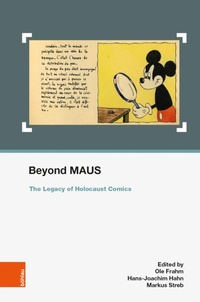
Beyond MAUS
The Legacy of Holocaust Comics
1st Edition
Published on 9. August 2021
420 pages
978-3-205-21066-5 (ISBN)
Description

Beyond MAUS. The Legacy of Holocaust Comics collects 16 contributions that shed new light on the representation of the Holocaust. While MAUS by Art Spiegelman has changed the perspectives, other comics and series of drawings, some produced while the Holocaust happened, are often not recognised by a wider public. A plethora of works still waits to be discovered, like early caricatures and comics referring to the extermination of the Jews, graphic series by survivors or horror stories from 1950s comic books. The volume provides overviews about the depictions of Jews as animals, the representation of prisoner societies in comics as well as in depth studies about distorted traces of the Holocaust in Hergé's Tintin and in Spirou, the Holocaust in Mangas, and Holocaust comics in Poland and Israel, recent graphic novels and the use of these comics in schools. With contributions from different disciplines, the volume also grants new perspectives on comic scholarship.
Ole Frahm studied German Literature, History and Psychology in Berlin and Hamburg. Co-founder of the Research Centre for Graphic Literature (ArGL) at the University of Hamburg. Member of the Villigster Forschungsforum zu Nationalsozialismus, Rassismus und Antisemitismus and the German Society for Comics Studies (Comfor). He published about radio and the history, theory, and aesthetics of comics. Genealogie des Holocaust. Art Spiegelmans MAUS - A Survivor's Tale (Paderborn 2006); Die Sprache des Comics (Hamburg 2010).
Ole Frahm studied German Literature, History and Psychology in Berlin and Hamburg. Co-founder of the Research Centre for Graphic Literature (ArGL) at the University of Hamburg. Member of the Villigster Forschungsforum zu Nationalsozialismus, Rassismus und Antisemitismus and the German Society for Comics Studies (Comfor). He published about radio and the history, theory, and aesthetics of comics. Genealogie des Holocaust. Art Spiegelmans MAUS - A Survivor's Tale (Paderborn 2006); Die Sprache des Comics (Hamburg 2010).
More details
Other editions
Additional editions
Book
08/2021
1st Edition
Böhlau
€59.00
Shipment within 5-7 days
Persons
Ole Frahm studied German Literature, History and Psychology in Berlin and Hamburg. Co-founder of the Research Centre for Graphic Literature (ArGL) at the University of Hamburg. Member of the Villigster Forschungsforum zu Nationalsozialismus, Rassismus und Antisemitismus and the German Society for Comics Studies (Comfor). He published about radio and the history, theory, and aesthetics of comics. Genealogie des Holocaust. Art Spiegelmans MAUS - A Survivor's Tale (Paderborn 2006); Die Sprache des Comics (Hamburg 2010).
Content
- Intro
- Beyond MAUS
- Cover
- Impressum
- ISBN 978-3-205-21066-5
- Table of Contents
- Sarah Lightman: Forward (And Backwords)
- Ole Frahm, Hans-Joachim Hahn and Markus Streb: Introduction
- Ole Frahm: Ghosts, Golems, Angels
- The Medial Specificity of Comics Representing the Holocaust
- I.
- Kathrin Hoffmann-Curtius: Post-war Graphic Cycles
- Emil Gruber: Israël Souviens Toi !
- Early Representations of the Holocaust Between Caricature and Comic Book
- II.
- Markus Streb: Early Representations of Concentration Camps in Golden Age Comic Books
- Graphic Narratives, American Society, and the Holocaust
- Didier Pasamonik
- Didier Pasamonik: From the Dreyfus Affair to MAUS
- A Short History of the Animalization of the Representation of the Jews
- Kees Ribbens: The Invisible Jews in August Froehlich's "Nazi Death Parade" (1944)
- An Early American Sequential Narrative Attempt to Visualize the Final Stages Of The Holocaust
- III.
- Jaqueline Berndt: Collapsing Boundaries
- Mangaesque Paths Beyond MAUS
- Susanne Korbel: The Portrayal of Children's Experiences of the Holocaust in Israeli Graphic Novels and Comics
- Kalina Kupczynska: Haunted But Not Healed
- The Holocaust in Recent Polish Comics
- IV.
- Hans-Joachim Hahn: Distorted Traces of the Holocaust in Hergé's Tintin
- Jörn Ahrens: Hidden Atrocities
- The Holocaust Framed by Edmond-François Calvo and Émile Bravo
- V.
- Georg Marschnig: "Students like it, it's still their genre."
- A Qualitative Approach to Teacher's Views on Holocaust Education with Comics
- Jeff McLaughlin
- Jeff McLaughlin: Graphic Novels and the Holocaust : "Just" comics ?
- VI.
- Nina Eckhoff-Heindl and Véronique Sina : Second Generation Comics
- On the Construction of (Post-)Memory in Art Spiegelman's Maus and Michel Kichka's Deuxième Génération
- Dana Mihailescu: "Shot in the heart on Valentine's day"
- Monsters, Sexuality, the Holocaust and Late 1960s American Culture in Emil Ferris's My Favorite Thing Is Monsters. Book I (2017)
- Dennis Bock: "Inside Concentration Camps"
- Social Life and Prisoner Societies in Comic Books and Graphic Novels
- List of Figures
- Contributors
- Index
