

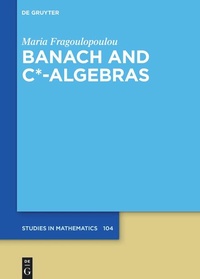
Banach and C*-Algebras
1st Edition
Published on 30. March 2026
VIII, 202 pages
978-3-11-115055-0 (ISBN)
Description

The Gelfand theory of Banach algebras is presented in this book, along with several significant applications. The famed commutative and non-commutative Gelfand-Naimark theorems are then addressed, and intriguing applications of them are shown, after presenting C*-algebras and using the prior theory.
More details
Other editions
Additional editions
Maria Fragoulopoulou
Banach and C*-Algebras
Book
03/2026
1st Edition
De Gruyter
€164.95
Shipment within 5-7 days
Maria Fragoulopoulou
Banach and C*-Algebras
E-Book
02/2026
1st Edition
De Gruyter
€164.95
Available for download
Person
University of Athens, Greece.
Content
- Intro
- Contents
- 1 Introduction
- 2 Normed and Banach algebras
- 2.1 Algebraic and topological preliminaries, notation, examples
- 2.2 Normed and Banach spaces - reminders
- 2.3 Definition and examples of normed and Banach algebras
- 2.4 Unitization and quotient of a Banach algebra
- 2.5 Invertible elements in Banach algebras
- Exercises
- 3 Spectrum of an element in Banach algebras
- 3.1 Definitions, examples, algebraic properties
- 3.2 Topological properties of the spectrum
- 3.3 Spectral radius, main properties
- 3.4 Gelfand-Mazur theorem
- Exercises
- 4 Gelfand space of a commutative Banach algebra
- 4.1 Characters, maximal ideals, regular maximal ideals
- 4.2 Gelfand topology and Gelfand space ( maximal ideal space)
- 4.3 Properties of the Gelfand space
- 4.4 Gelfand representation theorems
- Exercises
- 5 Concrete Gelfand spaces of various Banach algebras
- 5.1 The Gelfand space of C(X), with X a compact Hausdorff space
- 5.2 The Gelfand space of C0(X), with X a locally compact Hausdorff space
- 5.3 The Gelfand space of the disk algebra A(D)
- 5.4 The Gelfand space of C(n)[0,1]
- Exercises
- 6 Applications of Gelfand theory
- 6.1 Description of closed ideals in C(X), with X a compact Hausdorff space, in terms of its maximal ideals
- 6.2 The Gelfand space of l1(Z) and the Wiener theorem
- 6.3 The Singer-Wermer theorem
- 6.4 C8[0,1] and O(C) are not Banach spaces
- Exercises
- 7 Algebras with involution
- 7.1 *-Algebras, *-Banach algebras, and examples
- 7.2 Continuity of involution in Banach algebras
- 7.3 Jacobson radical and some of its properties
- 7.4 A new conceptual proof of the Shirali-Ford theorem
- 7.5 Positive linear functionals and *-representations
- 7.6 GNS-construction
- Exercises
- 8 C*-algebras
- 8.1 Definitions and examples
- 8.2 Basic properties of C*-algebras
- 8.3 The commutative Gelfand-Naimark theorem and applications
- 8.4 Stone-Cech compactification
- Properties of the Stone-Cech compactification
- 8.5 The Banach-Stone theorem and the Gelfand space of the C*-algebra Cb(X), with X a locally compact Hausdorff space
- Exercises
- 9 C*-algebras, continued
- 9.1 Continuous functional calculus
- 9.2 The cone of positive elements
- 9.3 Square root of a positive element
- 9.4 Approximate identities, ideals, and quotients
- Exercises
- 10 The nocommutative Gelfand-Naimark theorem and some applications
- 10.1 Construction of positive linear functionals in C*-algebras
- 10.2 The noncommutative Gelfand-Naimark theorem
- 10.3 The uniqueness of the (complete) norm topology in Banach algebras
- 10.4 Some consequences of semisimplicity on Banach algebras with involution
- Exercises
- Bibliography
- Index
