

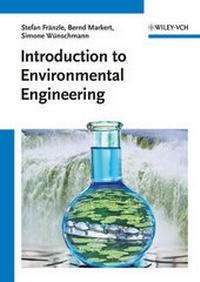
Introduction to Environmental Engineering
1st Edition
Published on 18. January 2012
XIV, 420 pages
978-3-527-65951-7 (ISBN)
Description

Building on the first principles of environmental chemistry, engineering, and ecology, this volume fills the need for an advanced textbook introducing the modern, integrated environmental management approach, with a view towards long-term sustainability and within the framework of international regulations.
As such, it presents the classic technologies alongside innovative ones that are just now coming into widespread use, such as photochemical technologies and carbon dioxide sequestration. Numerous case studies from the fields of air, water and soil engineering describe real-life solutions to problems in pollution prevention and remediation, as an aid to practicing professional skills.
With its tabulated data, comprehensive list of further reading, and a glossary of terms, this book doubles as a reference for environmental engineers and consultants.
As such, it presents the classic technologies alongside innovative ones that are just now coming into widespread use, such as photochemical technologies and carbon dioxide sequestration. Numerous case studies from the fields of air, water and soil engineering describe real-life solutions to problems in pollution prevention and remediation, as an aid to practicing professional skills.
With its tabulated data, comprehensive list of further reading, and a glossary of terms, this book doubles as a reference for environmental engineers and consultants.
More details
Other editions
Additional editions
Stefan Fränzle | Bernd Markert | Simone Wünschmann
Introduction to Environmental Engineering
Book
02/2012
1st Edition
Wiley-VCH
€72.90
Article exhausted; check different version
Persons
Stefan Fränzle, born 1961, is an instructor at Zittau University (Germany), teaching environmental sciences and technology, including analytics and ecotoxicology. His main research interests are applied (environmental) photochemistry, biological element cycles and element management in organisms, including bioinorganic chemistry and ecological stoichiometry. Dr. Fränzle has so far (co)published 6 books.
Bernd Markert, born 1958, is Professor of Environmental Technology and former director of the International Graduate School Zittau (Germany). His professional interests include the biogeochemistry of trace substances in the water/soil/plant system, instrumental analysis of chemical elements, eco- and human toxicology of hazardous substances, pollution control by use of bioindicators and technologies for waste management, environmental restoration, and remedial action on soils. Professor Markert has so far (co)published 18 books.
Simone Wünschmann, born 1967, is an environmental scientist. She works on human and ecotoxicology with emphasis on bioindication of trace elements in mammals and human milk. Dr. Wünschmann has so far (co)published 2 books
Bernd Markert, born 1958, is Professor of Environmental Technology and former director of the International Graduate School Zittau (Germany). His professional interests include the biogeochemistry of trace substances in the water/soil/plant system, instrumental analysis of chemical elements, eco- and human toxicology of hazardous substances, pollution control by use of bioindicators and technologies for waste management, environmental restoration, and remedial action on soils. Professor Markert has so far (co)published 18 books.
Simone Wünschmann, born 1967, is an environmental scientist. She works on human and ecotoxicology with emphasis on bioindication of trace elements in mammals and human milk. Dr. Wünschmann has so far (co)published 2 books
Content
INTRODUCTION
Definition of environmental engineering
History and development of environmental engineering
From environmental chemistry and technology to environmental engineering: Understanding and diversify anthropogenic environmental influences
How to determine environmental pollution
The Biological System of the Elements (BSE)
Information and communication
Ethical aspects
THE COMPARTMENTS OF THE ENVIRONMENT
The three environmental compartments and their mutual interactions: lessons for environmental situation analysis and technologies to be learned from copmarative planetology
Properties of Earth's environmental compartments and options to clean them depending on it
A comparison among environmental compartments: phase composition, miscibility towards key reactants and contaminants, transparency and biological activity
INNOVATIVE TECHNOLOGIES
Criteria for innovation
Examples of innovative environmental technologies
CASE STUDIES
Atmosphere: Biondication and biomonitoring are innovative means for monitoring and controlling environmental situations: the case of atmospheric emission surveillance
Atmosphere: CO2 reduction
Soils and sediments: Phytoremediation by use of organisms
Soils and sediments: Ethylenediamine tetraacetic acid (EDTA) - its chemical properties, persistence, ecological hazards and methods of removal
Water: Reactive walls
Water: Pharmaceuticals in the environment - special emphasis to Diclofenac (Voltaren) - an analgetic agent with difficult and interesting properties
Energy: The need for Renewable Energy
APPENDIX
Literature
Glossary
Index
Definition of environmental engineering
History and development of environmental engineering
From environmental chemistry and technology to environmental engineering: Understanding and diversify anthropogenic environmental influences
How to determine environmental pollution
The Biological System of the Elements (BSE)
Information and communication
Ethical aspects
THE COMPARTMENTS OF THE ENVIRONMENT
The three environmental compartments and their mutual interactions: lessons for environmental situation analysis and technologies to be learned from copmarative planetology
Properties of Earth's environmental compartments and options to clean them depending on it
A comparison among environmental compartments: phase composition, miscibility towards key reactants and contaminants, transparency and biological activity
INNOVATIVE TECHNOLOGIES
Criteria for innovation
Examples of innovative environmental technologies
CASE STUDIES
Atmosphere: Biondication and biomonitoring are innovative means for monitoring and controlling environmental situations: the case of atmospheric emission surveillance
Atmosphere: CO2 reduction
Soils and sediments: Phytoremediation by use of organisms
Soils and sediments: Ethylenediamine tetraacetic acid (EDTA) - its chemical properties, persistence, ecological hazards and methods of removal
Water: Reactive walls
Water: Pharmaceuticals in the environment - special emphasis to Diclofenac (Voltaren) - an analgetic agent with difficult and interesting properties
Energy: The need for Renewable Energy
APPENDIX
Literature
Glossary
Index
