

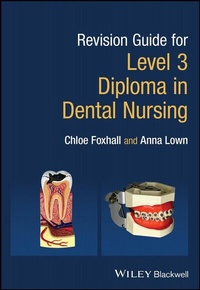
Revision Guide for Level 3 Diploma in Dental Nursing
Description

Enhance your learning and excel in exams with this essential guide to the Level 3 Diploma in Dental Nursing
Revision Guide for Level 3 Diploma in Dental Nursing supports trainee dental nurses enrolled on the Level 3 Diploma in Dental Nursing. This guide corresponds to the 11 course units of the diploma and covers essential topics such as preparing for practice, infection control, treatment planning, anatomy, and supporting various dental procedures including imaging, endodontics, and extractions.
This revision guide includes:
- The latest guidance, legislation, and governance within the dental sector
- Knowledge questions, diagrams, working activities, and revision tips
- Guidance on the end-point assessments and the synoptic test
- Specific chapters related to each unit of the course
- Elements of the learner evidence portfolio that providers are looking for
Revision Guide for Level 3 Diploma in Dental Nursing provides supportive information on the units within the qualification and acts as a revision tool to help prepare for formative and summative assessments. It is an invaluable resource for both trainee dental nurses and course providers.
More details
Other editions
Additional editions
Persons
Chloe Foxhall is a registered Dental Nurse, Curriculum manager, and Dental Nurse Tutor delivering NEBDN and City and Guilds qualifications in the UK.
Anna Lown is a registered Dental Nurse, Director of Smiles Dental Training Ltd and Dental Nurse Tutor and Assessor delivering NEBDN and City and Guilds qualifications in the UK.
Content
Acknowledgments ix
Tutor Info xi
Introduction 1
1 Preparing for Professional Practice in Dental Nursing 7
2 The Impact of Health and Safety Legislation on Working Practices in the Dental Setting 51
3 Prevention and Control of Infection in the Dental Setting 69
4 Dental and Regional Anatomy, Oral Health Assessments and Treatment Planning 95
5 Recognising and Supporting Actions During First Aid and Medical Emergencies 119
6 The Safe Use of Ionising Radiation to Produce Quality Radiographic Images 131
7 Provide Support for the Control of Periodontal Disease and Caries and the Restoration of Cavities 143
8 Provide Support during the Stages of Prosthetic Treatments 157
9 Provide Support during the Stages of Endodontic Procedures 169
10 Provide Support during Extractions and Minor Oral Surgery 179
11 Scientific and Practical Information to Support the Patient's Oral and Physical Health 189
Index 207
Introduction
This book is designed to be an invaluable revision tool to assist students who are undertaking their level 3 Diploma in Dental Nursing apprenticeship. It provides a breakdown of the programme to include the revision of assessment criteria, assessment range and examinations.
There are a range of apprenticeship providers and examining boards who all work from the same standards.
Structure of the Qualification
All apprenticeships are based on the Dental Nurse occupation standards and the operational duties include:
- Duty 1 Undertake routine dental nursing clinical and technical procedures and tasks relevant to the assessment, and diagnosis of patients.
- Duty 2 Undertake routine dental nursing clinical and technical procedures and tasks relevant to treatment planning and onward referral of patients.
- Duty 3 Communicate effectively, maintaining confidentiality and records appropriately.
- Duty 4 Provide professional leadership within the team working in partnership with patients, dental teams, other health and social care professionals.
- Duty 5 Practise as an autonomous professional exercising judgement and integrity, keeping within the scope of practice and the legal and ethical boundaries of the profession.
- Duty 6 Practise in a non-discriminatory and inclusive manner recognising the impact of culture, equality and diversity.
- Duty 7 Promote oral health to individuals and the wider population and raise awareness of its role in preventing ill health amongst communities.
- Duty 8 Reflect on, review and develop the quality of own practice.
- Duty 9 Manage own health and well-being and promote the well-being of others in the team.
Each of these duties are then broken down into knowledge, skills and behaviours that anyone training as a dental nurse is expected to demonstrate throughout the duration of the programme and thereafter. This revision book has been written to support dental nurses with the knowledge element of the programme. Skills and behaviours are assessed within the work environment.
- Functional skills in Maths and English if necessary.
- Portfolio of evidence made up of various assessment methods.
- Final examination.
All learning outcomes and assessment criteria have to be covered by sufficient evidence to create your portfolio.
Total Qualification Time (TQT) is comprised of two elements:
- Guided learning that has been allocated from the awarding organisation.
- Number of predicted hours the learner will spend during preparation, study or any other form of participation in education and training.
(Guided Learning Hours) GLH and TQT can differ depending on the awarding organisation and provides a level of standardisation for course providers.
Roles and Responsibilities
Assessor
The Assessor will either be a Dentist, Dental Nurse or Dental Care Professional holding a qualification recognised by the General Dental Council (GDC) for registration. All assessors must hold a current registration with the GDC.
Expert Witnesses
An expert witness must hold a dental qualification and be GDC registered. The role of the expert witness is to provide a testimony to demonstrate learner competence in any given unit. The testimony can only be valid if the activity is seen by the expert witness.
Assessment Strategies
Observations
This is the primary source of evidence for practice within the workplace. Observations are carried out by your assessor and can be supported by Expert Witness Testimony if/when appropriate. There is a minimum of six observations required, three of which must be carried out by the assessor and the remainder can be carried out by the expert witness.
Expert Witnesses
An Expert Witness may carry out an observation in the form of an Expert Witness Testimony to support the competence based units. This can be evidenced as a voice recording or written methods.
Work Product
These are copies of non-confidential records made or added to by the learner, for example, incident reports or maintenance reports. They can be any relevant product that the learner has significantly contributed to.
Confidential Records
These can be used as evidence if the learner has significantly contributed to them, however these should not be used in the evidence portfolio.
Questioning
Questions may be given orally or in a written format. Questions are asked to confirm learner understanding and knowledge. These must be recorded and included as evidence.
Professional Discussion
A professional discussion is in the form of a structured review, it covers the learner's practice and knowledge of the role up to that specific point in time. A professional discussion is good supportive evidence to authenticate other evidence.
Original Certificates
Certificates for further learning, training and records of attendance must be authentic, current and valid. Certificates can be copied but should always be authenticated by the centre and learning outcomes should be checked to ensure they meet the standards.
Projects/Assignments
These can be used to cover outstanding areas in the knowledge requirement of the learner's qualification. Any project or assignment that the learner has completed can be mapped to the relevant criteria.
Reflective Accounts
A reflective account can describe the learner's actions and behaviours and/or reflect on the reasons for practising in the ways selected. The learner can provide a reflective account to evidence their opinion on their performance of a certain task. A reflective account can be used to build on other forms of evidence such as an Expert Witness Testimony.
Case Studies
A case study must be based on real work practice and should heavily evidence step by step how the scenario played out.
Off the Job Hours
As an apprentice dental nurse you must be working for a minimum of 30 hours per week of which 20% of the hours must be classed as off the job training.
Off the job activities can include but are not limited to:
- Course work completion
- Study time
- Short courses
- Training
- Time spent with your assessor/tutor
- On-site training by other members of the team
- Attending college
- Research
- Revision
End Point Assessment (EPA)
The end point assessment (EPA) can include multiple choice written examinations, professional discussions and practical summative observations.
Please refer to the awarding bodies qualification handbook and standards for specific information.
About the Authors
Chloe Foxhall
Chloe is a qualified dental nurse and holds postgraduate certificates in Oral Health Education, Radiography and Fluoride application as well as a Level 3 Certificate in Education and Training and Level 4 Certificate in Internal Quality Assurance. Chloe works as a Curriculum Manager for a Dental Nurse Education Training centre, a Dental Nurse Tutor and Assessor for the NEBDN qualifications and City and Guilds apprenticeship and a Subject Matter Expert for the NEBDN. Chloe has written and developed multiple CPD courses and training courses covering a range of subjects.
Anna Lown
Anna is the Director of Smiles Dental Training LTD, a training company specialising in Dental Nurse Training and Education. She holds post graduate certificates in Oral Health Education and Topical Fluoride Application as well as PTLLS, Certificate in Assessing Vocational Achievement and L4 EQA and IQA certificates in Education. Anna is a registered Dental Nurse and holds a City and Guilds Licentiateship in Dental Nursing. Anna is an Education Associate with the GDC as well as an examiner, Independent End Point Assessor and Subject Matter Expert for the NEBDN.
Anna has written and developed NEBDN and Apprenticeship training courses as well as CPD courses for other dental companies and Health Care Sectors.
Methods of Retaining Information
Revision is something that is personal to the individual and everyone successfully revises in different ways. Some ways of revision that work well for you may not work as well for a classmate. This chapter is to give you some useful ways to revise aside from using this book. You can complete these with a class member or by yourself.
'Mind Map'
A mind map is usually focused around a topic, for example if you were revising plaque you would write plaque in the middle of your page. It does not matter what size paper you complete this on, but it is suggested that to get the best out of your mind map to use paper no smaller than A4. With your subject in the centre of the page you can circle that and then...
