

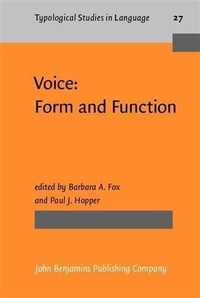
Voice: Form and Function
Voice: Form and Function
1st Edition
Published on 6. April 1994
XIII, 377 pages
978-90-272-7656-8 (ISBN)
Description

The volume's central concern is grammatical voice, traditionally known as diathesis, and its classical manifestations as Active, Middle, and Passive. While numerous problems in the meaning, syntax, and morphology of these categories in Indo-European remain unsolved, their counterparts in more exotic languages have raised still further questions. What discourse functions and diachronic events unite 'voice' as a recognizable phenomenon across languages? How are they typically grammaticalized? What stages do children go through in learning them? How does 'voice' link up with ergativity and with other categories and constructions such as the Inverse and the Antipassive?
The authors in this volume have different perspectives on these problems: they discuss voice, e.g., from a typological-universal view, in relation to language acquisition and to ergativity, and from diachronic and cross-linguistic perspectives.
The authors in this volume have different perspectives on these problems: they discuss voice, e.g., from a typological-universal view, in relation to language acquisition and to ergativity, and from diachronic and cross-linguistic perspectives.
More details
Other editions
Additional editions
Barbara A. Fox | Paul J. Hopper
Voice: Form and Function
Book
04/1994
John Benjamins Publishing Co
€137.80
Shipment within 10-15 days
Persons
Content
- Title page
- Copyright page
- Table of contents
- Abbreviations
- Introduction
- Active Voiceand Middle Diathesis
- 1. Introduction
- 2. Spanish se
- 3. Evidence from Koyukon Athabaskan
- 4. Get-constructions in English
- 5. Alternative Hypotheses
- 6. Conclusions
- NOTES
- REFERENCES
- Voice, Aspect and Aktionsart
- 1. Introduction1
- 2. Middle Voice and Affectedness
- 3. Transitivity and Aktionsart
- 4. Transitivity, Aspect and Aktionsart
- 5. Voice, Aspect and the Ordering of Events
- 5.1 Objectiveintransitive 1-participant events
- 5.2 Objective states
- 5.3 Physical processes
- 5.4 Motion, emotion and cognition
- 5.5 Volitionality and the -sa-suffix
- 5.6 Inherent reciprocals
- 5.7 Affectedness and agency
- 5.8 Transitive 2-participant events
- 5.9 Causatives
- 5.10 Patient-directed action
- 5.11 'Kill'
- 6. Discussion
- 7. Summary
- NOTES
- REFERENCES
- A Functional Typology of Antipassives
- 1. Preliminaries
- 2. Identifying the Functional Correlates of Antipassive Constructions
- 2.1 Property of the o: identifiability
- 2.2 Property of the predicate: aspectual changes
- 2.3 Property of the o: affectedness
- 2.4 Other marginal or infrequent functional correlates of the antipassive
- 2.5 Antipassives and the Transitivity Hypothesis
- 3. Some Parallel Constructions
- 4. General Functions of the Antipassive
- 4.1 The "core" function of backgrounding
- 4.1.1 Referential backgrounding
- 4.1.2 Propositional backgrounding
- 4.2 The general function of antipassives
- 5. The Co-opting Hypothesis:Using the Antipassive for Structural Purpos
- 5.1 Preliminaries
- 5.2 The principle of co-opting
- 5.3 Co-opting to resolve ambiguity
- 5.3.1 Dyirbal
- 5.3.2 Mayan languages
- 5.4 Co-opting to fill a structural gap
- 6. Final Remarks
- NOTES
- REFERENCES
- Voice:Beyond Control and Affectedness
- 1. Preliminaries
- 2. An Idealized Cognitive Model of Events
- 3. Event Self-Containedness, Causatives and Applicatives
- 4. Digression: Verbal Voice and Case Marking of NPS
- 5. Event Views and "Basic Voice
- 6. "Derived Voice" (Passive)
- 7. Conclusion: From Cognition to Discourse
- NOTES
- REFERENCES
- The Rise of the English GET-Passive
- 1. Synchronie Accounts
- 2. Textual Data Base
- 3. The Early Period
- 3.1 Chaucer
- 3.2Hardyng
- 3.3 Dunbar
- 3.4 More and Grafton
- 3.5 Tabulation and summary
- 4. Middle Period
- 4.1 Shakespeare and Marlowe
- 4.2 Sterne
- 4.3 Benjamin Franklin
- 4.4 Tabulation and summary
- 5. Late Period
- 5.1 Entrenchment of the GET-passive
- 5.2 Other inchoative-middle constructions
- 5.3 The obligative-modal 'get'
- 5.4 Idiomatic uses
- 6. The Maturation of the GET-Passive
- 6.1 From adversive to neutral
- 6.2 Fromagentive to non-agentive subject
- 6.3 The acquisition of an oblique overt agent
- 7. Discussion
- 7.1 The course of syntactic development
- 7.2 The role of analogy in complex grammatical change
- NOTES
- REFERENCES
- APPENDIX
- Passive Participles across Languages
- 1. Introduction
- 2. Participles and Orientation
- 3. Asymmetries between Passive and Active Participles
- 4. Resultative Participles
- 5. From Resultative Participle to Passive Participle
- 6. Non-Past Passive Participles
- 7. Explaining the Asymmetries
- 8. An Alternative Explanation
- 9. Where Do Passive Participles Come From?
- 10. Participles on the Noun-Verb Cline
- 11. Concluding Remarks
- NOTES
- REFERENCES
- Middle Voice, Transitivity, and the Elaboration of Events
- 0. Introduction
- 1. The Middle Voice: Background and Basic Observations
- 2. A Cross-Linguistic Look at Middle Morphology
- 3. Middle Systems: Typological Generalizations
- 3.1 Characteristics of middle voice systems
- 3.2 Types of middle voice systems
- 4. The Semantics of Reflexive and Middle Events
- 4.1 Reflexive semantics
- 4.2 Body action middles
- 4.3 Body actions vs. Reflexives
- 4.4 The middle as a whole
- 5. Transitivity and the Structure of Middle Events
- 6. Conclusion
- NOTES
- REFERENCES
- Grammars and Dictionaries
- On "Middle Voice" Verbs in Mandarin
- 1. Introduction
- 2. The Development of Lexical Transitivity from Classical Chinese to Mandarin
- 3. Lexical Transitivity in Modern Mandarin
- 4. Contact Influence
- 5. Conclusion
- NOTES
- REFERENCES
- The Implications of Ergativity for a Philippine Voice System
- 0. Introduction
- 1. Formal Case Marking
- 2. Absolutive Status
- 3. The Functional Basis of Ergativity
- 4. Voice in Kapampangan
- 4.1 The syntactic function of voice
- 4.2 The discourse function of voice
- 4.2.1 Obliques and absolutives
- 4.2.2 Ergatives and absolutives
- 5. The Universal and the Particular in Voice
- NOTES
- REFERENCES
- APPENDIX
- A Tale of Two Passives in Irish
- 1. Introduction
- 2. Structural Aspects of the Passive and Impersonal Passive
- 2.1 The passive
- 2.2 The impersonal passive
- 3. Discourse Pragmatic Aspects of the Passive and Impersonal Passive
- 3.1 The impersonal passive
- 3.2 The passive
- 4. The Information Structure of Irish Sentences
- 4.1 Nominal clauses
- 4.2 Participial clauses: The Irish ergative
- 4.3 Experiencers
- 4.5 Clefted NP'S and pronominal direct objects
- 5. Discussion
- 6. Conclusions
- NOTES
- REFERENCES
- The Tupí-Guaraní Inverse
- 1. Introduction
- 2. Person Marking Prefixes in TG Languages
- 3. The r- Formative
- 4. R- as an Epenthetic Element
- 5. Transitivity and Stativity of A-Clauses
- 5.1 Reference to the A nominal
- 5.2 Occurrence with discourse events
- 5.3 Imperatives
- 5.4 Sentence-final clitics in Guajajara
- 6. Topicality and Ranking of Third Persons
- 7. Word Order
- 8. TG Languages without an Inverse
- 9. Conclusions
- ABBREVIATIONS
- NOTES
- REFERENCES
- Passives and Alternatives in Children'sNarratives in English, Spanish,German, and Turkish
- 1. Introduction
- 2. Event Construal Dimensions
- 2.1 Introduction
- 2.2 The chasing scene
- 2.3 The deer scene
- 2.4 The head-in-jar scene
- 2.5 The breaking scene
- 3. Typological and Developmental Considerations
- 3.1 Passives and alternatives
- 3.2 Developmental patterns
- 3.3 Cognitive flexibility
- 3.4 Children's problems in finding an event perspective
- 3.5 Mastering the typology of the native language
- NOTES
- REFERENCES
- Index of Languages
- Index of Subjects
