

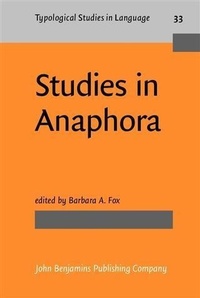
Studies in Anaphora
1st Edition
Published on 16. August 1996
XII, 518 pages
978-90-272-7606-3 (ISBN)
Description

The last 15 years has seen an explosion of research on the topic of anaphora. Studies of anaphora have been important to our understanding of cognitive processes, the relationships between social interaction and grammar, and of directionality in diachronic change. The contributions to this volume represent the "next generation" of studies in anaphora - defined broadly as those morpho-syntactic forms available to speakers for formulating reference - taking as their starting point the foundation of research done in the 1980s. These studies examine in detail, and with a richness of methods and theories, what patterns of anaphoric usage can reveal to us about cognition, social interaction, and language change.
More details
Other editions
Additional editions
Barbara A. Fox
Studies in Anaphora
Book
08/1996
John Benjamins Publishing Co
€153.70
Shipment within 10-15 days
Person
Content
- STUDIES IN ANAPHORA
- Editorial page
- Title page
- Copyright page
- Table of contents
- Introduction
- Acknowledgements
- References
- The Discourse-referential and Typological Motivation of Pronominal Procliticization vs. Encliticization
- 1. Goals and their Motivations
- 2. Pronouns and their Clitic Forms in Several Languages: Surface Typology
- 3. Typological Extensions
- 3.1. Modern Arabic
- 3.2. Welsh
- 3.4. Open questions
- 4. Properties across Romance and Germanic Pronominal Clitics (CL)
- 5. The Word Order of Strong Pronominal Elements in German
- 6. The Topic Comment Distribution in the (sov- ?) Clause - Topological Fields and Grammatical Structure
- 6.1. Discourse categories integrated into the clausal structure
- 7.Further CL-Properties in the sov-Type
- 7.1. Pronominal clitics: NP- (= constituent) status or single-word status?
- 7.2. Clitics positions are not identical with coreferential NP-positions host categories
- 7.3. CL-clustering
- 8. Functional Conclusions
- 9. Conclusion: The Explanation of CL-Displacement in Terms of Discourse Function and Basic Sentence Typology
- NOTES
- REFERENCES
- Referential Strategies and the Co-Construction of Argument Structure in Korean Acquisition
- 1. Introduction
- 2. Data and Method
- 3. Point-and-label routines
- 4. Novel activities
- 5. Co-narration
- 6. Summary and conclusions
- Acknowledgements
- NOTES
- REFERENCES
- Ad hoc Hierarchy: Lexical Structures for Reference in Consumer Reports Articles
- 1. Introduction
- 1.1. Data
- 2. Elements of Semantic Structure
- 2.1. Terms and categories
- 2.2. Category organization
- 2.3. Termset organization
- 2.3.1. Classifying compounds
- 2.3.2. Nicknames and compounds
- 2.3.3. Brand names and model numbers
- 3. Mapping terms to Categories
- 3.1. Home categories
- 3.2. Term inheritance
- 3.2.1. Pro-Heads
- 3.3. Parts and kinds of parts
- 3.4. Phantom categories
- 4. Making the Connections
- 4.1. Emergent classification
- 4.2. Establishing synonymy
- 5. Conclusions
- NOTES
- REFERENCES
- Proper Names as a Referential Option in English Conversation
- 1. The Preference for Recognitionals and the Use of Proper Names
- 1.1. Proper names and the cognitive status of the referent
- 1.2. The status of proper names relative to lexical recognitionals of other sorts
- 2. Other Factors Affecting the Likelihood that Proper Names will be Used
- 2.1. Degree of "protagonism" of the referent
- 2.2. Structural position of the mention within the discourse
- 2.3. Influence from the address term system
- 2.4. Territory-of-information and the use of proper names
- 3. Conclusions
- NOTES
- REFERENCES
- Interactional Motivations for Reference Formulation: He had. This guy had, a beautiful, thirty-two O:lds
- 1. Introduction
- 2. Methodological Considerations
- 3. The Case
- 3.1. Some preliminaries
- 3.2. Backing up
- 3.3. The utterance
- 4. Conclusion
- NOTES
- REFERENCES
- On Sources of Demonstratives and Anaphors
- 1. Introduction
- 2. Hypotheses
- 3. Independence of Definite and Deictic Markers
- 4. From 'Hand' to Definite Marker
- 5. From Verb to Determiner
- 5.1. Explanation
- 5.2. The nature of argumentation
- 5.3. Arguments from retention
- 5.3.1. The demonstrative *n
- 5.3.2. The demonstrative *k
- 5.3.3. The demonstrative *i
- 5.4. Evidence from innovations
- 5.5. Syntactic conditions for grammaticalization of deictics
- 6. From Verb 'to go' to a Pronoun
- 7. Conclusions and Implications
- ACKNOWLEDGEMENTS
- REFERENCES
- Demonstratives in Narrative Discourse: A Taxonomy of Universal Uses
- 1. Introduction
- 2. Data
- 3. Defining Characteristics of Demonstratives
- 4. Demonstrative Adjectives and Demonstrative Pronouns
- 5. Major Usage Types of Demonstratives
- 5.1. Situational use
- 5.2. Discourse deictic use
- 5.3. Tracking use
- 5.4.Recognitional use
- 6. Summary and Prospects
- NOTES
- REFERENCES
- Appendix
- Anaphora in Russian Narrative Prose: A Cognitive Calculative Account
- 1. Introduction
- 2. Cognitive Model
- 3. Discourse Sample: Preliminary Data
- 3.1. General
- 3.2. Referential devices in Russian
- 3.2.1. Non-zero pronouns
- 3.2.2. Referential zeroes
- 3.3. Referential device distribution in the sample discourse
- 4. Activation
- 4.1. Correlations between candidate activation factors and referential choices
- 4.2. Activation factors and their numerical values
- 4.2.1. Explanation of activation factors
- 4.2.2. Explanation of the factors' numerical values
- 4.3. Calculations of activation scores for major referential devices
- 4.4. Minor referential devices
- 4.4.1. Syntactic ON-pronouns
- 4.4.2. "De-deictic" ON-pronouns
- 4.4.3. TOT-pronouns
- 4.4.4. Ø1
- 4.4.5. Other
- 5. World Boundary Filter
- 6. Referential Conflict Filter
- 7. Conclusion
- Acknowledgements
- REFERENCES
- Appendix 1: The Discourse Sample
- Appendix 2: An Example of Activation Score Calculations
- Anaphora, Deixis, and the Evolution of Latin Ille
- 1. On Deixis, Anaphora, and the Evolution of ILLE
- 2. The Spanish 3p Clitics le/s, la/s, and lo/s
- 3. 'Activeness' vs. 'Individuation'
- 4. Hypersemantization of Gender
- 5. Saliency and Association with Person
- 6. Contextual Influences Compared
- 7. From Activeness to Individuation, via Saliency
- 8. Summary and Conclusion
- Acknowledgements
- NOTES
- REFERENCES
- Conceptual Grouping and Pronominal Anaphora
- 1. Interaction, Conceptualization, and Grammar
- 2. Conceptual Grouping
- 3. Pronominal Anaphora
- 4. Antecedence
- 5. What's a Nice Pronoun Like You Doing in a Space Like This?
- 6. Have We been Properly Introduced?
- 7. Conclusion
- REFERENCES
- Patterns of Anaphora in To'aba'ita Narrative Discourse
- 1. Introduction1
- 2. Immediate Anaphora after First Mention
- 2.1. Choice among the anaphoric strategies
- 2.2. Thematic prominence
- 2.3. Cataphoric deictics as indicators of thematic prominence
- 3. Preferred Argument Structure in To'aba'ita
- 4. The Independent Pronouns in To'aba'ita Narrative Discourse
- 5. Summary and Conclusions
- NOTES
- REFERENCES
- New Directions in Referentiality
- 1. Sahaptian
- 2. Shasta
- 3. Iroquoian
- 4. Conclusion
- Acknowledgements
- REFERENCES
- Some Practices for Referring to Persons in Talk-in-Interaction: A Partial Sketch of a Systematics
- 1. Introduction
- 2. Analytic Theme
- 3. Speaker and Recipient
- 4. Others: Locally Initial and Locally Subsequent Reference
- 4.1. Locally subsequent reference form in locally initial position
- 4.2. Locally initial reference forms in locally subsequent position
- 5. Recognitional and Non-Recognitional Reference
- 5.1. Preference for name over recognitional descriptor
- 6. Non-Recognitional Reference
- 7. "He had. This guy had, a beautif[ul, thirty two O:lds:" An Intersection with Ford and Fox
- 8. Methodological Postscript
- NOTES
- REFERENCES
- Topic Discontinuity and Zero Anaphora in Chinese Discourse: Cognitive Strategies in Discourse Processing
- 1. Introduction
- 2. Topic Continuity and Zero Anaphora
- 2.1. Topic and subject
- 2.2. Topic continuity and zero anaphora
- 3. Return-pop and Zero Anaphora
- 3.1. The data
- 3.2. Anaphoric choice
- 3.3. Return pop
- 4. Emergent Reference and Zero Anaphora
- 4.1. Emergent reference and return pop
- 4.2. Indexicality and zero anaphora
- 5. Conclusion
- NOTES
- REFERENCES
- Index
