

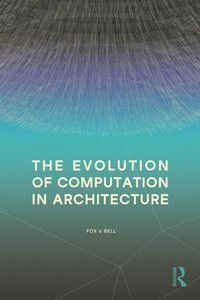
The Evolution of Computation in Architecture
1st Edition
Published on 31. October 2024
260 pages
978-1-040-15043-6 (ISBN)
Description

With forewords by Mario Carpo, Jenny Sabin, and Branko Kolarevic.
This book is the first comprehensive overview of the pioneering works, events, and people that contributed to the paradigm shift defined by computation in architecture.
Only recently has computation fostered profound new ways of designing, fabricating, constructing, and thinking about architecture. While the profession sits at the end of the beginning of this historically transformative shift, it is now possible to look back upon the rapidly maturing landscape of projects, influencers, and tools that have finally begun to catch up with the visionary thinking of the past. Readers are guided through the fascinating and fast-paced historical timeline of the development of computation in architecture. Beginning with an account of the pioneering futuristic thinkers, the authors then guide the reader through the birth of computation, the appropriation of tools and the impact of experimentation on the profession, leading into the legitimacy of research and how paradigms have been expanded. The examples and influences are presented in a way that they can be understood and built upon.
This book is a must-read for students of computation in architecture as well as researchers and practicing architects thinking about how the tools we use and the ways we design our buildings and environments with them can truly impact our lives.
This book is the first comprehensive overview of the pioneering works, events, and people that contributed to the paradigm shift defined by computation in architecture.
Only recently has computation fostered profound new ways of designing, fabricating, constructing, and thinking about architecture. While the profession sits at the end of the beginning of this historically transformative shift, it is now possible to look back upon the rapidly maturing landscape of projects, influencers, and tools that have finally begun to catch up with the visionary thinking of the past. Readers are guided through the fascinating and fast-paced historical timeline of the development of computation in architecture. Beginning with an account of the pioneering futuristic thinkers, the authors then guide the reader through the birth of computation, the appropriation of tools and the impact of experimentation on the profession, leading into the legitimacy of research and how paradigms have been expanded. The examples and influences are presented in a way that they can be understood and built upon.
This book is a must-read for students of computation in architecture as well as researchers and practicing architects thinking about how the tools we use and the ways we design our buildings and environments with them can truly impact our lives.
More details
Edition
1. Auflage
Language
English
Place of publication
London
United Kingdom
Publishing group
Taylor & Francis Ltd
Target group
College/higher education
Illustrations
1 Line drawings, black and white; 88 Halftones, black and white; 89 Illustrations, black and white
ISBN-13
978-1-040-15043-6 (9781040150436)
Copyright in bibliographic data and cover images is held by Nielsen Book Services Limited or by the publishers or by their respective licensors: all rights reserved.
Schweitzer Classification
Other editions
Additional editions
Michael Fox | Bradley Bell
The Evolution of Computation in Architecture
Book
10/2024
1st Edition
Routledge
€48.50
Shipment within 10-20 days
Michael Fox | Bradley Bell
The Evolution of Computation in Architecture
Book
10/2024
1st Edition
Routledge
€200.56
Shipment within 10-20 days
Persons
Michael Fox received his Master of Science in Architecture degree with honors from MIT and his undergraduate professional degree in Architecture from the University of Oregon. He has been elected twice as the President of ACADIA (Association for Computer Aided Design in Architecture). Fox founded a research group at MIT to investigate interactive and behavioral architecture, which he directed for 3 years. He has taught at Art Center College of Design, USC, MIT, HKPU, and SCIARC and is a Full Professor at Cal Poly Pomona. Fox's work has been featured in numerous international periodicals and books and has been exhibited worldwide. He is the author of two previous books on architectural computation. He is a practicing registered architect and directs the office of FoxLin Architects.
Brad Bell received his Master of Science in Architecture degree from Columbia University Graduate School of Architecture Planning & Preservation and a Bachelor of Environmental Design from Texas A&M. Brad is the former Director of the School of Architecture (2016-2023) and an Associate Professor at The University of Texas at Arlington. He currently directs the Digital Architecture Research Consortium (DARC) at UT Arlington and was a founding member of TEX-FAB (2008-2017). In 2020 Brad was honored by the Texas Society of Architects with the Award for Outstanding Educational Contribution in Honor of Edward J. Romieniec FAIA. He has previously taught at Tulane University and the University of Colorado. His research focuses on innovative material applications and computational fabrication within the architectural design process.
Brad Bell received his Master of Science in Architecture degree from Columbia University Graduate School of Architecture Planning & Preservation and a Bachelor of Environmental Design from Texas A&M. Brad is the former Director of the School of Architecture (2016-2023) and an Associate Professor at The University of Texas at Arlington. He currently directs the Digital Architecture Research Consortium (DARC) at UT Arlington and was a founding member of TEX-FAB (2008-2017). In 2020 Brad was honored by the Texas Society of Architects with the Award for Outstanding Educational Contribution in Honor of Edward J. Romieniec FAIA. He has previously taught at Tulane University and the University of Colorado. His research focuses on innovative material applications and computational fabrication within the architectural design process.
Content
Prologue 1. Pioneering (1973 - 1981) 2. Translation (1981 - 1991) 3. Appropriation (1992 - 2003) 4. Experimentation (2004 - 2012) 5. Legitimacy (2013 - 2018) 6. Paradigms (2019 - 2024)
