

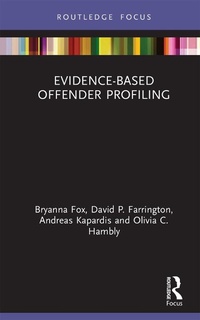
Evidence-Based Offender Profiling
1st Edition
Published on 18. February 2020
78 pages
978-1-000-04967-1 (ISBN)
Description

Offender profiling is an investigative tool used to narrow down the range of potential suspects for a crime by predicting the personality, behavioral, and demographic characteristics that an offender is likely to possess, based upon information collected at the crime scene. While offender profiling has been popularized by TV shows and movies such as Criminal Minds, Silence of the Lambs, and Mindhunter, the real-world impact of offender profiling is largely unknown. This book discusses the history of offender profiling, summarizes research on offender profiling methods, and reviews offender profiling evaluations of accuracy and applied impact.
This book also describes a promising new offender profiling methodology called evidence-based offender profiling. This new method relies upon empirical data and scientific methods to develop, evaluate, and replicate offender profiles, thereby increasing offender profiling's accuracy and utility for active police investigations. It uses prior information about statistical regularities between types of offenders and types of offenses to predict the characteristics of offenders in unsolved cases. A discussion of the future of offender profiling research and implications for law enforcement is also included.
This book also explains how practitioners can benefit from the use of empirically tested and validated profiles in their unsolved investigations and how the use, continued research, and evaluation of evidence-based offender profiling can advance the quality, prestige, and utility of the field of offender profiling.
This book also describes a promising new offender profiling methodology called evidence-based offender profiling. This new method relies upon empirical data and scientific methods to develop, evaluate, and replicate offender profiles, thereby increasing offender profiling's accuracy and utility for active police investigations. It uses prior information about statistical regularities between types of offenders and types of offenses to predict the characteristics of offenders in unsolved cases. A discussion of the future of offender profiling research and implications for law enforcement is also included.
This book also explains how practitioners can benefit from the use of empirically tested and validated profiles in their unsolved investigations and how the use, continued research, and evaluation of evidence-based offender profiling can advance the quality, prestige, and utility of the field of offender profiling.
More details
Series
Edition
1. Auflage
Language
English
Place of publication
London
United Kingdom
Publishing group
Taylor & Francis Ltd
Target group
College/higher education
Professional and scholarly
Product notice
Reflowable
Illustrations
6 Tables, black and white; 1 Line drawings, black and white
ISBN-13
978-1-000-04967-1 (9781000049671)
Copyright in bibliographic data and cover images is held by Nielsen Book Services Limited or by the publishers or by their respective licensors: all rights reserved.
Schweitzer Classification
Other editions
Additional editions
Bryanna Fox | David Farrington | Andreas Kapardis
Evidence-Based Offender Profiling
Book
09/2021
1st Edition
Routledge
€35.20
Shipment within 10-20 days
Bryanna Fox | David Farrington | Andreas Kapardis
Evidence-Based Offender Profiling
Book
02/2020
1st Edition
Routledge
€76.50
Shipment within 15-20 days
Persons
Bryanna Fox is Associate Professor of Criminology at the University of South Florida and studies the psychological and developmental risk factors for criminal behavior, forensic psychology, and evidence-based policing. She previously served as an FBI Special Agent and research fellow in the FBI's Behavioral Science Unit and received an Early Career Award from the American Society of Criminology's Division of Developmental and Life-Course Criminology in 2017. Her research can be found in outlets including Criminal Justice and Behavior, Psychological Bulletin, Law and Society Review, Social Forces, Development and Psychopathology, and the Journal of Criminal Justice.
David P. Farrington, O.B.E., is Emeritus Professor of Psychological Criminology at the Institute of Criminology, Cambridge University. He received the Stockholm Prize in 2013, and he has received the four major awards of the American Society of Criminology
Andreas Kapardis is an Emeritus Professor of Legal Psychology in the Department of Law at the University of Cyprus. He was formerly a faculty member in the School of Law at La Trobe University in Australia and is currently a Visiting Professor at the Institute of Criminology, Cambridge University. In recognition of his work, he was elected a Full Member of the European Academy of Sciences and Arts in 2016 and is a Life Member of Clare Hall, Cambridge University. His research and teaching interests lie mainly in criminology, criminal justice, legal psychology, and penology.Olivia Hambly is a social researcher within the Government of the United Kingdom. Olivia received her PhD in 2018 from the International Research Centre for Investigative Psychology at the University of Huddersfield. Her thesis focused on the psychological interpretations of domestic burglary offender styles, patterns, and offender characteristics.
David P. Farrington, O.B.E., is Emeritus Professor of Psychological Criminology at the Institute of Criminology, Cambridge University. He received the Stockholm Prize in 2013, and he has received the four major awards of the American Society of Criminology
Andreas Kapardis is an Emeritus Professor of Legal Psychology in the Department of Law at the University of Cyprus. He was formerly a faculty member in the School of Law at La Trobe University in Australia and is currently a Visiting Professor at the Institute of Criminology, Cambridge University. In recognition of his work, he was elected a Full Member of the European Academy of Sciences and Arts in 2016 and is a Life Member of Clare Hall, Cambridge University. His research and teaching interests lie mainly in criminology, criminal justice, legal psychology, and penology.Olivia Hambly is a social researcher within the Government of the United Kingdom. Olivia received her PhD in 2018 from the International Research Centre for Investigative Psychology at the University of Huddersfield. Her thesis focused on the psychological interpretations of domestic burglary offender styles, patterns, and offender characteristics.
Content
Foreword: Lawrence W. Sherman
Chapter 1: Introduction to Evidence-Based Offender ProfilingChapter 2: Development of Offender Profiling
Chapter 3: Progress Towards Evidence-Based Offender Profiling
Chapter 4: Evidence-Based Offender Profiles and Evaluations in the United States
Chapter 5: International Replication of Evidence-Based Offender Profiles in the United Kingdom
Chapter 6: The Future of Evidence-Based Offender Profiling
Chapter 1: Introduction to Evidence-Based Offender ProfilingChapter 2: Development of Offender Profiling
Chapter 3: Progress Towards Evidence-Based Offender Profiling
Chapter 4: Evidence-Based Offender Profiles and Evaluations in the United States
Chapter 5: International Replication of Evidence-Based Offender Profiles in the United Kingdom
Chapter 6: The Future of Evidence-Based Offender Profiling
