

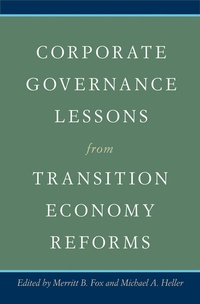
Corporate Governance Lessons from Transition Economy Reforms
1st Edition
Published on 1. October 2021
432 pages
978-0-691-22929-4 (ISBN)
Description

Corporate Governance Lessons from Transition Economy Reforms explores a timely topic at the intersection of economics, law, and policy reform. To date, most sophisticated theoretical work on corporate governance has focused on advanced market economies. In post-socialist countries, corporate finance and transition economics scholars have often done little more than convey the received theory to transition policymakers.
This volume focuses, for the first time, on the reverse concern: what, if anything, do the reform experiences of transition countries teach about corporate governance theory more generally? To investigate this question, Merritt Fox and Michael Heller have assembled a stellar group of corporate governance theorists. The answers are startling.
The principal essays approach the problem from three complementary perspectives that form the organizing themes of the book. The first part refines core corporate theory terms. The second presents important empirical work that explores the channels through which "good corporate governance" may link to the real economy. The final part links corporate governance theory to practical reforms. After fifteen years of experience, practice can now inform theory.
Together, these essays present a comprehensive new view on a provocative theme. Written in an accessible style, they will be of interest to a broad range of scholars, commentators, and policymakers.
This volume focuses, for the first time, on the reverse concern: what, if anything, do the reform experiences of transition countries teach about corporate governance theory more generally? To investigate this question, Merritt Fox and Michael Heller have assembled a stellar group of corporate governance theorists. The answers are startling.
The principal essays approach the problem from three complementary perspectives that form the organizing themes of the book. The first part refines core corporate theory terms. The second presents important empirical work that explores the channels through which "good corporate governance" may link to the real economy. The final part links corporate governance theory to practical reforms. After fifteen years of experience, practice can now inform theory.
Together, these essays present a comprehensive new view on a provocative theme. Written in an accessible style, they will be of interest to a broad range of scholars, commentators, and policymakers.
More details
Other editions
Additional editions
Merritt B. Fox | Michael A. Heller
Corporate Governance Lessons from Transition Economy Reforms
Book
11/2008
Princeton University Press
€42.70
Shipment within 10-20 days
Merritt B. Fox | Michael A. Heller
Corporate Governance Lessons from Transition Economy Reforms
Book
09/2006
Princeton University Press
€55.80
Article exhausted; check different version
Persons
Merritt B. Fox is Michael E. Patterson Professor of Law and Co-Director of the Center for Law and Economic Studies at Columbia Law School. He is the author of Finance and Industrial Performance in a Dynamic Economy. Michael A. Heller is Lawrence A. Wein Professor of Real Estate Law at Columbia Law School.
Content
- Cover Page
- Half-title Page
- Title Page
- Copyright Page
- Contents
- Introduction
- Part I: Framework
- Chapter One: What Is Good Corporate Governance?
- Part II: The Elements of Good Corporate Governance: Law
- Chapter Two: Patterns of Legal Change: Shareholder and Creditor Rights in Transition Economies
- Chapter Three: The Common Law and Economic Growth: Hayek Might Be Right
- Part III: The Elements of Good Corporate Governance: Owners and Managers
- Chapter Four: Russian Privatization and Corporate Governance: What Went Wrong?
- Chapter Five: Why Ownership Matters: Entrepreneurship and the Restructuring of Enterprises in Central Europe
- Part IV: The Elements of Good Corporate Governance: Stock Markets
- Chapter Six: Corporate Governance in Transitional Economies: Lessons from the Prewar Japanese Cotton Textile Industry
- Chapter Seven: Privatization and Corporate Governance: The Lessons from Securities Market Failure
- Chapter Eight: The Information Content of Stock Markets: Why Do Emerging Markets Have Synchronous Stock Price Movements?
- Part V: What Does Transition Contribute to Theory?
- Chapter Nine: Conclusion: The Unexplored Role of Initial Conditions
- List of Contributors
- Index
