

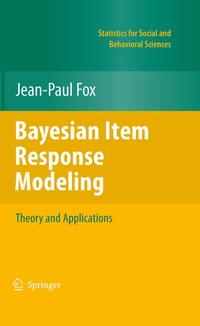
Bayesian Item Response Modeling
Description

Reviews / Votes
From the reviews:
"Item response theory is a general paradigm for the design and analysis of questionnaires measuring abilities and attitudes of individuals. . the book is written in a concise style and the technical level of the book is relatively high. . I believe this book makes an important contribution in summarizing much of the important literature in Bayesian IRT and I think it will lead to future books focusing on the use and interpretation of these models from a practitioner's perspective." (Jim Albert, Journal of the American Statistical Association, Vol. 106 (495), September, 2011)
"This book covers the parameter estimation of standard and extended IRT models using the Bayesian simulation based MCMC method. There are many Bayesian data analysis books, but this is the first book purely devoted to the Bayesian estimation of IRT models. . Overall, it is a good book for advanced learners to grasp the theoretical and technical detail of Bayesian MCMC estimation ofextended IRT models adapted to a specific measurement setting." (Hong Jiao, Psychometrika, Vol. 76 (2), April, 2011)
"This book develops a comprehensive treatment of Bayesian item response modelling . . The book is mostly self-contained. . Each chapter ends with a section of carefully thought-out exercises covering both the mathematical aspects of the models and their application to the analysis of interesting real-life data. . This book will equally cater for those users who just want to apply the models to analyze their data, and more technical users willing to get a deeper understanding of the models . ." (Eduardo Guti é rrez-Pe ñ a, International Statistical Review, Vol. 79 (3), 2011)
More details
Other editions
Additional editions
Person
Content
Response times and responses can be collected via computer adaptive testing or computer-assisted questioning. Inferences about test takers and test items can therefore be based on the response time and response accuracy information. Response times and responses are used to measure a respondents speed of working and ability using a multivariate hierarchical item response model. A multivariate multilevel structural population model is de ned for the person parameters to explain individual and group di erences given background information. An application is presented that illustrates novel features of the model.
8.1 Mixed Multivariate Response Data
Nowadays, response times (RTs) are easily collected via computer adaptive testing or computer-assisted questioning. The RTs can be a valuable source of information on test takers and test items. The RT information can help to improve routine operations in testing such as item calibration, test design, detection of cheating, and adaptive item selection. The collection of multiple item responses and RTs leads to a set of mixed multivariate response data since the individual item responses are often observed on an ordinal scale, whereas the RTs are observed on a continuous scale.
The observed responses are imperfect indicators of a respondents ability. When measuring a construct such as ability, attention is focused on the accuracy of the test results. The observed RTs are indicators of a respondents speed of working, and speed is considered to be a di erent construct. As a result, mixed responses are used to measure the two constructs ability and speed. Although response speed and response accuracy measure di erent con- structs (Schnipke and Scrams, 2002, and references therein), the reaction-time research in psychology indicates that there is a relationship between response speed and response accuracy (Luce, 1986).
This relationship is often characterized as a speed{accuracy trade-o . A person can decide to work faster, but this will lead to a lower accuracy. The trade-o is considered to be a withinperson relationship: a respondent controls the speed of working and accepts the related level of accuracy. It will be assumed that each respondent chooses a xed level of speed, which is related to a xed accuracy. A hierarchical measurement model was proposed by van der Linden (2007) to model RTs and dichotomous responses simultaneously that accounts for di erent levels of dependency.
The di erent stages of the model capture the dependency structure of observations nested within persons at the observational level and the relationship between speed and ability at the individual level. Klein Entink, Fox and van der Linden (2009a), and Fox, Klein Entink and van der Linden (2007) extended the model for measuring accuracy and speed (1) to allow time-discriminating items, (2) to handle individual and/or group characteristics, and (3) to handle the nesting of individuals in groups.
This extension has a multivariate multilevel structural population model for the ability and the speed parameters that can be considered a multivariate extension of the structural part of the MLIRT model of Chapter 6. In this chapter, the complete modeling framework will be discussed, and an extension is made to handle polytomous response data."
