

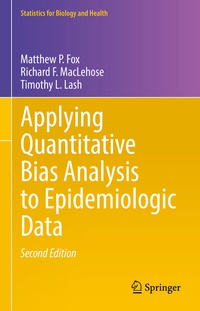
Applying Quantitative Bias Analysis to Epidemiologic Data
Description

This textbook and guide focuses on methodologies for bias analysis in epidemiology and public health, not only providing updates to the first edition but also further developing methods and adding new advanced methods.
As computational power available to analysts has improved and epidemiologic problems have become more advanced, missing data, Bayes, and empirical methods have become more commonly used. This new edition features updated examples throughout and adds coverage addressing:
- Measurement error pertaining to continuous and polytomous variables
- Methods surrounding person-time (rate) data
- Bias analysis using missing data, empirical (likelihood), and Bayes methods
A unique feature of this revision is its section on best practices for implementing, presenting, and interpreting bias analyses. Pedagogically, the text guides students and professionals through the planning stages of bias analysis, including the design of validation studies and the collection of validity data from other sources. Three chapters present methods for corrections to address selection bias, uncontrolled confounding, and measurement errors, and subsequent sections extend these methods to probabilistic bias analysis, missing data methods, likelihood-based approaches, Bayesian methods, and best practices.
More details
Other editions
Additional editions
Persons
Matthew Fox, D.Sc., M.P.H, is associate professor in the Center for Global Health & Development and in the Department of Epidemiology at Boston University. Before joining Boston University, he was a Peace Corps volunteer in the former Soviet Republic of Turkmenistan. Dr. Fox is currently funded through a K award from the National Institutes of Allergy and Infectious Diseases to work on ways to improve retention in HIV-care programs in South Africa from time of testing HIV-positive through long-term treatment. His research interests include treatment outcomes in HIV-treatment programs, infectious disease epidemiology, and epidemiological methods, including quantitative bias analysis.
Richard MacLehose, Ph.D., is associate professor in the Division of Epidemiology and Community Health at the University of Minnesota. Dr. MacLehose received his M.S. in epidemiology from the University of Washington and his Ph.D. in epidemiology from the University of North Carolina. His research interests include Bayesian statistics (including bias analysis), epidemiologic methods, applied biostatistics, and reproductive and environmental health.
