

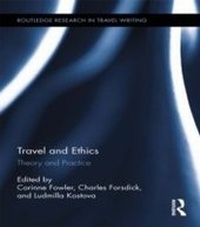
Travel and Ethics
Theory and Practice
1st Edition
Published on 13. December 2013
274 pages
978-1-135-01934-1 (ISBN)
Description

Despite the recent increase in scholarly activity regarding travel writing and the accompanying proliferation of publications relating to the form, its ethical dimensions have yet to be theorized with sufficient rigour.
Drawing from the disciplines of anthropology, linguistics, literary studies and modern languages, the contributors in this volume apply themselves to a number of key theoretical questions pertaining to travel writing and ethics, ranging from travel-as-commoditization to encounters with minority languages under threat. Taken collectively, the essays assess key critical legacies from parallel disciplines to the debate so far, such as anthropological theory and postcolonial criticism. Also considered, and of equal significance, are the ethical implications of the form's parallel genres of writing, such as ethnography and journalism. As some of the contributors argue, innovations in these genres have important implications for the act of theorizing travel writing itself and the mode and spirit in which it continues to be conducted. In the light of such innovations, how might ethical theory maintain its critical edge?
Drawing from the disciplines of anthropology, linguistics, literary studies and modern languages, the contributors in this volume apply themselves to a number of key theoretical questions pertaining to travel writing and ethics, ranging from travel-as-commoditization to encounters with minority languages under threat. Taken collectively, the essays assess key critical legacies from parallel disciplines to the debate so far, such as anthropological theory and postcolonial criticism. Also considered, and of equal significance, are the ethical implications of the form's parallel genres of writing, such as ethnography and journalism. As some of the contributors argue, innovations in these genres have important implications for the act of theorizing travel writing itself and the mode and spirit in which it continues to be conducted. In the light of such innovations, how might ethical theory maintain its critical edge?
Reviews / Votes
"Recommended." -- CHOICE, R. Payne, University of St. Joseph"This volume does as much to map out a way of rethinking institutional frameworks regarding student mobility in the twenty-first century as it does to reinvigorate the field of travel studies, which it does in wonderful ways." -- David G. Farley, St. John's University in Journeys: The International Journal of Travel and Travel Writing "Recommended." -- CHOICE, R. Payne, University of St. Joseph
More details
Series
Language
English
Place of publication
London
United Kingdom
Publishing group
Taylor & Francis Ltd
Target group
College/higher education
File size
4,20 MB
ISBN-13
978-1-135-01934-1 (9781135019341)
Copyright in bibliographic data and cover images is held by Nielsen Book Services Limited or by the publishers or by their respective licensors: all rights reserved.
Schweitzer Classification
Other editions
Additional editions
Book
02/2018
1st Edition
Routledge
€76.70
Shipment within 10-20 days
Book
09/2013
1st Edition
Routledge
€231.90
Shipment within 15-20 days
Persons
Corinne Fowler (editor) is a postdoctoral researcher at Lancaster University. She co-edited a special issue of the International journal Journeys on travel and ethics with Ludmilla Kostova (Berghahn: 2004). Her recent book Chasing Tales: travel writing, journalism and the history of British ideas about Afghanistan is forthcoming (Rodopi: 2007). She was the 2006 winner of the Feminist and Women's Studies essay award with her 'Journalists in feminist clothing: men and women reporting Afghan women during Operation Enduring Freedom, 2001' (online Journal of International Women's Studies, January 2007). She is currently working on an AHRC-funded project called Moving Manchester, which explores ways in which the experience of migration has informed the work of creative writers from Greater Manchester since 1960.
Charles Forsdick (editor) is James Barrow Professor of French at the University of Liverpool. He is author of Victor Segalen and the Aesthetics of Diversity (OUP, 2000) and Travel in Twentieth-Century French and Francophone Cultures: The Persistence of Diversity (OUP, 2005), and co-editor of Francophone Postcolonial Studies: a Critical Introduction (Arnold, 2003). He has published numerous articles on travel writing, exoticism, Caribbean literature in French and postcolonialism,and was director of an AHRB-funded project on 'New Approaches to Twentieth-Century Travel Literature in French' (2000-03). He sits on the advisory board of Liverpool University Press and is a member of the editorial boards of Francophone Postcolonial Studies, Journal of Romance Studies, Contemporary French and Francophone Studies and Studies in Travel Writing.
Ludmilla Kostova (editor) is Associate Professor of British literature and cultural studies at the University of Veliko Turnovo, Bulgaria. She has published widely on eighteenth-century, romantic and modern British literature and on issues of cultural encounter. Her book Tales of the Periphery: the Balkans in Nineteenth-Century British Writing (1997) has been frequently cited by specialists in the field. She has organized seminars and panels with a focus on travel and its representations.
Charles Forsdick (editor) is James Barrow Professor of French at the University of Liverpool. He is author of Victor Segalen and the Aesthetics of Diversity (OUP, 2000) and Travel in Twentieth-Century French and Francophone Cultures: The Persistence of Diversity (OUP, 2005), and co-editor of Francophone Postcolonial Studies: a Critical Introduction (Arnold, 2003). He has published numerous articles on travel writing, exoticism, Caribbean literature in French and postcolonialism,and was director of an AHRB-funded project on 'New Approaches to Twentieth-Century Travel Literature in French' (2000-03). He sits on the advisory board of Liverpool University Press and is a member of the editorial boards of Francophone Postcolonial Studies, Journal of Romance Studies, Contemporary French and Francophone Studies and Studies in Travel Writing.
Ludmilla Kostova (editor) is Associate Professor of British literature and cultural studies at the University of Veliko Turnovo, Bulgaria. She has published widely on eighteenth-century, romantic and modern British literature and on issues of cultural encounter. Her book Tales of the Periphery: the Balkans in Nineteenth-Century British Writing (1997) has been frequently cited by specialists in the field. She has organized seminars and panels with a focus on travel and its representations.
Content
Part One. Genre-Bending, Genre-blending Introduction Ethics on the Move Charles Forsdick, Corinne Fowler, and Ludmilla Kostova 1. Speech Acts: Language, Mobility, and Place Michael Cronin 2. From Legislative to Interpretive Modes of Travel: Space, Ethics, and Literary Form in Jean Baudrillard's America Gillian Jein 3. Ficiton and Affect: Anglophone Travel Writing and the Case of Paraguay Corinne Fowler 4. Terror Laurie Howell McMillin Part Two. Toxic Encounters. Issues in Travel Writing 5. Victor Segalen in the Contact Zone: Exoticism, Ethics, and the Traveler and "Travelee" Charles Forsdick 6.Ethical Encounters with Animal Others in Travel Writing Jopi Nyman 7.Ethical Perspectives on Cultural Sustainability and Postcolonial Island Literatures Anthony Carrigan 8. Gourdes and Dollars: How Travel Writers Spend Money Alasdair Pettinger 9. Writing Across the Native/Foreign Divide: The Case of Kapka Kassabova's Street Without a Name (2008) Ludmilla Kostova 10. 'Like a Member of a Free Nation, He Wrote Without Shame': Foreign Travelers as a Trope in Romanian Cultural Tradition Alexander Drace-Francis 11. Travelling in the Times of Empire Syed Manzu Islam 12. The Rhetorics of Arctic Discourse: Reading Gretel Ehrlich's This Cold Heaven in Class Jan Borm 13.Hauntings: W.G. Sebald as Travel Writer Graham Huggan
